The Getty
A fortress on a ridge holding the originals, reachable by one driverless tram.
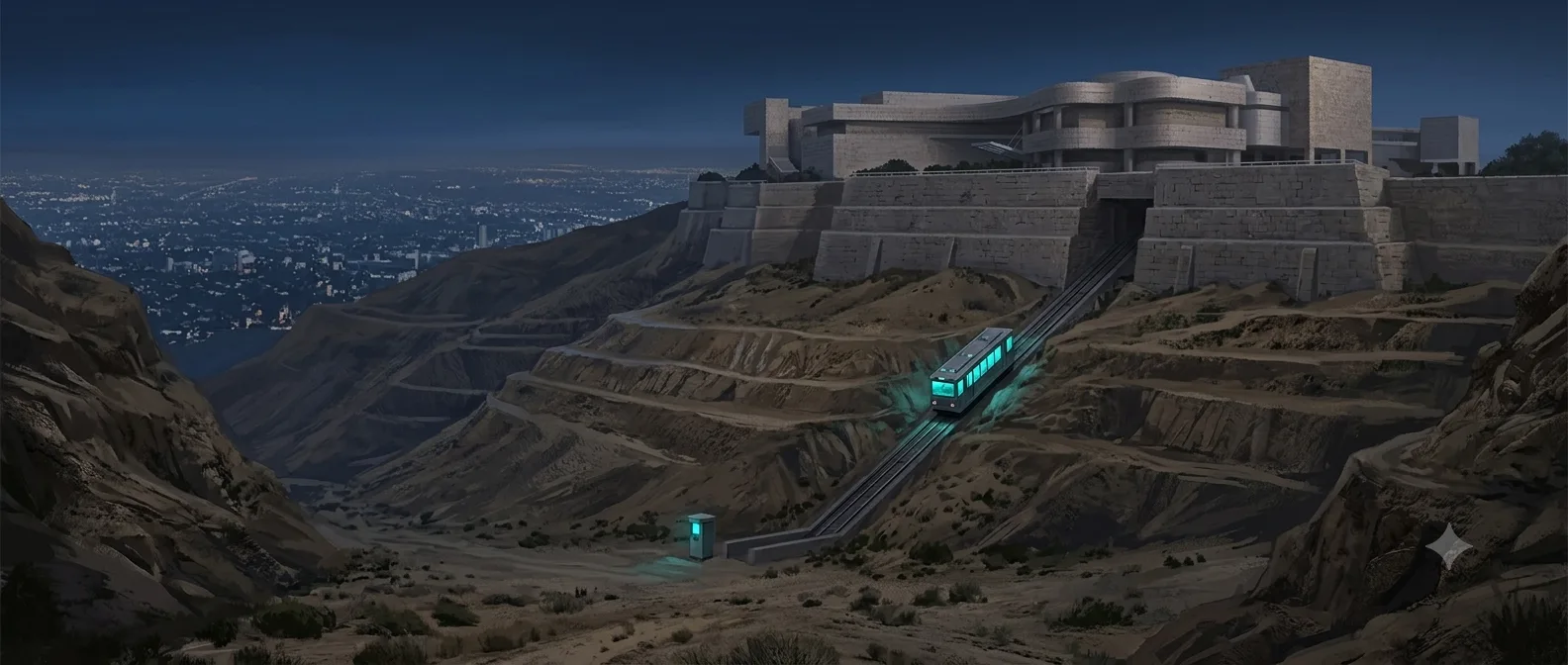
A travertine complex on a ridge above the 405, built in the 1990s by an architect who was told to make it last. It was designed for disaster before disaster was fashionable: a million-gallon water tank on site, an air-handling system that reverses to push smoke and ash out of the galleries, and plantings chosen because they hold water and don't burn. It has come through every fire since without losing anything, because that was the brief.
That design is why it matters now. After the Crash took most of what the clouds were holding, the only records anybody trusts are physical ones, and the only physical archive on this coast that has power, water, filtered air and a hilltop is this one. So the Getty stopped being primarily a museum. It is the region's vault of record: deeds, provenance files, patents, corporate originals, instruments that have to survive a challenge. The art is still on the walls, and it is no longer the most valuable thing in the building.
Somebody owns it now. The trust that ran it has a board, the board has sponsors, and nobody local can tell you whose money is decisive.
What the crew knows#
- The way up is a driverless tram, cable-driven, three quarters of a mile from the garage at freeway level to the top of the ridge. There is a service road, and it is gated, watched, and the only other option.
- If the tram stops while you're at the top, the only other way down is the gated service road, and whoever stopped the tram knows that too.
- The vault is not the galleries. Depositors don't visit the galleries and the galleries don't know what's in the vault.
- They accept deposits from anyone who can pay, so rival corporations store originals in the same building, and that is why none of them will move against it.
- The fire systems are the security systems. Sealing the building against smoke seals it against people, and the staff practize it twice a year.
- Weekends are open to the public, and a few hundred visitors a day is the best cover the building offers.
Getting in#
As a visitor, trivially: it's open, it's free, and the tram doesn't ask for names. As someone who wants the lower floors, not at all: separate credentials, separate lifts, a custodian's countersignature for any retrieval, and a log that is itself an archived document.
The realistic approaches are a deposit (become a client, walk in legitimately), a retrieval (arrive as somebody's authorized agent, on paper), or the service road during a fire drill.