The River and the Tunnels
Fifty-one miles of concrete nobody can see into, and thousands more miles of dark underneath it.
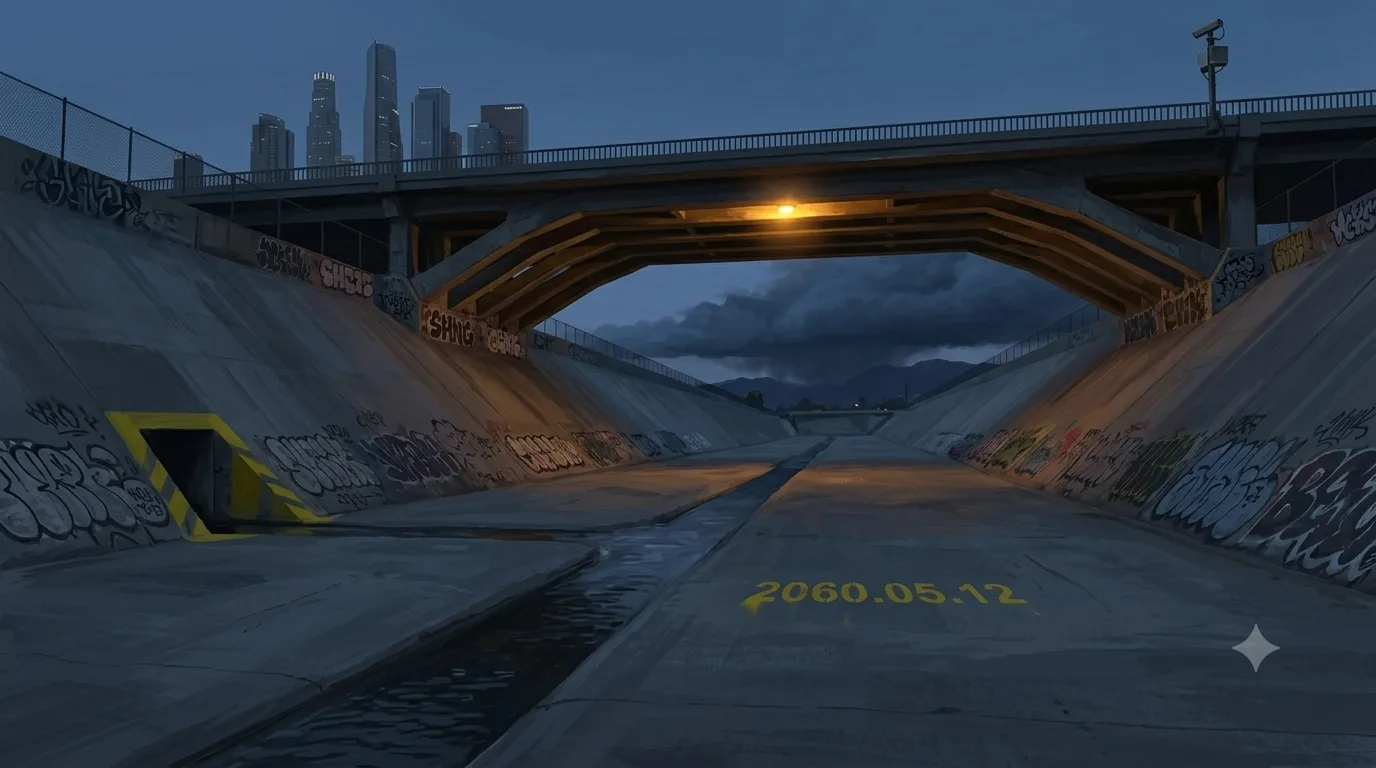
The one piece of infrastructure that touches every district in the city, and the only way to cross Los Angeles without being on a street.
Layer one: the channel. The river was poured into concrete after the 1938 flood and it has been a flood channel ever since: fifty-one miles from Canoga Park down through the Valley, past Griffith Park, under downtown and the 6th Street bridge, through Vernon and the rail corridor, and out at the harbor mouth. It is dry most of the year, it is graded below street level with bridges overhead, and there are almost no sightlines into it from anywhere anybody lives. You can walk, ride or drive it from the Valley to Long Beach and be seen by nobody.
It is also still a working flood channel: a storm thirty miles away in the mountains arrives here as a wall of water with no warning anybody in the channel will hear. People die in it every year and always have.
Layer two: the drains and tunnels. Thousands of miles of storm drain feed the channel, and where the city has built anything ambitious it left a hole behind. The abandoned Pacific Electric tunnel under Bunker Hill. Service ducts between the downtown towers. Metro's maintenance runs. The vaults under the harbor that the pump crews use to reach the injection wells. Prohibition-era basements downtown that connect buildings whose owners no longer exist. None of it is mapped in one place and several people would like to keep it that way.
The rule that matters: the deeper you go, the less of it is yours. The channel is public and everyone knows it: you can be down there legally and be told to leave, and that's all. The drains are claimed, stretch by stretch, by people who will want to discuss it, and the map of who holds what exists only in their heads.
What the crew knows#
- It is the fastest way across the city and the worst place to be caught. No cover, no exits between bridges, and a pursuer above you on the bank can simply follow at walking pace while somebody drives to the next crossing.
- Rain is the whole risk calendar. Check the mountains, not the sky over your head. A dry channel under a clear sky is not a safe channel.
- The bottom of it is dirty and the rest of it isn't. Water doesn't run uphill, so the Tide never came up this channel: what came up it was the 2058 wave, as a bore through the harbor mouth that ran the concrete as far as the Carson Street bridges and stopped. The harbor itself sat in Palos Verdes' shadow and only ever took a surge, but a surge funnelled into a concrete channel becomes a bore, and the dirt goes exactly as far as the water did. Below that line the invert is contaminated ground with a gradient, worse toward the mouth: masks, and nobody swims, ever. Above it the channel is just a channel, all forty-odd miles of it, and that continuity is why the river is still worth using.
- The soft-bottom stretch through the Glendale Narrows is the only part with living water in it, and consequently the only part with anything green. It is also the easiest place to get down, so it is watched more than the concrete miles.
- People live in the drains, in numbers, in communities with their own arrangements. They are not a hazard and they are not scenery. They know every outlet and they will tell you which ones flood first, if you have been decent.
- The Gaps, salvage crews and pump crews all use the tunnels and none of them agree about who has a right to which stretch. Passage is purchasable and the price is local.
- Things live down there that did not before 2056. Everybody has a story. Some of the stories are true.
- Somebody will always tell you a drain kept going: past the end of the pipe, into something nobody poured. Salvage crews trade the story, mages say the background count goes strange in certain chambers, and no two accounts describe the same place. Nobody has ever produced one, which is what you'd expect either way.
Getting in#
Down at the Glendale Narrows, at the Arroyo Seco confluence, from the maintenance ramps under most bridges, or through any of ten thousand storm drain outlets. There is no gate to defeat anywhere on the system: access is trivial and the difficulty is entirely about knowing which stretch is whose and which outlet comes up somewhere useful.
The tunnels are the opposite: knowing an entrance is the whole skill, and the entrances are in basements, substations, pump houses and utility rooms belonging to people who will ask what you're doing.