Los Angeles
Twenty million people, no government, no country. Where the ruin is, what held, and how you get in.
On this page (9 sections)
The city itself, in the shape a runner needs it: which ground the disasters took, which ground came through, and how you arrive. The political situation (no government, no flag, Pueblo on every landward side, a harbor guaranteed by a shipping clause) is on The Sixth World. District pages are in Locations.
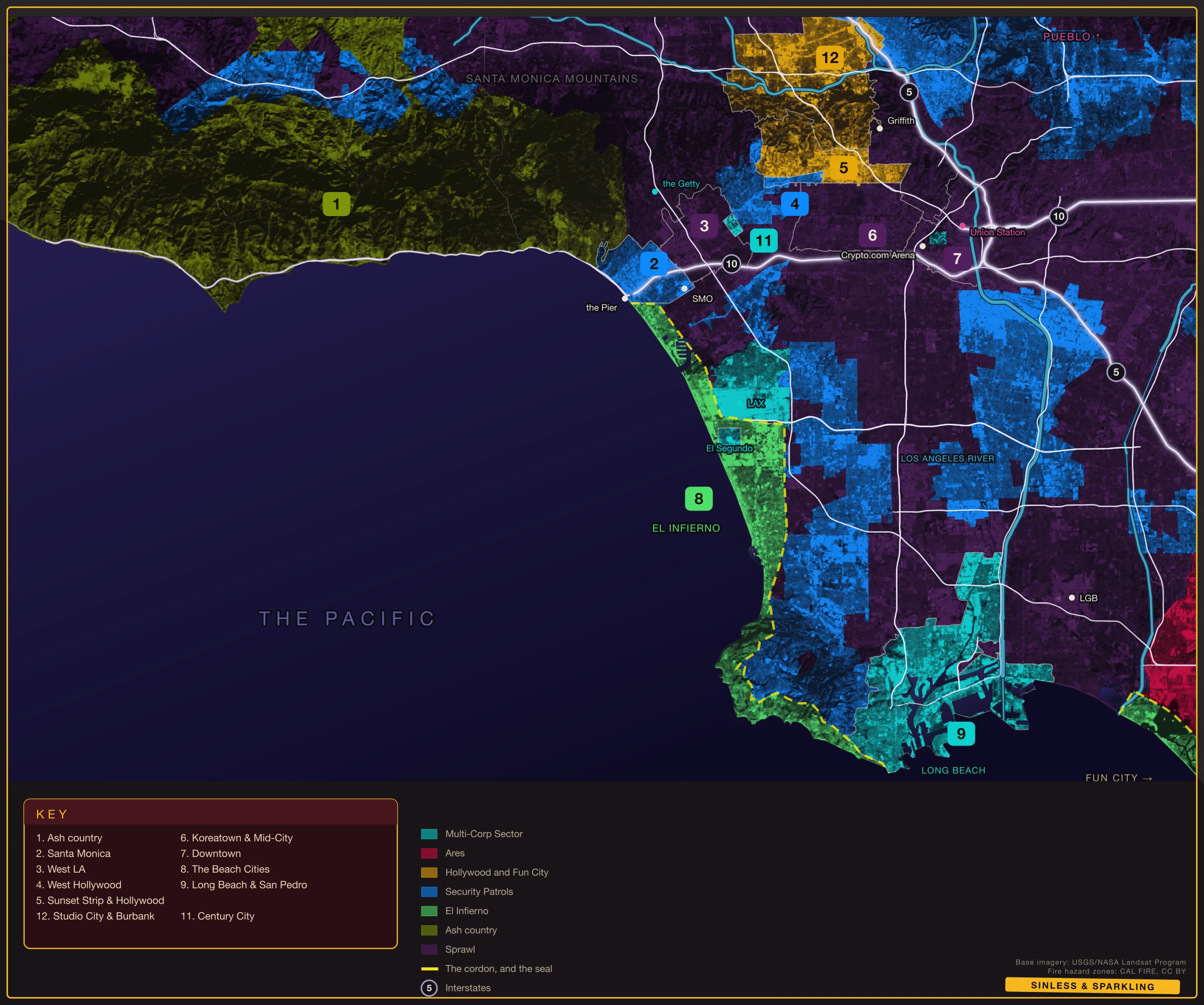
Numbers match the locations index, which also carries the regional map. Click for full size.
The 2028 line#
Everything in this city that works was built or rebuilt for the Games, and nothing has been built since. That's the most useful date to carry around, because it dates every functioning thing you will touch.
Los Angeles spent most of a decade getting ready for 2028 and it was the last time anybody spent money here on purpose: rail extensions and rebuilt stations, resurfaced arterials, venue retrofits, a terminal program at LAX, new substations, pumps and trunk mains. All of it delivered. Some of it delivered weeks before the Games opened.
Then the Games ended, the fault moved in the autumn, and the money that would have maintained any of it went into thirty years of arguing about who owed what. So:
- If it works, it's a 2027 or 2028 build, and it is now thirty-two years old with no program behind it.
- If it was going to be finished for the Games and wasn't, it never was. See Oceanwide Plaza.
- If it was finished for the Games and then broke, nobody replaced it, and the failure is usually where the new work met the old. LAX is the largest example and the beach cities' substations are the ones people actually notice.
The city runs on one decade of construction and thirty years of deferred maintenance, and the crew's whole professional advantage comes from knowing which parts of it were never inspected again.
What the disasters took#
The Big One in 2028 followed the soil. It came apart worst on river fill and in unretrofitted stock: the old low-rise cores, the soft-story apartment blocks, the freeway interchanges. LAX never reopened.
The neighborhood that lived off it went with it. Westchester's hotel strip along Century Boulevard, the rental lots, the freight forwarders, the long-stay parking: all of it served a field that stopped having passengers, and thirty years on there is nothing to replace it with. Loyola Marymount is still up on the bluff and still teaching, so the streets around the campus work, and everything between there and the airport fence is the emptiest ground in the city that nobody can blame on a disaster. It isn't burned, poisoned, drowned or dried out. Its employer died.
The Green Tide in 2056 followed the water, and it came from the south. San Onofre stopped generating power back in the twenty-tens; what it never stopped being was a storage yard. Sixteen hundred tons of spent fuel sat in casks a hundred feet from the surf for forty years, because no repository was ever built to take it and no government outlasted the argument about whose problem it was. The company holding the contract collected its fee and scheduled the work for later. The bluff kept eroding.
When the casks went, the coastal current did what it always does and carried it north: up the Orange County beaches, onto the San Pedro shelf, and into the harbor. That is the port districts and the low ground behind them, and it is a shoreline disaster: the water and the sediment and the first few streets, not the county. The wetlands and the beach cities came later and came differently: the 2058 wave took those, from in front.
El Infierno is what people call the cordon that went up around it, and it is bigger than people expect: about a hundred miles of shoreline, from the Santa Monica pier down to San Onofre. The harbor districts, Wilmington, the San Pedro waterfront, Terminal Island, the refinery belt from Carson out to El Segundo, the wetlands, the whole Orange County shore past Newport and Laguna, and the beach cities. Manhattan, Hermosa and Redondo were the most expensive streets on this coast in 2050, and they are inside the same wire, on the same maps, under the same name as the refineries, because the cordon closed around everything the water took in those two years, the poison from the south and the wave from the west.
It ends at the source, on the bluff the casks were standing on, which is the one part of the geography nobody has to have explained twice. And south of there the coast does not resume: the seventeen miles of empty buffer, and then a city sealed since 2050. See Long Beach and San Pedro for why the port in the gap at the middle of it still runs on schedule.
It is walled, it is contaminated, and it is empty, because a cordon is the opposite of an address. The million people the water displaced did not go far, since the alternative was leaving with nothing: they are packed against the wire in San Pedro, Wilmington and east Long Beach, and most of them work the port in the gap at the middle of it.
Nobody was charged. The contract had changed hands four times.
In 2058 the wave arrived, and it is the reason none of the money came back. A moderate quake offshore shook loose a piece of the Palos Verdes shelf (a submarine landslide, on ground geologists had been publishing about for fifty years), and the collapse pushed a tsunami into both bays at once. Modest by tsunami standards, it arrived at a coastline whose insurers had already left, and it did three things in twenty minutes: it destroyed the beach strip at sea level from Redondo up through Santa Monica, it drove harbor water and everything suspended in it a few miles up the concrete flood channel, and it laid contaminated sediment on beaches the current by itself could never have reached, because the peninsula was in the way.
The part people mix up: the Tide poisoned the coast and the wave emptied it, two years apart, and the second one is the reason the money never came back. You can decontaminate a beach, but nobody will underwrite a house that has now been proven to flood.
The fires never stopped. Everything where the city meets the hills has burned at least twice, no insurer will write a policy above the flood line, and the canyons are full of standing houses nobody owns and anybody can enter. Ash country runs from Malibu through the Palisades and Topanga, across the Verdugos and Altadena, out to Sylmar and Chatsworth. Some of the most expensive real estate in the history of the world is squats.
What held#
The flat working city, mostly: Watts, Compton, Inglewood, Boyle Heights, East LA, Huntington Park, Pacoima. Dense, poor, and standing, because those neighborhoods ran on families and churches and each other rather than on insurance policies and private patrols, and none of those things stopped working. They are dangerous and they work, which means a crew out of one of them has neighbors who will lie to a stranger on their behalf.
Money went where water, height and gunmen are: Bunker Hill, Century City, the Westside behind its checkpoints, Pasadena. The Valley's east end and the far suburbs dried out when the aqueducts changed hands and are emptying a household at a time.
The city is still the city#
Griffith Observatory is a mana observatory now, and open to the public on weekends. The Hollywood sign is lit and has a sponsor's logo bolted to the hillside beneath it. Dodger Stadium is a market six days a week and a stadium on the seventh. Union Station is the inland border hall, so if you leave the city by land you leave through it, and it's where you find out that the trains still run, for freight first and for people who can prove they're going to work second. Olvera Street still sells the same things. Angels Flight runs when it feels like it. The Coliseum is full most nights for something the city would rather you didn't ask about. The Watts Towers are exactly where they have always been. The Queen Mary is a hotel, a neutral ground, and the only place in the harbor where three corporations will sit at the same table.
The 2071 handover#
The city has two dates. One is behind it and explains everything that works. The other is eleven years ahead and explains everything anybody is arguing about.
Pueblo's published capital program lists Los Angeles as an anticipated service area from 2071. It's a budget document, not a declaration: projected connections, projected demand, a line for meter installation and trunk mains, a footnote about administrative integration costs. It is public, it is audited, and anybody here who knows a shareholder has read it.
What arrives is not soldiers but meters, rates, permits, licenses, a schedule of fees and an officer at a window who did not write any of it. Being administered, in other words, by a corporation that is genuinely good at administering things, which for a great many people here will be an improvement, and that is the uncomfortable part.
The two lists#
Pueblo will not adjudicate a hundred years of unrecorded claims, so on the day there are exactly two categories: interests entered on a register Pueblo recognizes, which convert, and interests entered nowhere, which are not refused but not heard. What matters is not whether a claim is good but whether it is written down, in a book somebody has kept continuously and can produce. And there is no record above the local ones to appeal to: the Crash took the county recorder's only copy in 2044, and nothing from Los Angeles was filed with Sacramento after the expulsion anyway. The rest of the mechanism, including what converting actually gets you, is on Pueblo.
Which districts are exposed, and it isn't the poor ones#
This is the part that surprises people, and it's worth getting right because it inverts what the rest of this page says about who came through.
| Ground | On the day |
|---|---|
| Santa Monica, West Hollywood | Fine. Both kept a council and a register through everything, and both registers are recognized. Most of both districts converts on paper it already holds |
| Bunker Hill, Century City, the studio lots, the plant fences | Unaffected. Extraterritorial corporate soil isn't Pueblo's to take, and the corporations have title in triplicate |
| The harbor | Fine. Port authorities, manifests, and a Corporate Court guarantee older than the annexation program |
| Parishes and associations that kept books | Fine, and some of them have minutes going back eighty years. Wilmington's committee can produce a continuous record and knows it |
| Koreatown, Westlake, Pico-Union, Mid-City | Catastrophically exposed. One address, forty households, an owner of record that is a payment address, and nothing in writing about who lives where. Almost none of it converts |
| El Infierno and the cordon | Nothing converts. The ground is contaminated and most of the title died with the companies that held it |
| Ash country | Nothing. Standing houses, no owners, no insurers, no register |
| The dark towers downtown, Oceanwide | Nothing. Several thousand people living in buildings with no owner anybody can name |
The exposure is about bookkeeping rather than money, and the districts that came through the last thirty years best are, in a lot of cases, the ones that came through on families, churches and each other rather than on instruments. Those things kept people alive. They do not convert.
It is also why this is a fight rather than a funeral. A register is a book somebody keeps. An association that has been collecting dues and minuting meetings for forty years has a continuous record and mostly doesn't know it counts. Getting that recognized, or getting a claim entered on somebody else's register before the date, is achievable work, and it is the reason half the paying jobs in this city are about paperwork rather than cargo.
What the crew knows#
- Ruin follows hazard and infrastructure, never who lived there. Five different geographies, none of them a map of anybody's neighborhood: shaken, poisoned, drowned, burned, dried.
- The flat working city is the part that works, because it ran on institutions rather than insurance. Poor is not the same as ruined and the difference is visible from the street.
- The emptied places are where the money was: the beach strip, the canyons, the bluff-top streets. Standing houses, no owners, no insurers, and salvage crews who know them better than any map.
- Nothing above the district level exists. Whatever a neighborhood has, it arranged itself, and the arrangements don't fit together.
- Except where a corporation built one. Century City, Downtown's Bunker Hill, and the studio arcology cluster in Studio City and Burbank are each a walled, badge-gated cluster with its own rules and its own security, and none of the district around it. Los Angeles never got Seattle's one Renraku-scale monolith. It got several smaller ones instead, which is the whole structural difference between the two cities in one fact.
Getting in#
Flying in is its own lesson. LAX has been rubble since the quake. Long Beach's field went when the water table did: the harbor has been sinking since the oil came out of it and only stays up because the injection pumps run, and what those pumps have been moving since the Tide is not clean. Burbank belongs to the studios. John Wayne is down in the border zone flying nothing civil. The longest runways in Southern California are at Ontario, on Pueblo's side of the line.
Which leaves a small plateau in Santa Monica that residents spent fifty years and one signed agreement trying to close, and which is now the busiest airport in Los Angeles.
Canon reference: Los Angeles