Hellhounds
Corporate security at kibble prices, housed better than the staff. The kennels breed them to the book; ash country breeds its own.
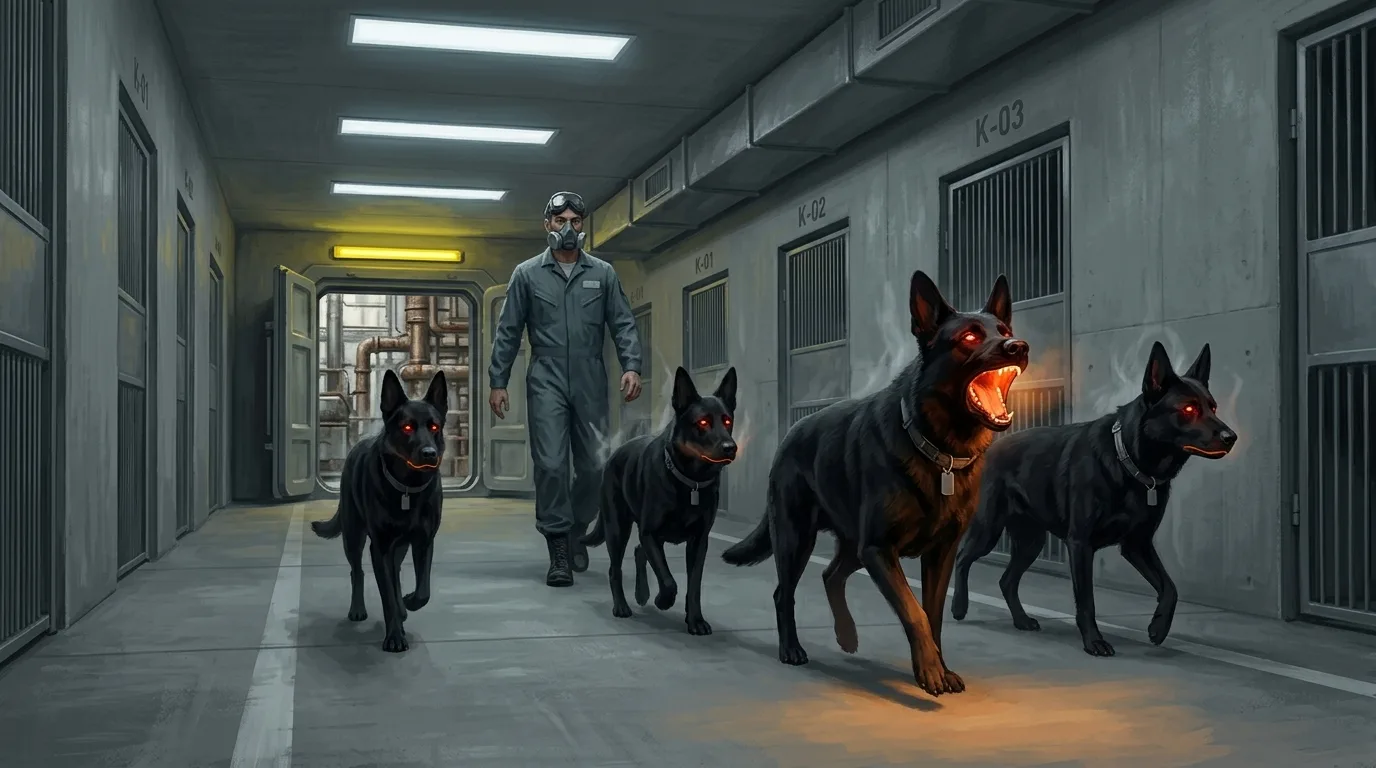
Hellhounds are Awakened dogs that breathe fire (corebook p. 256). The book's animal is a large wolf or a German shepherd, easy to train, and corporations run them as site security wherever a mage on the payroll costs too much, because a dual-natured dog watches the astral for the price of feed. Kennel stock holds to that description exactly: matched, numbered, silent, and every corp hellhound the crew ever meets will look the way the book says, because a corporation standardizes its dogs the way it standardizes everything else.
What the book says, specifically, is coal-black with red-rimmed eyes, and the eyes are the whole of the first impression: they burn, coal red, lit from behind by whatever the throat is doing, and on a black dog in a dark corridor they arrive before the animal does. The match is the part a kennel selects for: corporate stock is one build at one size, three of a kind with numbered tags, because a matched set is what the client is paying to see, and every hellhound alive supplies the black on its own. The eyes are not selected for and cannot be: they are lit on every hellhound alive, kennel or feral, two red lights with the raw wet rim of a turned-out lid around them, and in a dark corridor they are the first thing that resolves and usually the only thing. Under the lip the teeth and the inside of the mouth run hot enough to see, so a hellhound that opens its mouth shows you a furnace and a hellhound that keeps it shut shows you nothing but the rims.
The rest are ash country's, and they came the same way the barghests did: left behind in the canyons a household at a time, gone feral, Awakened out there where there is game and cover. A feral hellhound is built like whatever its grandmother was: the Awakening takes the color out and leaves the build, so the tell is the matching, never the coat. Three of one silhouette wearing numbered tags is inventory; seven builds and no tags is a pack. The red rims and the fire are the same out of any of them.
Neither population goes anywhere poisoned or hot, and this is the fact that decides where the crew meets them. A hellhound is a living animal with a working nose and a short life if you keep it in bad air, so the wild ones stay up in the burn and out in the dried suburbs, and the corporate ones are kept indoors on clean ground at real expense. Nobody puts a dog on a fence line in El Infierno's dirt, because a dog that walks that ground is a dog you replace.
What the crew knows#
- Where the dogs are is where the ground is clean. A kennel tells you the interior is sealed and worth sealing, which is a better map of a site's priorities than any badge list.
- The dogs are housed better than the staff. Filtered air, scrubbed concrete, a vet rotation, while the humans on the same site draw masks and filters from a shelf. That is not cruelty and it is not sentiment: it is what each of them costs to replace.
- A site with no mage on the books is not a site with no astral coverage. The dogs watch both sides of the world, and that is most of what a corp is paying for.
- Up in the burn you can tell a hellhound stretch of road from a barghest one before you see either: scorch lines along the curbs, burnt scrub against the fences, and the smell.
- A feral pack does not charge. It follows, for miles, patient, and takes you when you're tired. If something small is baying behind you and the brush keeps catching, turn around while you still have legs worth spending.
Contact#
Where they have turned up so far. You never deal with the dogs, you deal with the handler: a person on a shift with a feeding schedule, a decon cycle and a kennel key.
- Sealed corporate interiors, wherever a site has paid to clean its air. The kennel run inside the AES El Segundo complex on the Beach Cities coast is the one the crew will meet, and the dogs there have never been outside.
- The old Pendleton ground on the San Diego approach, worked in shifts off a kennel back at the airfield.
- Malibu and the canyons, for the ferals, on the same ground the barghests hold and never on the same streets.
- Not San Onofre, and the absence is worth stating because the site is corporate and the question comes up: the condition above is a contract paying to clean a sealed interior, and nothing at San Onofre has been paid for in four years. The gates are rusted open. Dogs are where somebody is still being billed for air.