The Beach Cities
Inside El Infierno, which nobody expected. The Green Tide made it cheap, the wave emptied it, and aerospace still runs behind the fences.
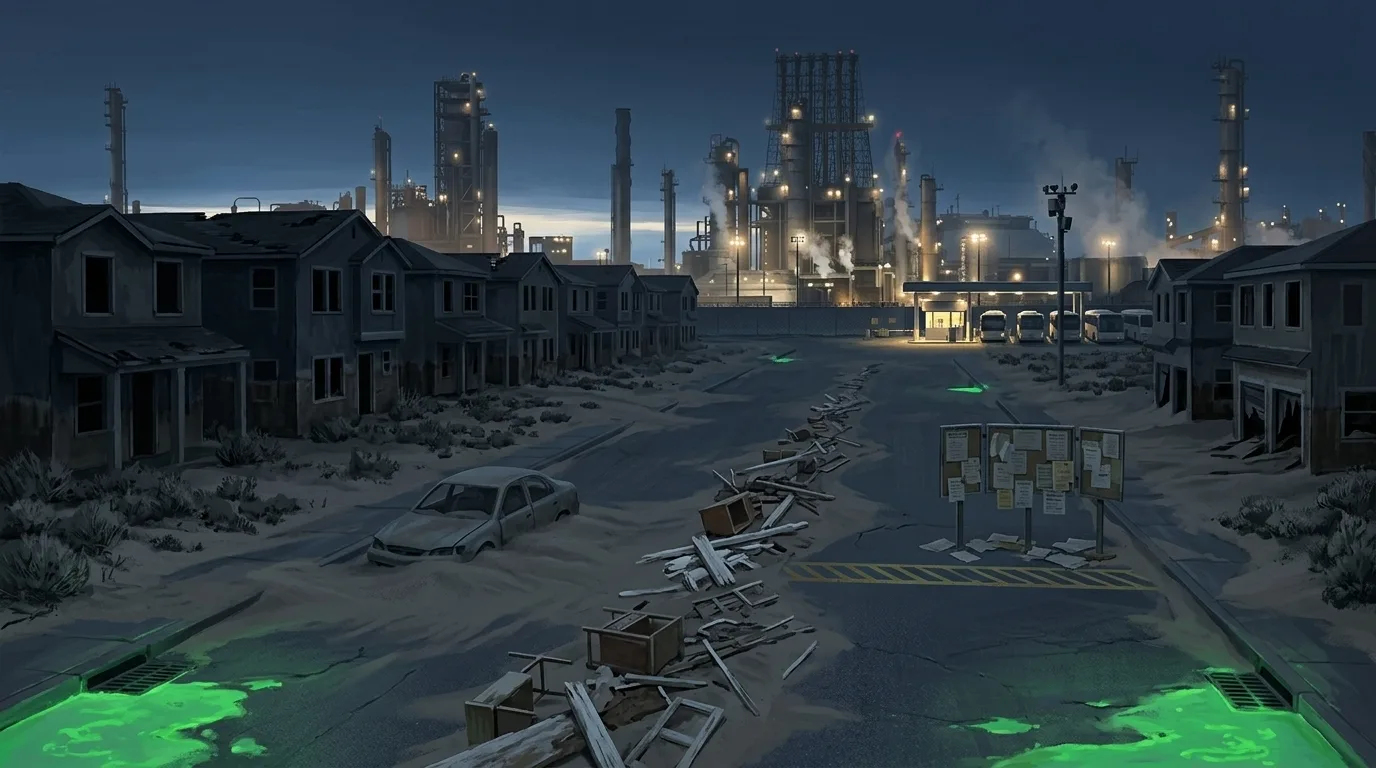
Manhattan Beach, Hermosa, Redondo, El Segundo and everything down to the harbor. It took both disasters, in the wrong order, and it is the clearest lesson in the city about who gets protected.
This is El Infierno. Say that first, because outsiders assume the name means somewhere else. The cordon follows the contamination, the contamination followed the water, and the water came ashore here, so Manhattan, Hermosa and Redondo are inside the same wire, on the same maps, under the same name as the Carson refineries and the Wilmington tank farms.
There is no separate word for the beach end and nobody is looking for one. A fence is a fence. The people working the plants inside it use one term for the whole zone and find it mildly funny that anybody expected otherwise.
The Tide didn't do this on its own, and the geography says so. The current runs north from San Onofre into San Pedro Bay, and the Palos Verdes peninsula stands between that and this coastline. What 2056 cost these towns was the water, the fishing and the property market. What actually emptied them was the 2058 wave, which came off the shelf collapse and did not have to go around the peninsula because it arrived from in front.
So the beach towns were expensive, then cheap, and now they're intact and empty: streets of houses with furniture in them, everything at sea level wrecked and everything a block back untouched, because on a west wind the air still isn't safe and the water table is worse. Untouched does not mean livable. Nothing outside the plant fences has power, so every window and porch on twenty-eight miles of coast is dark; the lawns went to salt-killed scrub years ago; the 2058 water left its stain level across the facades and its debris line down every street that runs to the sand; and the Tide's green scum still stands in the low corners no drain clears. People go in for what's in the houses. Nobody stays.
The industry never left, and it has names, because "the plants" tells you nothing.
The square mile is El Segundo, and the industry is defense engineering. Between Rosecrans and El Segundo Boulevard, inland of the beach and hard against the refinery, sits the aerospace corridor: the old Air Force research campus, the satellite and missile houses that grew up around it over a century, and the plants that still build guidance packages, sensor heads and launch hardware nobody else on this continent can build. It is Ares country. The campus was federal, so when California left the Union in 2050 the UCAS pulled its people out and disposed of the leases from two thousand miles away, quickly and to whoever was standing there. Ares was standing there.
Immediately south of it, the Chevron refinery: still called that, still the largest on this coast, still running, fed by pipeline from inland rather than over water nobody will put a hull on. And it is Shiawase's, bought with the AES generating station at Redondo as a single regional energy position in the 2040s, so the two sites share an administration. The 2058 wave came off the shelf collapse straight into Redondo, and afterwards that administration moved inland to the AES El Segundo complex behind the refinery fence: above the water, and next to the only ground on this coast anybody defends. It is an ordinary corporate site: standard Matrix, a staffed lobby, a guard contract, and a floor where a regional legal team assembles filings, which is what run 03 is about. The San Onofre paper never made the move and is still sixty miles south in concrete vaults. So that run can delay a document and cannot recover what it was built from.
The corporation that poisoned this coast still runs the refinery inside the cordon, profitably, on the same shift pattern as before. Nobody was charged. You can stand at the fence and look at it.
Why it's one square mile and not five#
Because it used to be five, and the difference is the whole story of what the last thirty years did to this city.
El Segundo was five square miles of leasable floorspace: office parks, media tenancies, engineering firms in tilt-up buildings, and the aerospace primes among them. Then four things happened in the wrong order for offices specifically:
- 2028. The quake took soft-story and tilt-up stock first, which is precisely what speculative office construction is made of.
- 2044. The Crash killed most of the businesses that filled the rebuilt space, and nothing arrived to replace them.
- 2050. Corporate head offices don't stay in a city with no government. Anything that was only a mailing address left within a year.
- 2056, and again in 2058. Nobody leases an office inside a hazard cordon, and office work is the single most relocatable thing there is.
The disasters sorted the ground by what could physically move, and desks can. What couldn't move is what's still here: a refinery, test cells, vacuum chambers, clean rooms, and tooling that took forty years and a dead government to accumulate. All of it bolted down, none of it replaceable, and all of it inside one fence line that was already built.
The other four square miles are empty tilt-ups with the signage still up. The money that used to work in them went to Orange County and it did not come back.
So the most profitable ground on this coast is a defense campus and an oil refinery, sitting in the middle of the worst environmental disaster in the region's history. Nobody involved finds this remarkable.
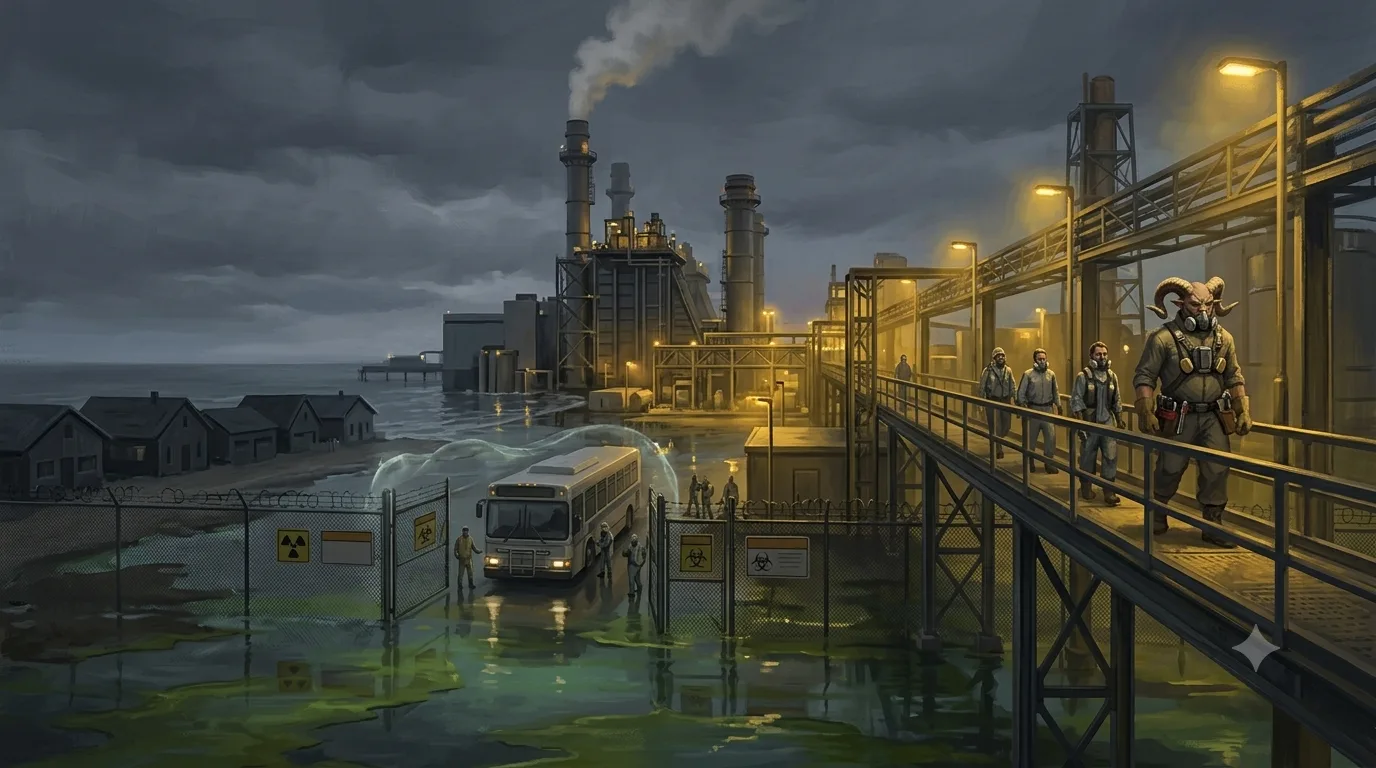
Both operate inside their own fences with their own power, their own filtration and their own armed security, running three shifts. Workers bus in through the cordon on company transport and bus out at end of shift.
What the crew knows#
-
The cordon is real but it is not a wall. It's fencing, signage, cameras and a patrol schedule, and it leaks in a hundred places.
-
Air matters here. On a bad wind you need a mask, and on a very bad wind you need to not be here. Locals check the wind the way other people check traffic.
-
The aerospace plants are Ares country. Their fences are the only ones on this coast that are seriously defended, and that's because of what's inside them rather than because of the sludge.
-
The AES generating station on the water at Redondo still runs, and so does the Hyperion treatment plant out at the edge of Playa del Rey. Redondo is the working station; the offices that used to sit behind it are at El Segundo now.
 Everyone
downwind of either has opinions. Hyperion is the reason the wetlands are the
way they are.
Everyone
downwind of either has opinions. Hyperion is the reason the wetlands are the
way they are. -
Salvage out of the beach towns is an economy. It is also how a lot of people got sick.
-
This is where a boat comes in. Twenty-eight miles of cordoned coast with nobody living on it, no patrol worth the name outside the plant fences, and a hundred streets that used to run down to the sand. The harbor books get checked eight times over by corporations that don't trust each other, and the pier in Santa Monica is the most-observed structure on this coastline. Here nobody is looking, because there is officially nothing to look at. A crew that works this out has a way in and out of Los Angeles that appears on no manifest, and it costs them a night on contaminated sand and a boat somebody will ask about later.
Getting in#
Walk, cut fence, or ride in on a shift bus with borrowed credentials. The cordon is designed to keep casual people out and to log vehicles, not to stop professionals.
The plants are the opposite: separate perimeters, real security, and no interest in the cordon's paperwork.
Canon reference: El Infierno