Koreatown and Mid-City
The densest ground in Los Angeles, and nobody administers it. This is where the crew lives.
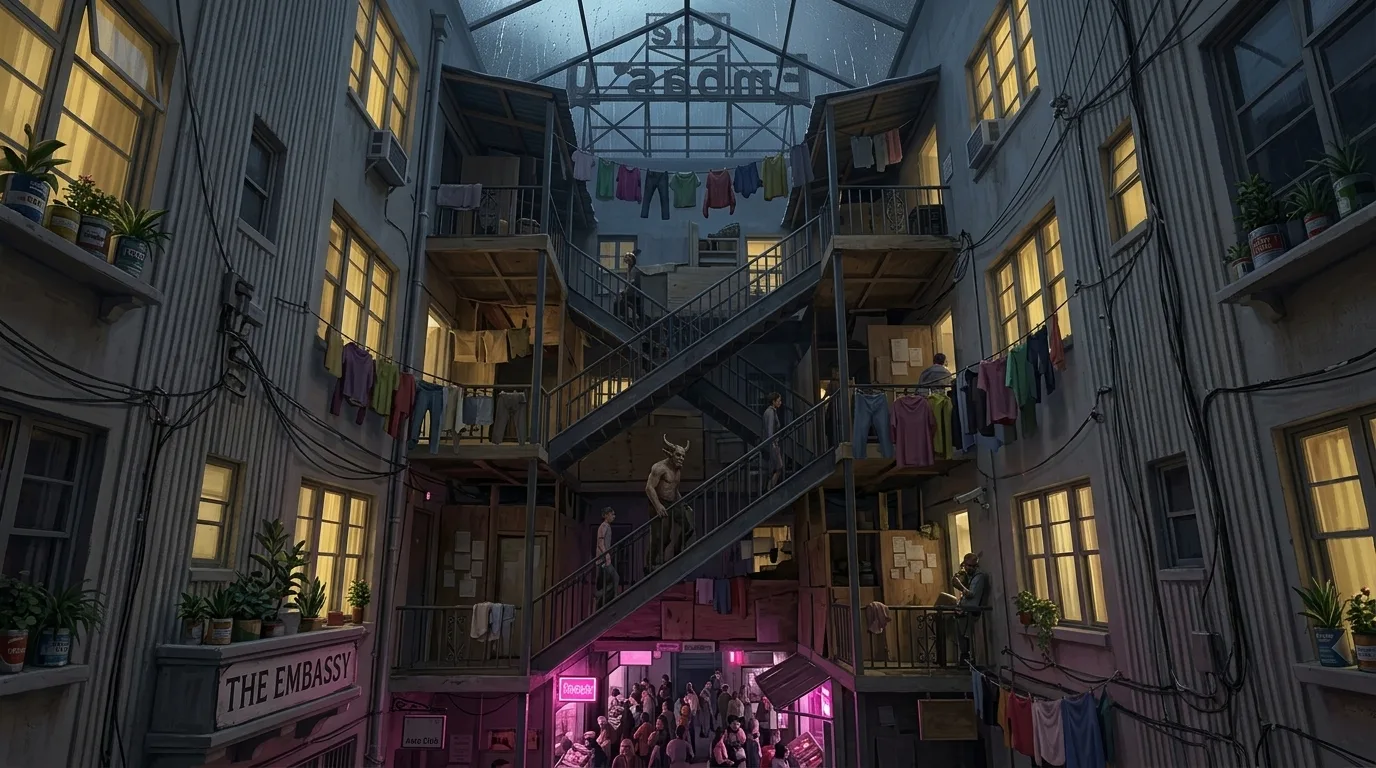
The opposite of a Barrens. When the plague came and the state left and the insurance market walked away, this part of Los Angeles did not empty: it filled. Twenty million people, nowhere to go because every direction is Pueblo's, and the cheapest standing housing stock in the basin already here in the form of pre-quake walk-ups and courtyard apartments. So the buildings subdivided. Then the subdivisions subdivided. Then people started building upward and inward: mezzanines inside high-ceilinged rooms, stairs bolted to lightwells, a third floor added to a two-storey building by people who did the maths themselves and were mostly right.
A stack is what locals call the result: one address, one water riser, forty households, and a landlord who may be an association, a cartel of tenants, a management company that exists only as a payment address, or nobody identifiable at all. Koreatown proper is the densest of it. Westlake, Pico-Union and Mid-City run the same way west and south.
Why a riser is worth fighting over#
Two different water problems get confused constantly, and the difference is the whole economy of these blocks.
The city's problem is supply. Pueblo holds the aqueducts, so what Los Angeles buys it buys at a price somebody else sets, and it arrives on a schedule: pressure in the mains for about an hour a day, district by district, rather than continuously. That's a rates-and-rationing problem, nobody on a block can affect any of it, and the reason it works that way is that intermittent supply is cheaper for Pueblo: less leakage out of hundred-year-old mains, measurable delivery, and every roof tank in the city doing the job a service reservoir would otherwise have to do. See Pueblo.
The hour is therefore the unit everything here is measured in. The time is posted in the lobby. The day is arranged around it. Somebody is always awake for it. A building that misses its window has a dry day, so the machine that fills the tank in that hour is the most important object in the building, and everybody knows exactly who controls it.
A stack's problem is lift, and that one is local, mechanical, and takeable. Mains pressure gets water to about the third floor and no further. Everything above that depends on a booster pump filling a roof tank during the window when there's pressure to draw on. Miss the window and the tank doesn't fill; the tank doesn't fill and floors four to six have nothing until tomorrow.
So the thing being sold on these blocks is not water but the last hundred feet, which is monopolisable in a way an aqueduct never could be:
- The pump is an object in a basement, in a building whose owner of record is a payment address. Unowned machinery in an unadministered building can simply be taken.
- A pump cannot be replaced, which is what makes taking one worth it. Nobody in this city manufactures a booster pump. Everything that works came through the port years ago on somebody's manifest, and every unit in the basin that still runs is already bolted to a riser with people living above it, because a pump nobody is using is a pump that doesn't work. Salvage yards are full of casings with no impellers, the harbor pump crews hold what few seal sets exist and trade them for favors, and the Risers will sell you a working unit for roughly what a family earns in a year.
- A pump without power is scrap, so the Risers do water and electricity, and it is one racket rather than two: hold the tap and you hold the pump, hold the pump and you hold the tank, hold the tank and you hold everybody above the third floor.
- Rationing turns timing into leverage. Under a schedule, whoever controls the pump controls when you get water, and a fortnight of filling late is a more effective argument than any threat.
That's what "territory is infrastructure" means on the ground, and it's why a run about a stolen pump is a run about forty families rather than a plumbing callout. See The Risers.
Nobody polices it. There is no contract here and there never was one to lose. What there is instead: business associations, churches in six denominations, forty languages on a block, a Korean commercial spine over a mostly Latino residential population, and a dozen overlapping mutual-aid arrangements that work well for the people inside them and not at all for anybody else.
The crew's doctor is one of those institutions: Esther Kwon, in the back of a dental suite in Chapman Plaza on Sixth.
What the crew knows#
- This is where a runner can live. No SIN checks because nobody is checking, rent payable in cash to somebody who doesn't want a name, and enough churn that a new face on the block is unremarkable for about a week.
- Vertical, not sprawling. Moving through a stack means stairwells, lightwells, roofs and the gaps between buildings. Roof-to-roof is often faster than the street, and the people who live there know every route.
- Institutions here are commercial and associational, not familial. A merchants' association can get something done in an afternoon that no authority in Los Angeles could manage in a month, but its reach stops at its members.
- The fire risk is the real terror. Informal construction, one riser, illegal power taps, and no fire service worth the name. Everybody knows which buildings are bad and nobody says it out loud.
- Water and power are the local politics. Who taps what, who pays for the pump, whose generator serves which floors. Most disputes in the district are about utilities, not territory.
- Anybody who calls it a slum has never had to find an address in it.
Getting in#
There is no getting in. Walk. Drive if you must, park badly, accept that you will not find the address from the street: the number on the door refers to a building that now contains nine other places to live and the one you want is up a stair at the back.
The friction is navigational and social. A guide is worth more than a weapon, and everybody who lives there is one.