Pueblo
The country on the other side of every road out. Runs its border like a procurement department, with a schedule of fees.
On this page (10 sections)
The Pueblo Corporate Council holds everything landward of Los Angeles: the desert, the passes, the Inland Empire, the aqueducts and the ground the water crosses. It took all of it in pieces through the 2050s and then stopped at the city limits, which was a decision rather than a failure. Twenty million people and a poisoned coastline are a liability. What Pueblo wanted was the water and the land under the water, and it has both.
Where it stops, going north and west: the Sierra Nevada crest and the Tehachapi range. Pueblo has the dry side of both, meaning the Owens Valley, the Mojave, the high desert and the Colorado, while the California Free State has the wet side: the Central Valley and the coast. Leaving Los Angeles up the Grapevine means crossing into Pueblo at the county line and out of it again over the Tehachapi crest, twenty minutes later, into Kern County and somebody else's paperwork.
That line is why the water fight is with Pueblo and not with Sacramento. The aqueducts begin in the Owens Valley, on Pueblo's side of the crest. The Free State has no say in it.
It is a nation run as a corporation whose citizens are its shareholders, and the border is administered the way a company administers anything: permits, manifests, quotas, schedules of fees. All of it can be bought and none of it can be bribed, and the difference between buying and bribing is the single most useful thing to understand about dealing with Pueblo. The price is posted, it moves with how badly you need it, and the officer at the window has no authority to discount it and no reason to want to.
Who lives out there#
Briefly, because a runner's mental map of Pueblo is mostly how empty is it and who will see me rather than census figures:
| Region | How populated | What it actually is |
|---|---|---|
| The Inland Empire: Ontario, Riverside, San Bernardino | Dense. Millions. The populous face of Pueblo and the part a runner deals with | Logistics parks, warehouses, the eastern customs house, and the longest runways in the region at Ontario. Everything that reaches Los Angeles by ground is sorted here first |
| The Grapevine: the Tejon pass on I-5 | Nobody. Deliberately | The northern door, instrumented and garrisoned. You don't live in a chokepoint; you staff it |
| Palm Springs and the Coachella Valley | Comfortable and growing | Shareholder country. Water means golf, dates and citrus, and it is the most pleasant place in Pueblo's west to be rich |
| The high desert: Antelope Valley, Barstow, Mojave | Thin and thinning | Towns strung along the aqueduct and the rail, most of them service settlements for infrastructure rather than places with their own reason to exist |
| The Owens Valley and the aqueduct corridor | Almost nobody, by design | The water. The most heavily patrolled ground in Pueblo's west, and the reason the Council never needed to take the city |
| The Colorado at Parker and Blythe | Company towns | Dams, pumping plants, and the people who run them |
| Las Vegas | Prosperous, and Pueblo's | The one piece of Pueblo an Angeleno has plausibly visited. The casinos are shareholder businesses with audit trails, which makes it a poor place to wash money and an excellent place to be publicly seen not working |
| Arizona: Phoenix, Tucson | The heartland. Millions | Where the Council actually governs, five hundred miles east. Nobody on this crew has been, and they know it from freight manifests |
The hour#
Los Angeles gets water for about an hour a day. Pressure in the mains comes up on a published schedule, district by district, and goes away again. Everything about how this city lives is organized around that hour, and the hour exists because it is the cheaper choice for Pueblo, which is worse than cruelty, because a policy that saves money is one nobody is ever going to change.
Why intermittent supply is the efficient choice#
- A pressurized network leaks the whole time it's pressurized. Los Angeles has hundred-year-old cast iron under it and has had no capital program since 2028. It leaks when the mains are down too, because the pipe drains, the ground comes back in, and every morning's refill hammers the joints a little further apart. But an hour at pressure loses a great deal less than a day at pressure, and that difference is most of what pays for the policy.
- The pumps run at their best point. One window means running the plant flat out for an hour rather than modulating against demand all day, which is where pumping efficiency actually lives.
- It makes delivery measurable. A scheduled volume into a known district in a known window is a number you can put in a forecast and audit against. Continuous supply is an estimate. Pueblo does not like estimates.
- It moves the storage onto us. Intermittent supply forces every building in the city to install a roof tank and a booster pump to fill it, and to maintain both. The tanks on ten thousand roofs are Pueblo's reservoir, built and paid for and repaired by the people living underneath them. No dam, no service reservoir, no maintenance liability, no capital line.
- The distribution network stops being their problem too. Pueblo delivers to the city limit at pressure for an hour. What happens to the water after that is somebody else's failing infrastructure, and there is nobody here to bill for it.
So Pueblo carries the aqueducts and the treatment plant, and Los Angeles carries the pipes, the tanks, the pumps and the risk. The city pays capital costs it can't afford for an asset that belongs to a nation it isn't part of.
If you don't pay, they close the meter#
No warning that means anything, no negotiation, no discretion. The account goes to arrears at thirty days and the valve at the building's service connection closes at sixty, and the person who closes it is a technician with a work order and eleven other stops that morning.
The account is the building, not the flat. Forty households can be current on their rent and go dry because a landlord in Arizona didn't settle an invoice, and Pueblo does not know their names and has no mechanism to learn them. Nobody decided to do it to them, and a harm with no author is much harder to argue with than one with a villain attached.
What's left is the tank on the roof, and it's a clock. Three days for a careful building, less in a hot week, and everyone in it can watch the level going down. A cut-off is a deadline rather than a hardship, and the crew can be hired inside one.
Getting it back costs more than the debt. Arrears, a reconnection fee, and a pressure test on the building's own plumbing before Pueblo will put water into it again. The test is the trap: hundred-year-old risers fail it routinely, and a failed riser has to be replaced before the valve opens, which is a capital job in a building that couldn't pay a water bill. Buildings have gone permanently dry that way and are still occupied.
There is nobody to appeal to, and that is an absence rather than a euphemism. No governor, no utilities commission, no regulator, no legislature, and no press that covers a building going dry, because buildings go dry every week. There is no story to suppress.
So the block improvises, and all of it is illegal: trucked water at four times the mains rate, a hose over a wall into a neighbor's riser during the hour, buying somebody else's tank by the hour after theirs has filled. You can tell who is cut off by who is carrying containers at six in the morning, and everybody on the street already knows.
What that does to a day here#
Everybody knows their district's hour and plans the day around it. Laundry, washing, cooking, filling anything that holds water. Buildings post the time in the lobby. People who work somewhere with a different window than the one where they sleep get two chances a day and are quietly considered lucky.
A building with a failed pump misses the window entirely, which turns an inconvenience into a day with no water at all. That is why a pump in a basement is the most valuable object on a block, and why the people who control them can charge what they charge. See Koreatown and Mid-City.
What's on the calendar#
Everybody in this city knows Pueblo is going to take it, and roughly when, and nobody was ever told. The knowledge is in the paperwork rather than in a rumor or a threat, because Pueblo is a corporation whose citizens are shareholders, and corporations publish.
The Council issues a ten-year capital program, quarterly forecasts and water allocation projections. All public, all audited, and anybody here who knows a shareholder can read it.
Los Angeles appears in the current program from 2071, not as a target but as an anticipated service area. Projected connections, projected demand, a capital line for meter installation and trunk-main works, and a footnote about anticipated administrative integration costs. Eleven years out, with the arithmetic done and the number carried forward.
That's the whole thing in one document: no declaration, no ultimatum, nobody to argue with. A spreadsheet that assumes the outcome and has been assuming it, revision after revision, for six years. It gets updated on schedule. The date has moved twice, both times by a year, both times outward, and both revisions were noted in a footnote.
What people do now is hedge, all of them against the same date. Anybody with something to protect is trying to get it written down before then: a title, a tenancy, a license, a claim, a shareholding of their own. Every records fight in this city is a race against a line item in somebody else's budget.
What integration actually means, and why paper is the whole game#
The footnote about anticipated administrative integration costs is the most important sentence written about this city, and it is four words long. Here is what sits behind it, because Pueblo published that too.
Pueblo does not intend to adjudicate any of it, because twenty million people with a hundred years of unrecorded claims is unbounded liability and a corporation will not accept unbounded liability. So the procedure, the same one it used across the Inland Empire in the 2050s, is simple and entirely in character:
- An interest entered on a register Pueblo recognizes is adopted. It gets converted into a Pueblo instrument, the holder becomes a rate-paying resident with a path to shareholding, and the cost of doing that is knowable in advance. That's why it's a line item.
- An interest not entered anywhere is not adjudicated. Not refused: not heard. The ground vests in the Council as unclaimed, and the people living on it become occupants at the Council's discretion.
Whether the claim is any good does not enter into it. Pueblo is buying a priced schedule rather than justice. A weak claim entered on a register is an asset with a number attached. A watertight claim nobody ever recorded is a conversation, and Pueblo doesn't have conversations at this volume.
Nobody is going to ask Sacramento, which is the question everybody asks first. The California Free State held the county recorder until 2057 and in principle should be able to settle every one of these claims. It can't. California had moved its registers onto three companies' platforms and destroyed much of the paper behind them on a retention schedule, and the Crash took the authoritative copy in 2044. What was rebuilt afterwards came off tax rolls, which say who was billed rather than who held title, and nothing from Los Angeles was filed there at all after the expulsion.
Pueblo wouldn't use it even if it were intact. Adopting a foreign government's register means inheriting that government's errors and being unable to audit any of them, which is precisely the unbounded liability the whole procedure exists to avoid. Pueblo adopts registers it can inspect itself.
That puts an extraordinary amount of weight on about a dozen surviving bodies. Los Angeles has no county recorder, so a "register Pueblo recognizes" means whatever still keeps one and can show it has been kept continuously, on paper, by hand: the Santa Monica rent boards, West Hollywood's council, two harbor authorities, a handful of parish and association registers, and the boards' equivalents in three other districts. That's it. That is the entire list of places in this city where a piece of paper can be made to count in 2071, and the reason the list is so short is 2044 rather than 2057.
So the fight everywhere is to be entered: on any of them, in any form, before the date. Getting a claim supported on one of those registers is worth more than owning the building, because the register converts and the building doesn't.
And 2071 is a floor, not a promise#
The people who have actually thought about it are frightened not of the date but of arriving there early, because the program describes an orderly handover and nothing guarantees an orderly one.
It takes a bad week. A quake, a fire that jumps a cordon, a cartel war over a riser that runs out of hand, and then somebody with standing asks Pueblo to come and help, and Pueblo helps, and the capital program gets revised inward for the first time.
The uncomfortable part is who could make that call. There's no city government to do it. The only bodies in Los Angeles with the standing to formally ask anybody for anything are the district councils: Santa Monica's boards and West Hollywood's council. The two districts that kept their institutions are the two that could sign the city away, in writing, while trying to do the right thing.
What the crew knows#
- Two ways out of Los Angeles by road and Pueblo owns both. North on I-5 over the Grapevine, and east on the 10 through Ontario. Each has a customs house and each keeps records. Two more cross the Santa Ana Mountains out of Orange County, which is a different set of records and the same customs house. The remaining direction is the coast south, which is somebody else's border and worse.
- Two doors on a three-hundred-mile border, because the border is a mountain range. The basin is a bowl and the line is the rim, ten thousand feet of San Gabriels, and a ridge is not somewhere you can drive. The routes over it were graded once, a century ago, by a state that no longer exists, and every one of them except the Grapevine comes down on Pueblo's side of the line. Pueblo doesn't fence the rim and doesn't need to: a vehicle off the road is a vehicle with nowhere to arrive.
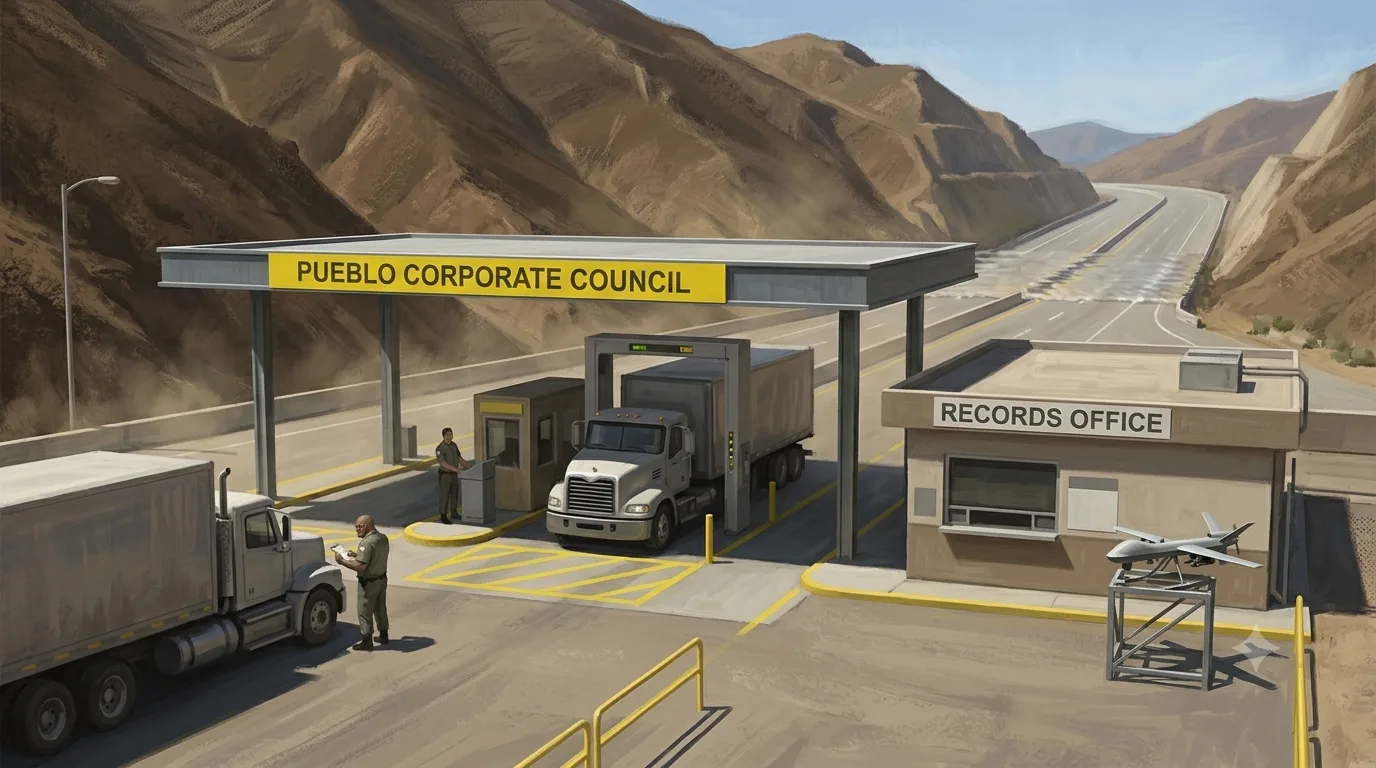
- The eastern crossing holds because the 10 is a tube, not a line on the ground. East is the one direction with no mountain in it, so the border runs through forty miles of occupied suburb, and Pueblo never tried to fence that. Instead: every interchange between Pomona and Ontario is closed, so twelve miles of the 10 has concrete on both sides, no on-ramps, no off-ramps and an inspection plaza at the far end. Every cross street that used to run through is a severed dead end with a barrier and a plate reader, and there are hundreds of them. Nobody mans a severed street; it only has to not connect.
- The eastern border leaks people and holds freight, on purpose. You can walk across at Pomona in an afternoon and nobody will stop you, because the border was built to stop a vehicle and a tonne rather than a body, and bodies are cheap to move and impossible to sell. A container has to use the plaza, and the plaza is why there is a smuggling economy at all.
- One facility covers the lot. The gap the 10 uses is six miles wide, between the San Gabriel front and the Chino Hills, and the freeway, four rail tracks and the aqueduct all pass through it. Pueblo built a single installation across the gap, which makes it the most heavily staffed ground in their west and the last place to try anything clever.
- Citizenship is shares, not blood. Pueblo sells standing, so there are Angelenos with Pueblo shareholding and people whose families have been in Arizona for four hundred years with none. Losing standing is a financial event with a form to fill in, and that is exactly why an officer with shares cannot be bought: you would have to outbid their dividend, in cash, forever.
- The rules are enforced, consistently, and that cuts both ways. On Pueblo soil you are licensed or you are in violation, and there is no third state. It's the most predictable jurisdiction in the region and the least forgiving. See getting around.
- They hold the water. The east end of the Valley is drying out household by household because the aqueducts are on their side of the line, and every rate rise in Los Angeles is a decision somebody made in Arizona.
- Ontario has the runways and it doesn't help you. The airport isn't the obstacle; the fifty miles and the customs house after it are, and Pueblo can simply decline the permit.
- Freight is the relationship. Hobart Yard and the Alameda Corridor exist to feed Pueblo's border, so whoever holds the corridor decides what reaches it.
- Pueblo is not the villain, and on most measures they're the ones doing it right. The water arrives, the numbers are published, the officer at the counter is the same officer on Thursday. It's also a procurement department with territory, and it will process you. Those are the same sentence.
Getting in#
By rail from Union Station, which is the ordinary way people do it and involves being on a manifest. By road on the Grapevine or the 10, where a permit is a purchase rather than a favor. By air into Ontario with a filed permit that can be refused for no stated reason.
And by the aqueduct service roads, which is the worst idea available: they go exactly where you want to go, they are unfenced for miles, and they are watched more closely than anything else Pueblo owns, because the water is what the country is for.
Canon reference: Pueblo Corporate Council