Santa Monica Airport
Two hundred acres of contested jurisdiction, so everything comes through here.
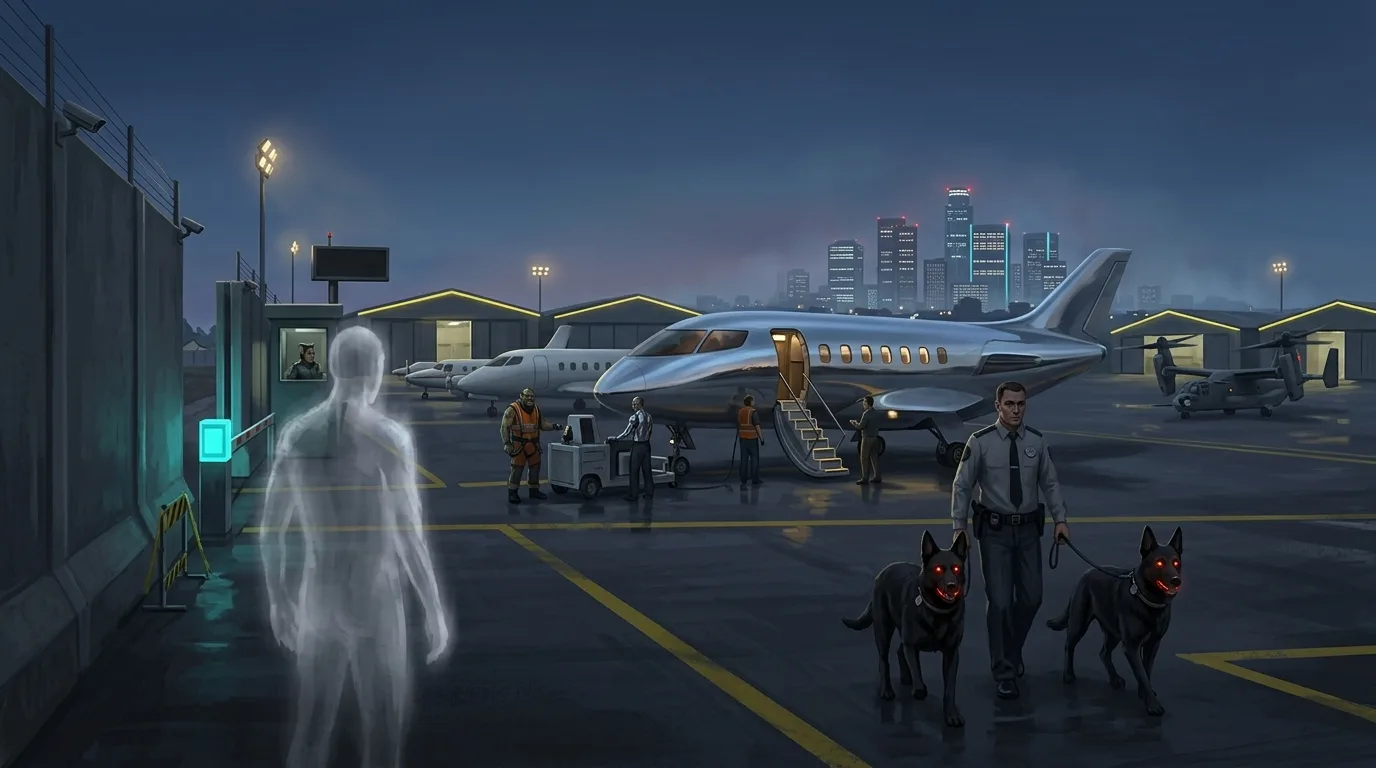
A single runway on a plateau above the bluffs, hemmed in on all four sides by houses. Two hundred and some acres, one strip of asphalt, hangars down both flanks, and a fence that residents have been photographing through for eighty years.
It should not be the busiest airport in Los Angeles, but the two fields that ought to be doing this work are both gone, and neither of them was bombed. Both died of the ground underneath them, which is also why nobody can simply build a replacement.
LAX died in the 2028 quake, months after finishing the largest construction program in the city's history. Terminals, an automated people mover, a consolidated rental facility, new taxiways: all delivered for the Games, all paid for, all inspected and signed off, and then in the autumn the fault moved. The runways are why it never came back. The Newport-Inglewood fault runs under the eastern approach. It is named for the neighborhood next door, it is the fault that flattened Long Beach in 1933, and in 2028 it moved. Terminals can be rebuilt and were, twice, by two different consortia. Four parallel runways whose subgrade has been displaced cannot be un-displaced, and no operator would certify them for loaded aircraft. So the field was insured, litigated and abandoned, in that order, and what sits out there now is a drone port working the two least-damaged strips, freight only, surrounded by several square miles of concrete nobody has a use for.
Long Beach died of subsidence, slowly, and on paper. The harbor district sits in a bowl up to twenty-nine feet deep, sunk by the Wilmington oil field, and it is above sea level only because the largest waterflood program in the world has been injecting water back underneath it since the 1950s. Stop injecting and it resumes sinking. After 2056 the program was injecting harbor water, because that is what there was, and the airfield's subgrade went brackish underneath it: the runways heaved, no insurer would cover a fuel farm on contaminated ground, and the field's certification lapsed rather than being revoked. Nobody ever decided to close Long Beach airport. It simply stopped being somewhere an aircraft could legally land, and the port's freight went back over the docks and onto rail the way it did before there was an airport there at all.
That leaves a single runway on a plateau in Santa Monica. What lands here is private aviation, charter, air ambulance, courier work, corporate shuttles and a steady volume of freight that the manifests describe imprecisely.
Most of it does not need the runway, so the runway being short stopped mattering. The 2029 settlement cut the strip, and the traffic moved to aircraft that lift off vertically and never touch the centerline. All of it carries people: executive VTOLs at the expensive end, sleek and low and quiet, and small personal ones at the other, four seats and a paint job somebody has stopped maintaining. The strip still gets used by the older fixed-wing charters and by anybody who wants to look conventional. The residents won a shortening that the technology routed around inside a decade, and nobody has ever bothered to lengthen it back.
Nothing based here is a freighter, and that is precisely how the freight moves. The cargo the manifests describe imprecisely arrives in the same charter aircraft as the passengers, in the hold of something with eight seats and a client list. An airframe built to carry boxes would have to say what was in them.
The houses really are at the boundary, and the boundary is no longer a fence. Two hundred acres in the middle of a city means the property line runs along the back of somebody's yard for most of its length, and for most of the field's history that line was six feet of chain-link between a washing line and an active taxiway. It is not any more. What sits there now is a perimeter built for what uses the field: an outer chain-link at the property line, then forty meters of cleared ground with nothing growing on it and sensor posts down the middle, then a precast concrete wall four meters high with monofilament along the top and camera housings every fifty meters, and only then the apron. A corporate shuttle and a security tilt-rotor do not park behind a garden fence.
The wall is the whole boundary, not a stretch of it. It runs the entire perimeter, all the way around, and the chain-link people picture is the outer line forty meters further out where the cleared ground ends. There are four ways through the wall and they are all gates: two vehicle, two pedestrian, each with a guard post built into the wall beside it, badge readers, and a road on both sides. Nothing stands loose out on the movement area, because the movement area is where aircraft go: a booth in the middle of an apron is a thing to taxi into, and every checkpoint here is against the wall it controls.
The forty meters is the tell, because it used to be somebody's houses. The operators bought the nearest row out over the 2050s, a parcel at a time, and cleared it: the wall is built on the footprints. What is left is a neighborhood that ends abruptly at a strip of dead ground, with the wall beyond it and aircraft noise over the top, and residents whose back fences look at concrete instead of at the runway they were promised would close. Somebody standing in one of those yards can hear the field perfectly and cannot see it at all, and everyone involved understands this as the compensation it was.
How a closed airport stayed open#
The district won this fight. It won it fairly, in writing, and it has spent thirty-two years watching the win not take effect. The sequence matters, because every strange thing about the field today follows from it:
After decades of complaints, hearings and lawsuits, the city and the federal aviation authority settled. The runway was shortened and the city acquired the right to close the field from 1 January 2029. Signed and dated. Residents framed copies.
Then the Games. For three weeks in the summer of 2028 this two-hundred-acre plateau ran more traffic than it had in its history: charters, corporate aircraft, security flights, people who do not queue. The neighborhood endured it in the specific good humor of people who know the thing ends in December.
The quake came in the autumn and took LAX with it. So: four parallel runways on displaced ground, a region with no primary airport, and a closure order due to take effect in a matter of weeks on the one undamaged field left standing.
The suspension was for ninety days. Then another ninety. It has been extended every quarter since by an office whose forms somebody still files, and the emergency has never been formally lifted, because lifting it would mean somebody declaring the airport situation resolved. Nobody is going to.
The authority that issued it then expelled the city. The suspension is a California order, and the California Free State still exists: legislature, governor, revenue service, all of it, six hours up the valley. It is also the body that legislated Los Angeles out of California in 2057, which means it has no jurisdiction over a facility here and no procedure for acquiring one.
So the order stands, and the deadlock is total: the only government that could lift it is the one government legally barred from having an opinion about us. Nobody in Los Angeles has standing to ask, and Sacramento would have nothing to answer with if anybody did.
That deadlock is what the whole field runs on: nobody's authority out here is clean. The district holds a right it cannot exercise. The operators run a facility they don't quite own. Whoever is enforcing anything out here does it under a delegation nobody wants tested in front of the Corporate Court, and the residents' association still files the same objection every year, into a file that is now measured in meters.
What the crew knows#
- This is the way in, not because it's poorly guarded but because the paperwork is contested, and contested paperwork is a door.
- Freight moves at night down the south side hangars. The ramp crews are a closed shop, they've worked together for years, and they can be paid.
- Air ambulance traffic runs at all hours and nobody delays it, which is the single most reliable cover for moving a person quickly.
- Noise complaints are logged by residents obsessively and go into a public record. That record is the best free flight log in the city, if you're willing to read the whining of the wealthy.
- Every other field in the region is closed to this kind of work, for a different reason each time:
| Field | Why not there |
|---|---|
| LAX | A drone port on displaced ground, freight only. There is no terminal, no passenger flow and no crew to blend into: every movement is a filed cargo manifest, and the two working strips are watched precisely because so much of the field is empty |
| The port | With Long Beach's field gone, harbor freight goes over the docks: into the Corporate Court's own manifest system, where every entry is checked by eight rivals assuming the worst of each other, which does more than good guards ever could. And it's cargo, so there's no passenger flow to hide a person inside |
| Burbank | A company town. Everyone on the ramp is on a studio payroll or a union roster and has been for a decade; the workforce all know each other's names. Studio anti-piracy screening is already the best content search in North America and it points both directions |
| John Wayne | Ares' forward field for the San Diego border, forty-five miles north of the line. No civil traffic at all, so there's no crowd to be part of, everything is on a military or security manifest, and getting caught there isn't a fine, it's an interrogation |
| Ontario | The longest runways in the region, and on Pueblo's side of the line. The airport isn't the problem: the fifty miles and the customs post afterward are. Pueblo can simply decline a permit, and Pueblo has every reason to control what reaches the city it plans to annex |
Getting in#
Landside is a public road and a fence, and the fence is old. There's a perimeter patrol, cameras on the hangar rows, and a badge system for ramp access that is enforced with real diligence during the day and considerably less at three in the morning.
The useful approach is employment rather than the fence: a ramp badge, a courier contract, a charter booking, or a medical flight. Anything that puts a name on a legitimate list makes the rest of it trivial.