Studio City and Burbank
A walled arcology cluster of soundstages. This is where Hollywood actually works.
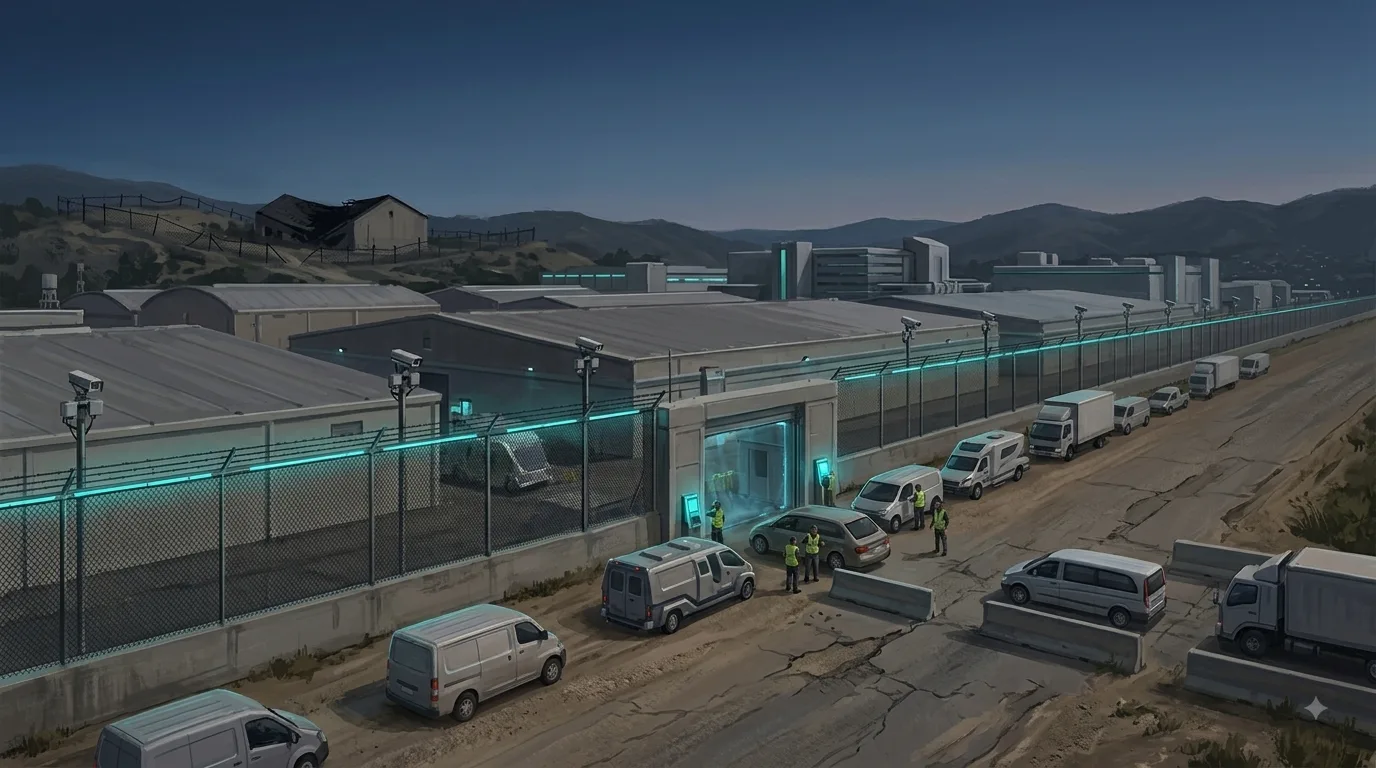
This is the industry's factory floor, where everything Sunset Strip and Hollywood is its front of house: the deals, the parties, the premieres. This is where the thing actually gets made, and it looks nothing like a boulevard. Radford Avenue in Studio City, over the hill from Hollywood proper, and Burbank's studio blocks north of it are now one continuous, badge-gated arcology cluster: walled soundstage complexes, backlots, and production offices behind a perimeter that has been thickening for thirty years, run by people who answer to nobody outside it.
It didn't used to be one place. Paramount held on in Hollywood proper longest of the majors, and Sunset Bronson and Sunset Gower took everyone else's overflow for a while after that. All three consolidated here through the 2050s, chasing the same badge-and-perimeter security the surviving majors already had at CBS Studio Center on Radford, and the cluster grew north to swallow Warner Bros. and Walt Disney Studios in Burbank rather than stopping at the old city line. 20th Century Fox's old backlot didn't get left behind so much as promoted: it was sold off in 1961, long before any of this, and became Century City, which is the other reason that district's geometry makes no sense as a city block. MGM's Culver City lot is the one that actually got left behind: too far south to fold in cheaply, and not worth the cost once everyone who mattered had already moved. It stands derelict now, stripped of anything a working lot needs, and what's left draws exactly the kind of attention a badge-gated cluster was built to keep out: unlicensed pressing outfits running salvaged gear in an old soundstage, squatters in the office blocks, and crews who know the fence line better than the studio that abandoned it.
One conglomerate holds most of what's inside the wall. Amalgamated Studios got here the same way it got Fun City: buying distressed lots outright while everyone else was retrenching, and it now owns or leases the majority of the working floor space on both sides of the hill. It is not yet a monopoly and the table should not play it as one: smaller outfits still lease bays, and Amalgamated's own board keeps hearing pitches from a data-and-media combine that hasn't made a serious move on the coast yet. Whether that changes is a later problem.
This is one of the city's arcology clusters, and it is worth knowing what that means here specifically before running a job inside one: see Los Angeles for the pattern, and Century City and Downtown for the other two the crew is likely to meet. Los Angeles never got Seattle's one Renraku-scale monolith. It got several smaller ones instead, none of them big enough to matter to the Corporate Court on its own, all of them run exactly like small countries.
What the crew knows#
- A studio badge gets you further inside than any forged executive ID. The perimeter is credentialed, unionized, and built to keep content out rather than people; a walk-on with the right lanyard is the easiest infiltration in the city.
- Content security is the real economy here. Studio anti-piracy screening is the best search on the continent and it points both ways: at what leaves and at what arrives. Simsense piracy interdiction pays better than almost anything else a crew can be hired for on this side of the hill.
- Burbank is a company town in every way that matters. Everyone on a soundstage crew, on the studio payroll or the union roster has been for a decade, and they all know each other's names. A stranger reads as a stranger inside an hour.
- The old MGM lot is nobody's ground now. No badge, no perimeter, no content security, and nothing left worth stealing except the equipment nobody bothered to move. What operates there now operates because nobody official is looking.
- Talent, technicians and rights lawyers move between the two halves constantly; the hill between Studio City and Burbank is a fifteen-minute drive that several thousand people make daily.
Getting in#
Every gate is badged, and the badge matters more than the vehicle behind it. On the studio-adjacent streets, production traffic parks wherever it likes, which makes a plain work vehicle less visible here than almost anywhere else in the city; the camouflage rules live on Getting Around.
The old MGM lot has no gate at all. Walk in through whatever fence line has already fallen down; somebody's already using at least one entrance regularly, and finding it is the recon.