Downtown
A corporate haven that failed, with a fortified core that didn't.
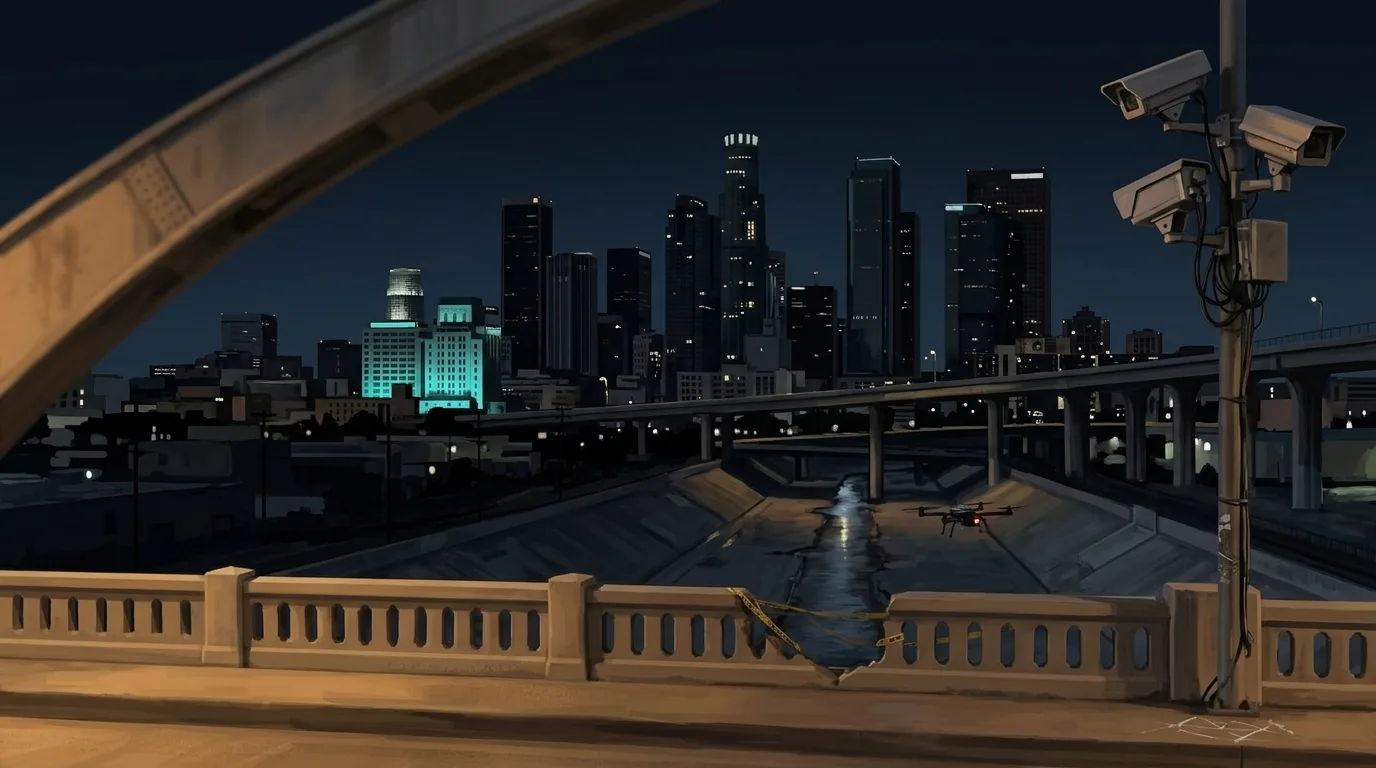
Downtown is two places, and the seam between them is a hill.
Bunker Hill still works. A dozen blocks on top of a literal hill, walled by its own parking structures, connected floor-to-floor by skybridges so the people who work there can cross downtown without touching a street. The Corporate Court keeps its local offices up here, along with the banks of record and the law firms that argue extraterritoriality for a living. This is the most secure ground in Los Angeles and the only part of the city where a corporation will admit to an address. It's one of the city's arcology clusters, the same species of ground as Century City or the studio arcology cluster in Studio City and Burbank: see Los Angeles for the pattern.
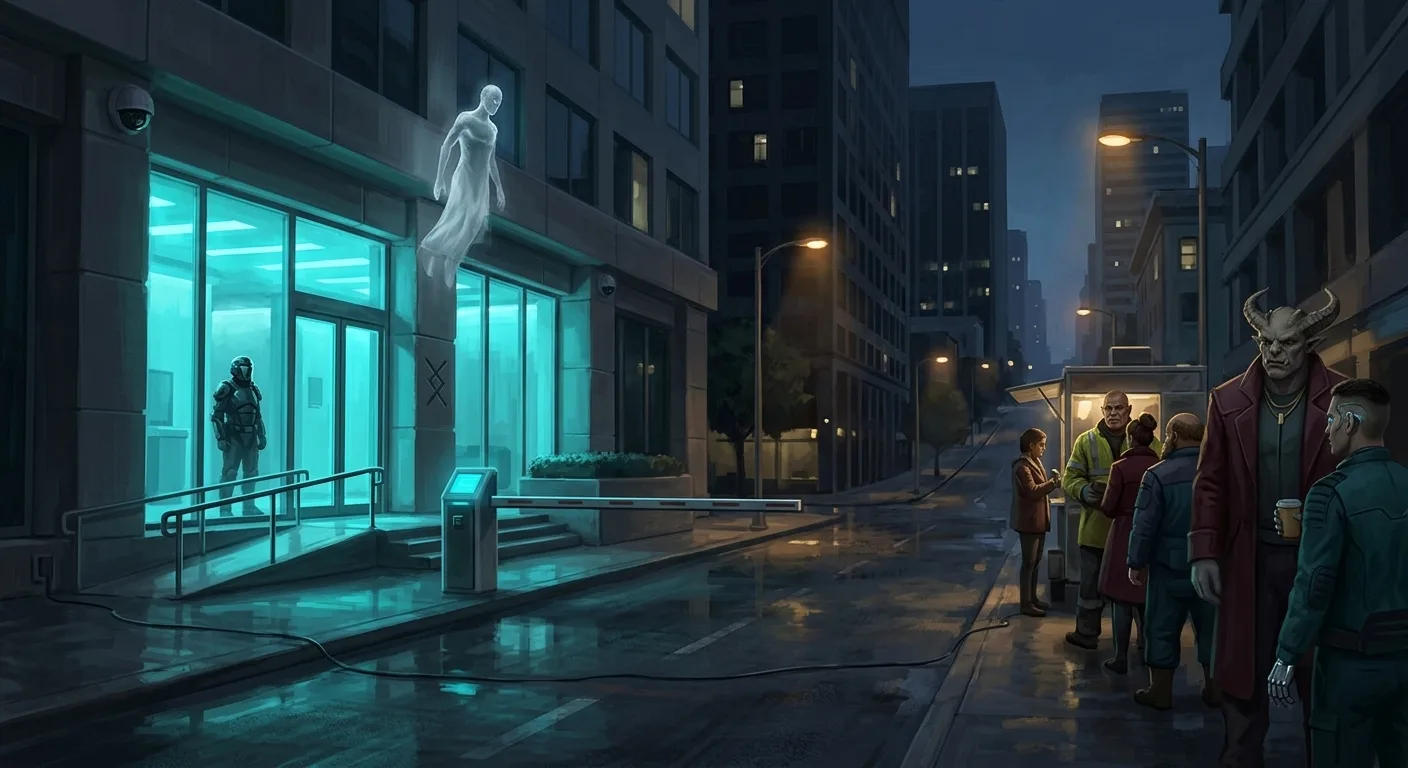
The rest of the office core failed. Everything down the slope (Figueroa, Seventh, Flower, the towers that were the tallest things west of Chicago) is half-empty and has been for a generation. The operations left for Century City decades ago, and after the Crash and the plague nobody replaced them. The buildings are still there, still structurally fine, and worth so little that ownership has stopped being a meaningful question on several of them: mortgages defaulted, holding companies dissolved, floors dark since before most of the crew was born.
Downtown's empty buildings are not slums, and the reason is architecture. An office slab is terrible housing: one service core, no plumbing run out to the rooms, floor plates so deep that the middle has never seen daylight. You cannot subdivide it into homes without rebuilding it, so the crowding in this city happened in Koreatown's walk-ups and courtyard apartments instead: buildings designed for dwelling, with a riser on every floor and light down a well. Residential stock stacks, and office stock just goes dark.
The exception is the old historic core, Spring and Broadway, where the pre-1930 buildings are narrow, windowed and built around small floor plates. Those converted decades ago and are densely lived in now: genuinely more like a stack than like the slabs four blocks west.
Water is the line. Habitation in any tall building stops at whatever floor the pumps still serve, which is usually low. Above that a tower is dry, and a dry floor is no use to anybody who wants to live there. It is extremely useful to anybody who wants to store something, grow something, run a lot of hot equipment, or hold a conversation nobody walks in on.
A staffed lobby under nine dead stories has four reasons behind it, and none of them are hospitality:
- One tenant is still paying. A law firm on four, a records office, some corp's two-person regional desk. The lease obliges the landlord to provide access, a lift and a desk, so the desk exists for them and nobody else.
- Liability is cheaper with a guard than without one. An unsecured high-rise means fires, falls, copper stripped out of the risers and a claim nobody can pay. A doorman costs less than the first incident.
- It is evidence of possession. This is the real one. A building being operated is a different legal animal from a building being abandoned: for title, for tax, and for not turning into Oceanwide Plaza, where ownership became a question nobody can answer. A landlord with a signed-in visitor log can prove continuous control, and one without can't.
- The address still means something. Shell companies need a Bunker Hill zip code and somebody who will say "yes, they're on nine." That service is the product, and the nine dead stories are irrelevant to it.
So Bunker Hill has the authority and the flats below have the space. Go uphill to find out who decided something, and downhill to find somewhere to do it.
Downslope of that: South Park, Crypto.com Arena, which everybody calls Staples Center, and Oceanwide Plaza facing it across the street, lighting the intersection off a screen nobody admits to owning. Those two buildings have the same legal problem and opposite outcomes, and the difference is that one of them has an operating company. Skid Row, the same poverty on the same blocks, and the longest-running mutual-aid network in the city: missions, clinics and kitchens that have been operating continuously for a hundred and forty years, and which did not stop for the plague. The Arts District warehouses, full of fabricators, chop shops, and workshops that need floor space and no questions. Little Tokyo, dense and working and a century old, where the Japanese corporate consumer presence is most visible because it's most profitable. The Fashion and toy districts, which are wholesale, informal, and where a container's contents get redistributed within a day.
At the bottom of the hill, Union Station is the inland border hall. Everything leaving the city by land leaves through it, and it's the reason the trains still run at all, since freight sets the timetable and the labor shuttles fit around it.
What the crew knows#
- Skybridges are a jurisdiction problem. Up on Bunker Hill you can cross from one company's building into another's without going outside, which means crossing a border without a checkpoint. The bridges are where credentials get checked, and they are the reason nobody walks up there.
- Angels Flight still runs the slope when it feels like it. Two cars, a hundred meters, and the fastest legitimate way from the flats to the top.
- Downtown has three kinds of empty and they are not interchangeable. Dark floors in live buildings: working lobby, working lifts, a security desk answering to a management company that may not exist, and nine unlit stories above. Common, cheap, and semi-legitimate; you can rent one badly. Dead towers: finished buildings whose mortgage defaulted and whose holding company dissolved, sealed or lightly squatted, a dozen or more of them, still technically somebody's. And unfinished, which is only Oceanwide Plaza.
- Roughly a third of the pre-2030 office core has been dark since before the plague. Title work costs more than the buildings are worth, so nobody is in a hurry to establish who owns what.
- The old gas company tower changed hands for a fraction of what it cost to build and then changed hands again. People still use it as a landmark for giving directions, which tells you how long it's been like this.
- The Court's local offices are not a courthouse. It's an embassy with a filing window, and the queue outside it is corporate lawyers.
- One Wilshire is why downtown still matters. Every fiber crossing the Pacific comes ashore and gets handed off in that one building. Half the towers around it are dark and that one has a waiting list. The office district failed; the interconnect didn't.
- Skid Row will feed you. Say what you actually need and don't lie to the people running the kitchen; they've heard it.
Getting in#
The flats are open city: walk, drive, or ride a labor shuttle in, which asks for a badge rather than a name. Bunker Hill is not: garage credentials, lobby biometrics, skybridge badges, and a patrol that treats the sidewalk as part of the building. There is no fence, because the parking structures and the grade change do the job.