The Coliseum
Ninety thousand seats, a city that can't license anything, and a card every Wednesday.
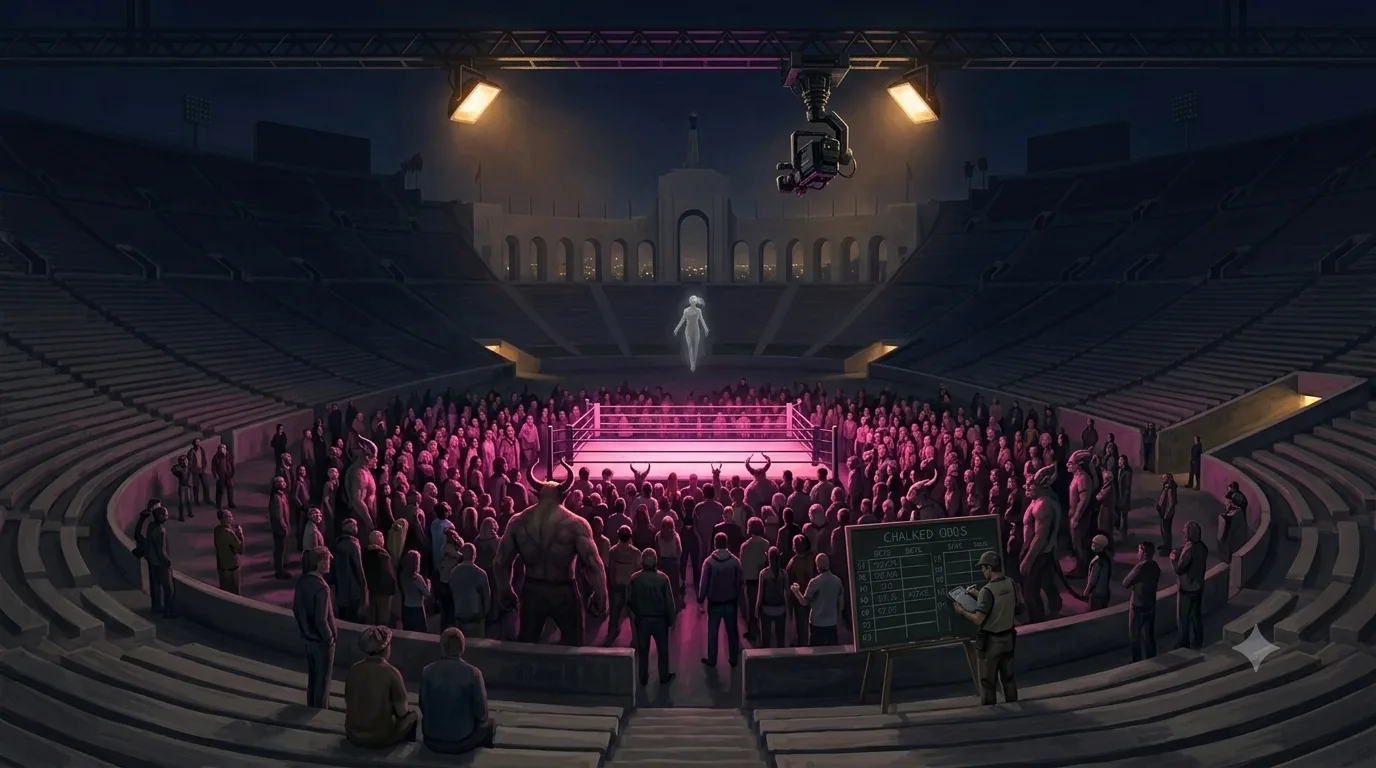
The Los Angeles Memorial Coliseum, Exposition Park, built in 1923 and refurbished for the 2028 Games: new seating, new structure at the peristyle end, a full seismic retrofit, handed over in the spring. The Games were the summer. The fault moved in the autumn.
It came through. Nobody owns it in a way that would survive a challenge: the university next door maintains the part it uses, a promoters' association maintains the part it needs, and the rest is standing there because 1923 concrete with a 2027 retrofit is the most over-engineered thing in the basin.
It is full most nights and the city would rather you didn't ask what for.
What it is now is the one venue big enough to host the things Los Angeles has no authority to license and no ability to prohibit. Ninety thousand seats means you don't need to fill it; you need eight thousand people in one bowl of it, which is a Tuesday.
The Wednesday card is the one that matters. Unsanctioned fights, wagered, with a promoters' association running the book and paying out the same night. It's a real business with real accounts: there's a scale at the weigh-in, a doctor at the apron, a schedule posted a week ahead, and somebody whose job is making sure the money is there. Nothing about it is furtive. There's simply no licensing body to have refused it.
The other nights are whatever pays: cage promotions, sanctioned-in-name-only boxing, a touring band, a religious revival, two market days, and one night a month of something the promoters describe on the schedule as "exhibition" and nobody asks about twice.
The other two venues, for contrast#
Los Angeles built three of these and the oldest is the one that works.
The arena downtown has its own page, because the naming alone earns one: the naming license expired in 2041 and the sign is still up, so the building advertises a dead company under a lapsed twenty-year deal while everybody calls it Staples Center after the brand before that. The sign says Crypto.com, two dead words and a period, and nobody in the building can define either of them. It works, it's booked, and it's where anything wanting to look legitimate goes, and that is why the Wednesday card isn't: a few hundred people around a ring don't need twenty thousand seats, and nobody bets in a building that issues invoices.
SoFi is a dirty lake. It was the best building in the region and it is now forty acres of standing water. The full story is on Inglewood.
The city's whole argument, in three buildings: the newest and most expensive one is underwater, the middle one is running somebody else's dead brand, and the one from 1923 is full every night.
What the crew knows#
- This is where the unaffiliated get seen. Anybody hard and unattached fights the Wednesday card sooner or later, which makes it the best hiring hall in the city for short-notice muscle. See Rival Crews.
- The promoters are not a gang and behave better than most employers. They pay on the night, in front of witnesses, because their entire business is people believing the money will be there. Cross them and you don't get hurt: you stop being on the card, and so does anybody who vouched for you.
- Eight thousand recording witnesses is a form of armor. A crowd this size, all of it filming, shuts down any pursuit that needs deniability. It's on the list of ways to lose a response team for exactly that reason: see Getting Around.
- The tunnels underneath are the useful part. Player tunnels, service ways, the old press and locker levels, and connections out to Exposition Park's own service loop. It's a building designed to move large numbers of people out fast, and that works in both directions.
- Fights, markets and revivals share the same parking lots, so a crowd here is never one kind of crowd, and nobody can tell from outside which one is on tonight.
- Nobody is armed inside the bowl, and there is no rule that says so: the promoters' own people enforce it, because a shooting would end the card permanently and everybody standing to make money that night knows it.
Getting in#
Walk in and pay. It's a public event in a public building with a posted schedule, and that makes it the least deniable place in the city to do business and the least watched.
For anything else, the service levels. Loading gates on the Menlo side, the old press entrance, and the tunnels: all of them staffed by people working a shift for a promoters' association rather than a security contract, which means they can be dealt with.