Crypto.com Arena
Two dead words and a period that stopped working after the Crash. Locals say Staples Center. It's the one venue in this city that still looks legitimate.
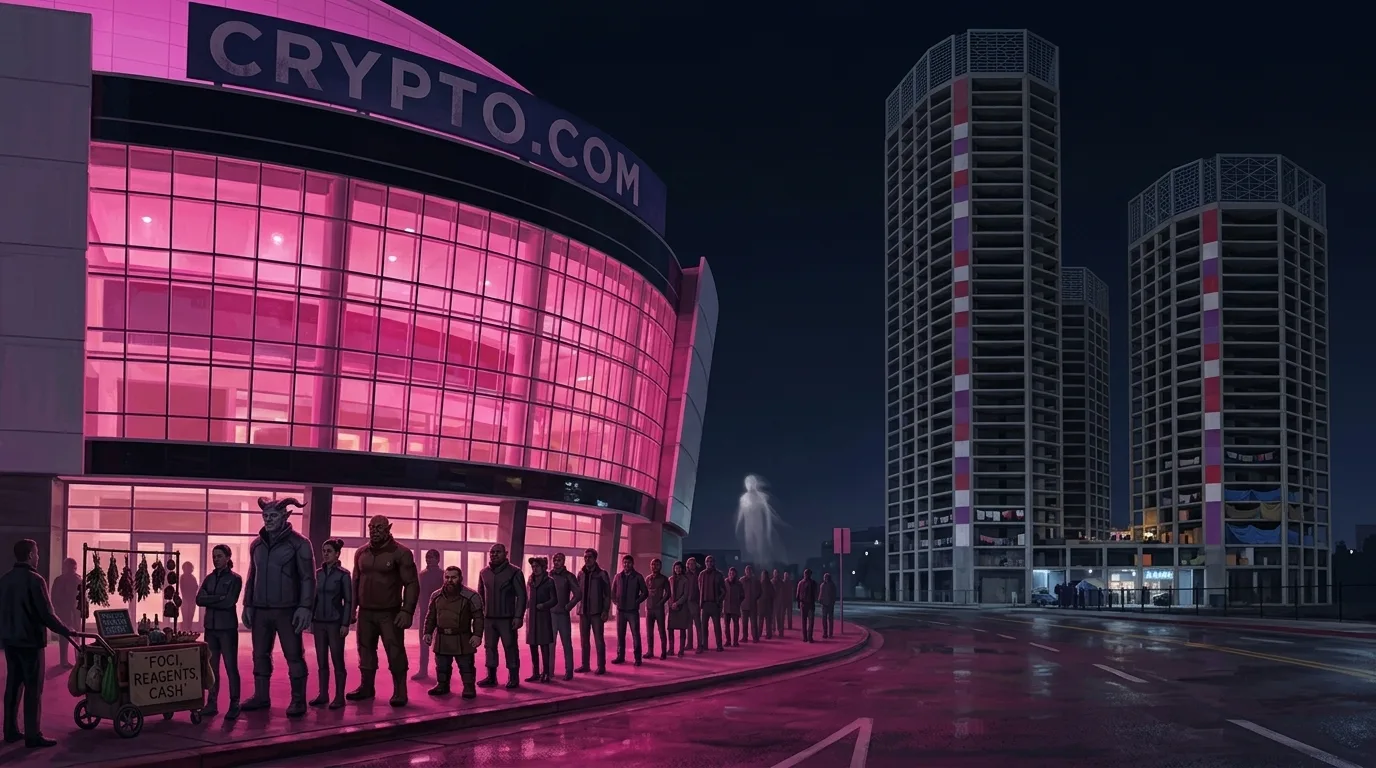
South Park, downtown, across the street from Oceanwide Plaza. Twenty thousand seats under a roof, and the roof is sound, because the arena got Games money in 2027 along with everything else that still works.
The name on the building expired in 2041 and nobody has taken it down.
The license was a twenty-year deal signed in 2021. It ran out in 2041, which is nineteen years ago. Renewal talks were open at the time and never concluded, and then the counterparty stopped existing in the Crash three years later, so there has been nothing to renew and nobody to renegotiate with since.
Legally the arena has no name at all. The operating company's own paperwork calls it the Arena, because that's all it can accurately call it.
Why nobody has bought the slot#
It is the obvious question, because advertising always wins and a naming slot on the biggest indoor room in a city of twenty million ought to sell itself. The operator has been trying to sell it since 2041. There is a folder.
The polite refusals cite the market, and the market is real: no SINs, no credit, no measurable audience, nobody a campaign could bill. The folder says something else. Since 2041 four approaches got past pricing, and not one reached a signature:
- 2046: the Silver Rim Group, a Pueblo casino operator, commissioned mock-ups of the frontage. The week its board met to vote, its flagship floor in Las Vegas flooded from a standpipe that inspection records say was dry.
- 2051: Meridian Broadcast, a Free State media brand, got to a letter of intent. The executive who championed the deal drowned the night before signature in a hotel pool, in front of witnesses, none of whom describe the water the same way twice.
- 2058: Pacific Crest Sportswear sent a due-diligence team of five. Two resigned inside a month, one was hospitalized after a fall down stairs the building doesn't have, and the file came back marked do-not-pursue with no reasons attached.
Corporate risk desks had a name for the pattern before anybody believed in magic: the Enron Field curse, after the Houston ballpark whose sponsor put its name up at the turn of the century and stopped existing inside two years, the first entry on a list the sports pages kept for decades of naming sponsors that died holding the rights. Back then it was a joke about hubris. This building has run the pattern twice on its own (the office brand was gone before the plague; the exchange died in the Crash), and in a city where magic is a documented fact, a pattern like that eventually gets assensed instead of laughed at.
The operator has paid for exactly that, twice. Both magicians took the fee, walked the building, and declined to produce a written report. The only advice either of them left in the folder is one line: leave the sign alone.
The one buyer that keeps coming back is Aztechnology. Openly, for the last ten years: a first approach through brokers around the time San Diego was sealed, then at intervals ever since, lately in its own name. Nothing unexplainable has ever happened to anyone Aztechnology sent. The operator keeps saying no, because the operator's only real asset is respectability and this is the one city where that name costs more than it pays: half the basin eats out of their shopfronts without knowing it, everybody knows who sealed San Diego, and a venue that survives on looking legitimate cannot wear that wordmark forty feet high without becoming a target for every person with family behind the cordon.
The corporate world put the two facts together years ago: the only bidder the curse has never touched is the one that has been bidding the longest. Nobody has proof, nobody has filed anything, and nobody puts it in writing. It gets said out loud in bars, and Aztechnology has never once sued anybody for saying it.
So the slot sits empty from both ends. Everyone who could afford it and isn't Aztechnology has concluded the slot is cursed, with the evidence on their side, and the one bidder the curse leaves alone is the one the operator can't afford to sell to. The old sign stays up because a legible name is how twenty million people find the building, and because a dead company's name is, per the folder, the only kind this building has ever carried without cost. The operator maintains it to exactly that standard: readable, never repainted, faded to a shape people recognize without reading.
Locals call it Staples Center, after the brand that held the naming rights before that one, because that's what their grandparents called it and names outlive their reasons.
Three names are in play and not one of them is current. The legal name is nothing. The sign says a brand whose license lapsed in 2041. The street says a brand that lapsed two decades before that. And the sign itself is two dead words and a period: nobody can define crypto, nobody can define com, and the dot between them is punctuation from an addressing system that stopped working in the Crash.
- Ask somebody at the bar what a staple is and the only person who answers is whoever has been stitched up recently, because a staple is what closes a scalp wound. Everybody knows that one. The paper fastener it was actually named after stopped mattering before the plague, along with the offices that needed any, so the word survived by changing what it points at, which means most of this city has quietly concluded the arena is named after a surgical supply, and nothing about that assumption has ever caused anybody a problem.
- Ask what crypto was and you'll get a shrug and a story about the Crash that isn't accurate.
- And nobody can tell you what the dot-com is doing there at all. It's a fragment of an addressing system that died with the open network (the Matrix is credentialed hosts, not names you could buy), so the sign carries punctuation from a way of finding things that hasn't worked in sixteen years. People read it as part of the word. Some of them pronounce it.
Everybody says one of them fluently and none of them wonder. That's what a name is in this city: a sound that outlived the contract, the company and the country that produced it.
The difference between this and the building opposite#
Look across the street. Oceanwide is three unfinished towers with no owner anybody can name and several thousand people living in them. The arena is the same era, the same city, the same legal fog: the ground is held by an entity nobody can serve papers on and the name on the front is an advertisement that expired in 2041.
The difference is one operating company, whose only real asset is an operating agreement nobody has ever challenged. It hires ushers, buys insurance, pays a roofing contractor, books acts and collects at the door. That's it. That is the entire reason one of these buildings has a box office and the other has a water queue.
Worth remembering the next time somebody explains that this city is ungovernable: it isn't ungovernable, it's unstaffed.
What actually happens here#
It's the respectable venue, which in a city that cannot license anything means the venue that looks like it has been licensed. Anything wanting to be seen being legitimate books here.
- Corporate everything. Product launches, recruitment drives, hospitality for people flown in who need to be shown that Los Angeles still functions. Knight Errant runs hiring days here and they are extremely well attended.
- Sport, sanctioned by leagues rather than by any government, because there is no government to sanction it. The distinction matters to nobody in the seats.
- Trideo and simsense production, and this is the interesting one. A crowd sim needs a crowd, controlled acoustics, riggable power and a building somebody can lock. This is the only room in Los Angeles that has all four, so the arena is permanently wired for it and there is a master store somewhere in the back of house. See Simsense.
- Two market weekends a year, a religious convention, and the graduation ceremonies of four institutions that no longer have campuses.
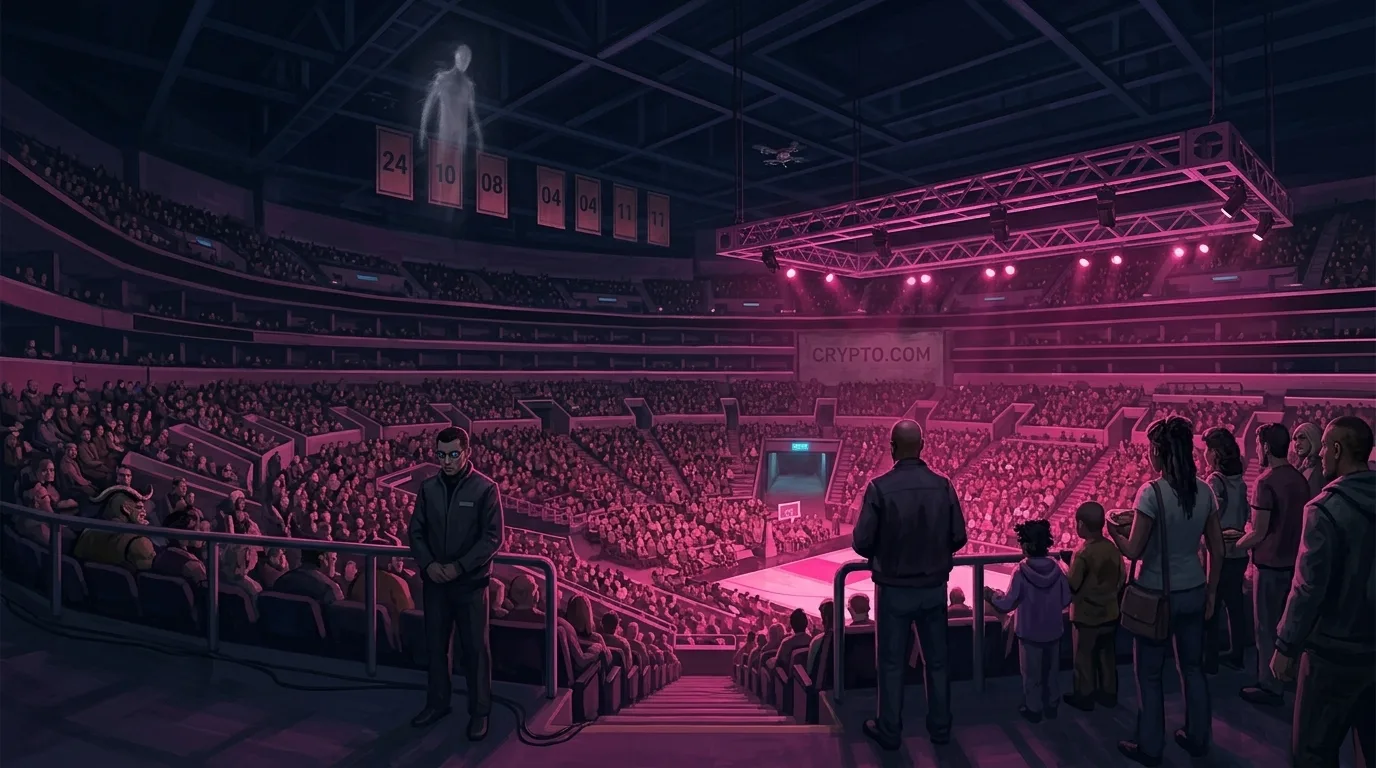
What doesn't happen here is the Wednesday card, for the dull reason that an unsanctioned fight night is a few hundred people around a ring, and this is a twenty-thousand-seat building with a booking calendar and an hourly rate. The card runs where a crowd that size can stand without renting anything, which is the Coliseum, four miles southwest.
What the crew knows#
- Everything here is ticketed, staffed and recorded, and that is the appeal rather than the obstacle. A crew that wants to be somewhere unremarkable in front of twenty thousand witnesses has exactly one venue.
- The operator's security is an operator's security, and there is a lot of it. Roughly four hundred people work a full house, a supervisor stands on every level, and the camera wall lives in a control room behind the north concourse. What they are good at is getting twenty thousand people out of a building safely. What it is made of is below.
- Back of house is the whole building. Loading docks on the Chick Hearn side, production corridors, dressing rooms, the rigging galleries, and a service level that connects to the parking lots. A production credential opens more of it than any badge.
- There are masters in there. Every crowd sim recorded in this building went to a store somewhere on the production level, and nobody has audited it since the operator changed hands.
- The arena and Oceanwide are four hundred feet apart, and people move between them constantly: day labor, vendors, and everybody working a shift on one and sleeping in the other.
- The signage is maintained to be legible and no further, because it's a wayfinding device now rather than an advertisement. Faded to a shape people recognize without reading.
- The naming slot is for sale and has been for nineteen years. Every serious buyer since 2041 walked away or got carried, except Aztechnology, who have been bidding openly for ten years and getting refused for reasons everybody understands. The street version of the story, that the curse is theirs and they're waiting the operator out, is told freely in every bar in South Park, and nobody has ever been sued for telling it.
What the security is made of#
Everything on the door is written against a stampede. Wands, hand searches, batons, restraints, a radio and a body cam, and the shift briefing is about exits and crush points. Nobody on the operator's payroll carries a long gun or wears armor past a jacket, because the insurer that underwrites this building has never been asked to price a firefight.
The astral is the layer that catches people, and almost nobody plans for it. Watchers cost the operator very little, so two of them ride the concourse for the length of every event, conjured by whoever holds the magical services contract this quarter. They can't stop you and they won't try. They watch, they report, and a crew that spent three days mapping cameras learns about them at the moment it least wants to. On the nights the gate justifies it the contract magician is here in person, in a folding chair behind the north tunnel with their eyes shut and a runner sitting beside them to keep the public off.
Against that, the Matrix side is old and nobody has audited it since the operator changed hands: the ticketing host, the credential system, and the badge readers at the tunnel mouths, patched for nineteen years by whichever contractor came in cheapest.
They escalate by telephone, and the number they call is Knight Errant's, so a firefight here buys you a clock rather than a fight: a site contract answered out of the regional office in Century City, eight miles west, into downtown traffic. Minutes rather than seconds, but not many of them, and whatever you came to do has to fit inside that number.
The night to be careful is the one where the client brings its own security, because a corporate launch arrives with a detail that is armed properly, armored properly, astrally covered, and running two drones parked up in the roof steel. They stand on the operator's floor, they don't answer to the operator, they have never seen this building before, and the two forces are not on the same radio channel. That last part is worth more than any door.
Back of house is thinner than the front. Everyone competent is out where the twenty thousand people are.
Getting in#
Buy a ticket. It's a public venue with a posted schedule and that remains the cheapest way into any building in this city.
Otherwise: the production entrance and the loading docks, which run on credentials issued by whoever is putting on tonight's event rather than by the arena. That's a different and much softer list, and it changes every night. A clipboard and a lanyard go a long way here for the same reason they go a long way on a studio lot.