Archetypes
The roles, an example 375,000¥ build for each, and a flowchart for picking one.
On this page (10 sections)
Anarchy 2.0 has no archetype list and no tag system, which between them are the two things people will tell you it has. The 2016 edition shipped pregenerated characters you picked from, and built characters out of Tags; 2.0 does neither. Every line on the sheet has a price in nuyen, you get a lump sum, and what you spent it on is what you are.
So your role (street samurai, decker, face, magician) is a shape you build rather than a box you tick. This page is both halves of that: what the roles do when a plan comes apart, and one worked example of what each costs.
We're starting at Runner level, so 375,000¥ each. Nothing here is binding. Bring something that isn't on the list and we'll build it.
What you are#
What you have to spend#
375,000¥ is the entire character, and creation and advancement use the same price list, so there's no separate build-time economy to game. Everything on the sheet starts at zero. A commlink with trodes and a fake SIN are free.
| Thing | Cost |
|---|---|
| Attribute, per point | 10,000¥, and the last point, at your metatype maximum, costs 20,000¥ |
| Skill, per point | 2,500¥ to rating 5, then 5,000¥ to rating 8 |
| Specialization | 2,500¥, needs rating 1 in the skill, and you may take as many per skill as you like |
| Knowledge skill | 2,500¥ |
| Shadow Amp, per rating point | 5,000¥, and that covers cyberware, adept powers, decks, drones, qualities and contacts |
| Spell | 5,000¥ |
| Armor, per point | 2,500¥ |
| Weapon | 2,500¥, or 5,000¥ for an expert weapon |
| Equipment | 2,500¥ |
Armor is the line on that list that trips everybody, because there are two different numbers called armor and only one of them is capped at 1. What you wear is a rating from 1 to 5, at 2,500¥ a point:
| Armor | Rating |
|---|---|
| Armored clothes | 1 |
| Armored clothing with a heavy coat | 2 |
| Light armor: armored vest, kevlar vest, lined coat | 3 |
| Heavy armor: full body armor, SWAT armor | 4 |
| Military armor | 5 |
| Ballistic shield | +1 |
Armor ratings don't stack. Wearing a vest under a lined coat gets you 3, not 6, and the only two things that add on top are a shield and a Shadow Amp. The amp bonus is the one capped at +1, so an armored jacket built as an Equipment amp can take you from 3 to 4 and no further. The cap is on the bonus rather than on the amp: buying two amps that each give Armour +1, one against physical and one against mental, is legal and sometimes sensible, but only one of them applies to any given attack. A ballistic shield still adds on top of all of it. Every starting package includes armor 3 and every pregen wears it; the one character in the books wearing 4 had custom work done.
Dermal armor, and the cheapest +1 in the game#
The books sell that +1 two ways, and neither is written for a troll:
| Amp | Rating | Cost | Essence |
|---|---|---|---|
| Dermal plating (cyberware) | 2 | 10,000¥ | −1 |
| Orthoskin (bioware) | 3 | 15,000¥ | −0.5 |
Both are base rating plus 1 for the Armour +1 effect, which is the whole of the arithmetic: cyberware starts at 1 and bioware at 2, and every amp is 5,000¥ a rating point.
This campaign sells a third, cheaper way: Dermal deposits, a Quality rather than an implant, at 5,000¥ and no Essence if it is the first Quality you buy. It has its own page with the arithmetic and the catches, along with anything else this campaign costed itself: Custom Shadow Amps.
Runner level also caps three things, and the caps come off later through play rather than by spending more:
- one attribute at your metatype maximum, no more
- skills no higher than rating 5
- Risk Reduction 1 for an attribute or a skill, RR 2 for a specialization, counting everything that stacks
The other two levels in the book are Ganger (300,000¥, nothing at max, skills to 4) and Prime Runner (450,000¥, two attributes at max, skills to 6). If the campaign ever wants one of those instead, say so at session zero; it's four numbers.
The book explains why money rather than experience: different roles need different things, so "gaining nuyen will reflect money and experience combined." Table Agreements rule 3, even shares, exists for the same reason: in this system nuyen is advancement, and a runner who out-earns the others out-equips and then out-survives them.
Metatype, and what the ratings mean#
Attributes run 1 to 4 for humans: 2 is average, 3 is strong, 4 is exceptional. Your metatype widens exactly one of them, and humans trade that for a point of Edge.
| Strength | Agility | Willpower | Logic | Charisma | Edge | Racial quality | |
|---|---|---|---|---|---|---|---|
| Human | 1-4 | 1-4 | 1-4 | 1-4 | 1-4 | 4 | none |
| Elf | 1-4 | 1-4 | 1-4 | 1-4 | 1-5 | 3 | low-light vision |
| Dwarf | 1-4 | 1-4 | 1-5 | 1-4 | 1-4 | 3 | thermographic vision |
| Ork | 1-5 | 1-4 | 1-4 | 1-4 | 1-4 | 3 | low-light vision |
| Troll | 1-6 | 1-4 | 1-4 | 1-4 | 1-4 | 3 | thermographic vision |
The racial quality is free and narrative only. Ork low-light vision means you ignore a Disadvantage for fighting at night; it doesn't buy you a bonus on a long shot.
Skills run 0 to 8: untrained, 2 trained, 4 professional, 6 expert, 8 elite. Rating 5 is your ceiling this level, and a specialization adds +2 on top when it applies, so a specialized skill can effectively hit 7. At 2,500¥ that is the cheapest capability on the price list, and most builds are better off with three specializations than with one more skill point.
Five skills come up in nearly every session regardless of role: Athletics, Stealth, Perception, Influence, Network. Zero in any of them will hurt eventually. Athletics is also your ranged defense, which is to say it's how you don't get shot.
You also pick five Keywords, four Dispositions and four Cues. None of them costs anything and all three do mechanical work.
Keywords are the five phrases that say what you are: metatype and social class, where you're from, your role, your lifestyle, and one open slot for anything else that defines you. They double as knowledge skills, and so does any skill at rating 4 or better, so "Longshore", "ex-Ares" and "Boyle Heights" are all things you now know about for free.
Dispositions are four personality traits, and they are not supposed to be four virtues: a motive, a shortcoming, an addiction, a grudge with a name on it. Cues are four things you actually say, the lines that come out under stress or when you're pleased with yourself.
Both feed Edge, in both directions. Spend an Edge to claim an Advantage when a Disposition or Cue applies, and gain an Edge when one of them walks you into a bad decision. That second half is why the interesting sheets have flaws on them: four admirable Dispositions give away half the economy, and the book says outright that the ambiguous ones are the best ones.
The three packages#
If spreading 375,000¥ across nine price lines sounds like an evening you'd rather not have, the book pre-slices it. Points here are in each category's own currency: attribute points cost 10,000¥, skill points 2,500¥, amp points 5,000¥.
| Package | Attributes | Skills | Amps | Everything else |
|---|---|---|---|---|
| Balanced | 14, one at max | 35 | 24 | commlink, fake SIN, armor 3, 2 standard weapons, 2 equipment |
| Magician | 14, one at max | 35 | 18 | commlink, fake SIN, armor 3, 1 standard weapon, 3 equipment, 6 spells |
| Fighter | 14, one at max | 35 | 22 | commlink, fake SIN, armor 3, 4 standard weapons, 1 specialist weapon, 2 equipment |
All three come to exactly 375,000¥. They're a starting shape rather than a straitjacket: nuyen moves between categories freely as long as the total holds, at these rates.
| 1 attribute point | 10,000¥ | 2 amp points, or 4 skill points |
|---|---|---|
| 1 amp point | 5,000¥ | a spell, or 2 skill points, or 2 pieces of equipment |
| 1 skill point | 2,500¥ | a specialization, a knowledge skill, a point of armor, a weapon |
So the Balanced package's 24 amp points are 120,000¥, or just under a third of you.
Shadow Amps, which is nearly everything interesting#
An amp is anything on the sheet that isn't a bare attribute, a skill or ordinary gear. Your cyberware is amps. So is your bioware, each adept power, your Awakened talent, your deck, every drone, every named contact, and every quality.
You build one by taking a type, which sets a base rating, then adding effects, each of which adds to that rating. Multiply the total by 5,000¥.
| Amp type | Base rating |
|---|---|
| Quality | 0 for your first, 3 for each one after |
| Awakened | 0, and every capability you add raises it |
| Cyberware | 1, and Essence -1 |
| Bioware | 2, and Essence -0.5 |
| Adept power | 1 |
| Equipment | 0, and you buy the item itself first |
| Cyberdeck | 1, giving Firewall 1 and Attack 0 |
| Vehicle or drone | 1, giving Pilot 6, Armour 0, and 12 points across Body, Handling and Speed |
| Contact | 0 |
The effects worth knowing before you start:
| Effect | Rating cost |
|---|---|
| Risk Reduction 1 on a specialization | +2 |
| Risk Reduction 1 on a skill | +5 |
| Risk Reduction 1 on an attribute | +10 |
| Damage value +1, to a maximum of +2 | +1 |
| Armor +1, maximum +1 | +1 |
| An additional light wound box, maximum +1 | +3 |
| Initiative: +1 Edge per action scene, and unlimited extra actions at 1 Edge each | +2 |
| The next initiative tier, +1 action per narration | +3 |
Most of your amp points are really buying Risk Reduction. On any test you may swap plain dice for risk dice: risk dice hits count double, and every 1 rolled on one is a glitch. Each level of RR lets you ignore one of those 1s. So an amp buys you the option of rolling more risk dice on whatever it covers. One level of RR per amp per attribute or skill, and Runner level caps you at 1 anyway (2 on a specialization).
Two examples from the book, both worth copying. A smartlink is cyberware, base 1, plus RR 1 on Ranged Weapons at +5: rating 6, so 30,000¥ and a point of Essence. A useful contact is base 0 plus RR 1 on Network (street) at +2: rating 2, so 10,000¥.
Qualities are the one thing with a deadline. They can only be bought at creation, or later after a major event and only if the GM agrees, so if your character has an innate knack, buy it now. Your first is base 0 and the rest start at 3, so a second quality costs 15,000¥ before it does anything.
Amps aren't taken away permanently. One can be destroyed, jammed or confiscated, and it comes back next scene or next adventure without being bought again. Maintenance is already in the price: the sam has a street doc, the rigger has spares.
Essence is the exception to all of that, because it never comes back. You start at 6, every cyberware amp takes 1 and every bioware amp 0.5, and the losses bite in steps: at 5 you lose a hit on every magic-related test, at 4 a hit on every test to heal you, at 3 magic again, at 2 healing again, at 1 a Disadvantage on most social tests, at 0 you die. So four cyber implants means Dr. Kwon is working uphill on you every time, which is a real cost in a city where she is the only medicine you have.
The roles#
These are the roles the books actually ship a character for, and each one ends with at least one full 375,000¥ build. Several have three or four, because the books do: there are three street samurai, four deckers and four riggers, and the differences between them are more instructive than any of them alone.
Every list below is an example, not a template. None of them is a class, a package you have to take, or the best version of that role. They exist so you can see where the money actually goes, argue with a specific number instead of a blank page, and start by editing something rather than by dividing 375,000 by nine. Change any line, move nuyen between categories, take a different metatype, ignore the whole thing and hand me a list of your own.
All 23 are the books' own pregenerated characters, priced out line by line, with their Seattle contacts swapped for people who exist here. Every one of them lands on exactly 375,000¥, which is the best evidence on this page that the price list is the whole game.
Reading the middle column: a bare number is a Shadow Amp rating, at 5,000¥ a point. Everything else says what unit it's in, because armor, weapons, equipment, spells and knowledge skills are their own lines on the price list rather than amps.
Street samurai. Bought muscle: reflexes, bone, a smartlink, and the training to use all three. You're the reliable answer to a room going bad, and the only person at the table who can plan on winning a fight. Here, that means you're also the walking reason nobody wants you at a licensed venue, because every part of you shows up on a scan. The trap: violence is expensive in a city with no ambulance service worth the name, and the best runs are the ones where you never draw. Bring a second thing you're good at.
Example build: Wild Jane, ork street samurai, Essence 3.5
| Item | Rating | ¥ |
|---|---|---|
| Strength 3, Agility 4 (ork max), Willpower 2, Logic 2, Charisma 3 | 14 points | 150,000 |
| Ranged Weapons 5 (rifles), Perception 4 (physical), Athletics 3 (ranged defense), Close Combat 3 (unarmed), Influence 3 (intimidation), Network 3 (government), Piloting 2 (cars), Stealth 2 (physical sneaking) | 33 points | 82,500 |
| Cybernetic eyes (cyberware): smartlink RR 1 Ranged Weapons, vision enhancement RR 1 Perception (physical), low-light, camera | 8 | 40,000 |
| Wired reflexes (cyberware): +1 Edge per action scene, +1 action per narration, no cap on extra actions | 6 | 30,000 |
| Reflex recorders (bioware): RR 1 Close Combat (unarmed) | 4 | 20,000 |
| The shotgun, as an Equipment amp: customized stock, RR 1 Ranged Weapons (rifles) | 2 | 10,000 |
| Reinforced sedan (vehicle): Body 6, Armour 1, front weapon mount | 2 | 10,000 |
| A district-office clerk (contact): RR 1 Network (government) | 2 | 10,000 |
| Kevlar vest | 3 points of armor | 7,500 |
| Stun gloves, heavy pistol, shotgun | 3 weapons | 7,500 |
| Grenade launcher | expert weapon | 5,000 |
| Stim patches | equipment | 2,500 |
| Total | 375,000 |
Example build: Drakk, troll street samurai, Essence 2
The only character in either book wearing armor 4, and it had to be custom-made to fit him. Three of his amps are drugs, which is where a troll who is already the biggest thing in the room spends money instead of on more muscle.
| Item | Rating | ¥ |
|---|---|---|
| Strength 5, Agility 3, Willpower 3, Logic 2, Charisma 2 | 15 points | 150,000 |
| Close Combat 5 (blades, unarmed), Athletics 4 (ranged defense), Influence 4 (intimidation), Ranged Weapons 4, Survival 4 (navigation), Perception 3, Network 2, Piloting 2 (bikes), Stealth 1 | 35 points | 87,500 |
| Berserker (Equipment amp): a BTL. DV +1 in melee and RR 1 Close Combat, at the price of taking a High or Extreme risk on every action until the scene ends | 4 | 20,000 |
| Synthetic cyberarm with a heavy pistol inside it (cyberware): RR 1 Ranged Weapons (pistols) | 4 | 20,000 |
| Jazz (Equipment amp): a drug. +1 Edge per action scene, +1 action per narration, no cap on extra actions, and a Disadvantage through the scene after it wears off | 3 | 15,000 |
| Counterfeit datajack (cyberware): direct neural interface, BTL-only hot-sim | 2 | 10,000 |
| Combat bike (vehicle): Pilot 6, Body 5, front weapon mount, customized to look like a unicorn | 2 | 10,000 |
| Two weapon combat style (quality, your first): RR 1 Close Combat (blades) | 2 | 10,000 |
| An antiquarian (contact): RR 1 Network (street) | 2 | 10,000 |
| Bliss (Equipment amp): a drug. Ignore wound modifiers, Disadvantage on anything Willpower | 1 | 5,000 |
| Auto-injector (cyberware): dose yourself on a mental command, and the other three become worth carrying | 1 | 5,000 |
| Custom-made armor | 4 points of armor | 10,000 |
| Two swords, heavy pistol, throwing knife, assault rifle | 5 weapons | 12,500 |
| Bliss, Jazz, Berserker, and a role-playing kit: dice, books, pen and paper | 4 equipment | 10,000 |
| Total | 375,000 |
Example build: Sledge, ork street samurai, Essence 1
Two of his contacts are rating 0, which costs nothing and does nothing mechanically: a weapons dealer and a cop who is also an ork are just people he knows. Worth copying. A contact only needs a rating if you want to roll better because of them.
| Item | Rating | ¥ |
|---|---|---|
| Strength 5 (ork max), Agility 3, Willpower 3, Logic 2, Charisma 2 | 15 points | 160,000 |
| Close Combat 5 (blades), Ranged Weapons 4 (pistols), Athletics 3 (ranged defense), Influence 3 (intimidation), Network 3 (street), Perception 3 (physical), Stealth 3, Survival 2 (composure) | 33 points | 82,500 |
| Evo cybereyes (cyberware): visual interface, night vision, camera, smartlink RR 1 Ranged Weapons | 6 | 30,000 |
| Obvious cyberarms (cyberware): retractable spurs, expert system RR 1 Close Combat (blades) | 4 | 20,000 |
| A custom katana (Equipment amp): monowire DV +1, RR 1 Close Combat (blades) | 3 | 15,000 |
| Ares Predator V (Equipment amp): smartgun RR 1 Ranged Weapons (pistols), burst fire | 3 | 15,000 |
| Reaction enhancer (cyberware): +1 Edge per action scene, no cap on extra actions | 3 | 15,000 |
| Bruiser (quality, your first): RR 1 Influence (intimidation) | 2 | 10,000 |
| An old chopper (vehicle): Pilot 6, Body 5, front weapon mount | 1 | 5,000 |
| A weapons dealer, and a cop who is also an ork | 2 contacts at 0 | 0 |
| Armor vest | 3 points of armor | 7,500 |
| Spurs, katana, heavy pistol, assault rifle | 4 weapons | 10,000 |
| Trauma patch, smoke grenades | 2 equipment | 5,000 |
| Total | 375,000 |
Physical adept. Magic in the body and nothing outside it: you move, hit and endure in ways that don't survive being written down. The most useful property is that you pass. No ware, no foci, nothing a scanner flags, and you look like somebody's cousin. The trap: no ranged answer and nothing to sell. All your capability is in you and you can't lend it to anybody. One thing to know before you commit: adept powers are the capability background count interferes with, and Los Angeles runs hot.
Example build: Mictlan, elf physical adept, Essence 5
The Awakened amp at rating 2 buys Adept plus astral perception. Without the perception an adept is blind to the half of this city that matters.
| Item | Rating | ¥ |
|---|---|---|
| Strength 3, Agility 4 (elf max), Willpower 2, Logic 2, Charisma 3 | 14 points | 150,000 |
| Athletics 5 (parkour), Close Combat 5 (whips), Stealth 5 (physical sneaking, lockpicking), Influence 4 (etiquette), Network 4 (corporate), Perception 4 (physical) | 34 points | 85,000 |
| Awakened: Adept, astral perception | 2 | 10,000 |
| Cybernetic ears (cyberware): RR 1 Athletics (parkour), RR 1 Perception (physical) | 5 | 25,000 |
| Light-footed (adept power): RR 2 Stealth (physical sneaking) | 5 | 25,000 |
| One with the ropes (adept power): RR 1 Close Combat (whips) | 3 | 15,000 |
| Reflexes boost (adept power): +1 Edge per action scene, no cap on extra actions | 3 | 15,000 |
| The whip, as a weapon focus (Equipment amp): RR 1 Close Combat (whips), works on astral targets | 3 | 15,000 |
| Infiltration kit (Equipment amp): RR 1 Stealth (lockpicking) | 2 | 10,000 |
| A relative inside a corporation (contact): RR 1 Network (corporate) | 2 | 10,000 |
| Lined vest | 2 points of armor | 5,000 |
| Whip | weapon | 2,500 |
| Infiltration kit, grapple launcher, binoculars | 3 equipment | 7,500 |
| Total | 375,000 |
Magician. Spells, spirits, the astral. You see what nobody else in the crew can see, so you're the one who notices the problem before it happens. Magic has been public since 2030, so this is a licensed profession, and you don't have a license. The trap: you're fragile, you're conspicuous the moment you work, and astral security is the one kind this city can actually afford. Watchers are cheap. And magic costs you: every Sorcery and Conjuring test causes Drain, which rides on your glitches: a minor glitch is a disadvantage on magical activity, a critical glitch is a light wound, a disaster puts you down.
The Awakened amp is where the money goes, and it's assembled from parts rather than bought whole. Astral perception is +1, perception with projection +2, Sorcery +1, Conjuring +2, Adept +1. Five of the combinations are standard, and the cheap ones are cheap enough to bolt onto a character whose main job is something else:
| Awakened build | Amp | Cost |
|---|---|---|
| Full magician: astral perception and projection, Sorcery, Conjuring | 5 | 25,000¥ |
| Conjurer, conjuring aspected: astral perception, Conjuring | 3 | 15,000¥ |
| Sorcerer, spellcasting aspected: astral perception, Sorcery | 2 | 10,000¥ |
| Clairvoyant, astral aspected: astral perception and projection | 2 | 10,000¥ |
| Adept | 1 | 5,000¥ |
A shamanic mask, where your magic is visible to anyone watching you work, is a negative effect: it takes 1 off the amp's rating and gives you a Disadvantage on Stealth when you try to hide what you're doing.
Two ways to be one, and 2.0 treats it as real: every Awakened character has a tradition, and it changes how you use mana rather than what you can do. Both shape spells, conjure and banish spirits, and arrive at the same end product: the tradition governs the how.
Mentor spirits have their own rules, so following one carries mechanical weight rather than being a line of backstory. Two things about them that older Shadowrun will mislead you on: any Awakened character can take one, whatever their tradition, and nobody has to. A mentor is a Quality amp you buy like any other, typically rating 2 to 5, and the only obligation is that what it wants shows up in your Dispositions. Bear asks for RR on healing and unarmed and gives you Rage in exchange. Earlier editions made a totem compulsory for shamans and forbade it to mages; 2.0 does neither.
A tradition is nobody's birthright: it's what you learned, not where you're from. Mechanically it does one thing, and you'll feel it every session: your tradition decides which attribute Conjuring runs on. Hermetics summon on Logic, shamans on Charisma. Sorcery is Willpower for everybody.
- Hermetic mage. Magic as a discipline you studied and wrote down. Your spirits arrive looking like the thing they're made of: a rough humanoid of fog, of troubled water, of earth and stones, and a fire spirit that sometimes turns up as a salamander instead.
- Shaman. Magic as a relationship you keep in repair. Your spirits take their shape from the ground you called them on, so the same spirit of air is a dust column in a river bed and a gust of spray off a breakwater, and if you follow a mentor your fire spirits wear its face.
Older Shadowrun handed mages elementals and left a shaman's spirits in whatever ground they happened to be standing on. Neither restriction survived into 2.0: either tradition can summon any of the seven types anywhere, and tradition changes only how the thing looks when it gets here. Both buy foci, as well. The book's own shaman pregen owns a sustaining focus, an infiltration kit and a magic lodge, so don't build one expecting to travel light.
Neither is stronger. They differ by one attribute and a lot of description. Pick the one you'd enjoy talking about.
Example build: Shades, human hermetic mage, Essence 3
Two foci carry most of the capability, and note the giveaway that she's hermetic rather than shamanic: her Conjuring rolls on Logic.
| Item | Rating | ¥ |
|---|---|---|
| Strength 2, Agility 2, Willpower 4 (max), Logic 3, Charisma 3 | 14 points | 150,000 |
| Sorcery 5 (detection spells, illusion spells), Conjuring 5, Network 5 (corporate, plus government unspecialized), Influence 3 (intimidation), Perception 3 (physical unspecialized), Stealth 3, Athletics 2 (ranged defense), Close Combat 2 (astral combat), Ranged Weapons 1 (pistols) | 36 points | 90,000 |
| Awakened: astral perception and projection, Sorcery, Conjuring | 5 | 25,000 |
| Sorcery focus (Equipment amp): RR 1 Sorcery (detection spells), RR 1 Sorcery (illusion spells) | 4 | 20,000 |
| Cybereyes (cyberware): RR 1 Perception (physical) | 3 | 15,000 |
| Sustaining focus (Equipment amp): hold one extra spell without penalty | 2 | 10,000 |
| A corporate director you used to work for (contact): RR 1 Network (corporate) | 2 | 10,000 |
| A lawyer who is also your lover (contact): RR 1 Network (government) | 2 | 10,000 |
| Six spells: Manabolt, Mask, Chimera, Analyze Truth, Borrow Senses, Heal | 30,000 | |
| Light armor vest | 3 points of armor | 7,500 |
| Heavy pistol | weapon | 2,500 |
| Sorcery focus, sustaining focus | 2 equipment | 5,000 |
| Total | 375,000 |
Example build: [Trash](people/trash.md), elf shaman, Essence 6
Note what this one does with the package: 15 attribute points instead of 14 and only 15 amp points, which is a legal trade and a good illustration that the packages bend.
| Item | Rating | ¥ |
|---|---|---|
| Strength 2, Agility 3, Willpower 4, Logic 2, Charisma 4 | 15 points | 160,000 |
| Conjuring 5 (spirits of beasts), Sorcery 5 (manipulation spells), Influence 4 (impersonation, etiquette), Athletics 3 (ranged defense), Perception 3 (astral), Stealth 3 (palming, lockpicking), Survival 3, Network 2 (medical), Ranged Weapons 2, Close Combat 0 (astral combat) | 37 points | 92,500 |
| Awakened: astral perception and projection, Sorcery, Conjuring | 5 | 25,000 |
| Raccoon mentor spirit (quality, your first): RR 1 Stealth (palming), RR 1 Sorcery (manipulation spells), and a disposition it hands you | 4 | 20,000 |
| Infiltration kit (Equipment amp): RR 1 Stealth (lockpicking) | 2 | 10,000 |
| Sustaining focus (Equipment amp): hold one extra spell | 2 | 10,000 |
| A street doc (contact): RR 1 Network (medical) | 2 | 10,000 |
| Six spells: Lightning, Detect Life, Phantasm, Control Thoughts, Shaping, Magic Fingers | 30,000 | |
| Armored coat | 3 points of armor | 7,500 |
| Taser | weapon | 2,500 |
| Infiltration kit, sustaining focus, a lodge | 3 equipment | 7,500 |
| Total | 375,000 |
Example build: Coydog, elf street shaman, Essence 6
Eight spells, where the magician package budgets for six, paid for by carrying no weapon at all and taking the cheapest vehicle anywhere on this page.
| Item | Rating | ¥ |
|---|---|---|
| Strength 2, Agility 3, Willpower 4, Logic 2, Charisma 4 | 15 points | 160,000 |
| Conjuring 5 (spirits of air), Sorcery 5 (manipulation spells), Stealth 4 (astral sneaking), Influence 3 (impersonation), Athletics 2 (ranged defense), Close Combat 2 (astral combat), Perception 2 (astral), Network 2, Survival 2 | 34 points | 85,000 |
| Awakened: astral perception and projection, Sorcery, Conjuring | 5 | 25,000 |
| Coyote mentor spirit (quality, your first): RR 1 Influence (impersonation), RR 1 Sorcery (manipulation spells), and the Mischievous disposition that comes with him whether you wanted it or not | 4 | 20,000 |
| Eagle feather pendant (Equipment amp): a minor air focus, RR 1 Conjuring (spirits of air) | 2 | 10,000 |
| A pick-up (vehicle): Pilot 6, Body 7, front weapon mount | 1 | 5,000 |
| Her brother, a ganger (contact): RR 1 Network (street) | 2 | 10,000 |
| The talismonger who taught her (contact): RR 1 Network (magic) | 2 | 10,000 |
| Eight spells: Manabolt, Lightning Bolt, Telekinetic Fingers, Control Thoughts, Mask, Confusion, Invisibility, Heal | 40,000 | |
| Bulletproof clothes | 3 points of armor | 7,500 |
| The pendant | equipment | 2,500 |
| Total | 375,000 |
Example build: Le Brumeur, ork mistwalker, Essence 5
The only sheet in either book that takes the cheap Awakened option from the table above: sorcerer aspected, astral perception and Sorcery for 2 points, no projection and no Conjuring. Spirits never turn up because he cannot call them, and what he saved bought nine specializations, the most on this page.
| Item | Rating | ¥ |
|---|---|---|
| Strength 4, Agility 3, Willpower 4 (ork max), Logic 2, Charisma 2 | 15 points | 160,000 |
| Perception 5 (astral), Sorcery 5 (detection spells), Athletics 4 (ranged defense), Close Combat 4 (blades), Stealth 4 (physical sneaking), Survival 4 (navigation), Influence 2, Network 2 (magic), Piloting 2 (water vehicles), Ranged Weapons 2 (rifles) | 43 points | 107,500 |
| Mystic tattoo (quality, your first): RR on his detection work | 4 | 20,000 |
| Cybernetic forearm (cyberware) | 3 | 15,000 |
| Awakened, sorcerer aspected: astral perception and Sorcery | 2 | 10,000 |
| A fisherman's knife with a carved handle (Equipment amp) | 2 | 10,000 |
| A modified boat (vehicle) | 1 | 5,000 |
| A modified shotgun (Equipment amp) | 1 | 5,000 |
| A pirate, and a talismonger | 2 contacts at 0 | 0 |
| Five spells: Detect Magic, Detect Enemies, Manabolt, Mana Barrier, Astral Armor | 25,000 | |
| Armored jacket | 3 points of armor | 7,500 |
| The knife, the shotgun | 2 weapons | 5,000 |
| Gas mask, medkit | 2 equipment | 5,000 |
| Total | 375,000 |
Occult investigator. The Awakened one who does legwork rather than artillery: assensing a scene, reading an astral signature, asking a spirit who was here, knowing which of the four things a client told you is a lie. In a city with a background count nobody has explained and no institution that will investigate anything, this is the role with the most unanswered questions in front of it. The trap: you are a detective on a crew of burglars, so you need the table to want the mystery. Say so early, and expect to be the one who says "wait" while everyone else is ready to leave.
Example build: Luna, ork occult investigator, Essence 6
No purchased weapon at all. The tattoo focus at rating 13 is the single most expensive amp on this page: it's a second quality, so it starts at base 3, and it carries four separate Risk Reductions.
| Item | Rating | ¥ |
|---|---|---|
| Strength 2, Agility 2, Willpower 4 (ork max), Logic 3, Charisma 3 | 14 points | 150,000 |
| Sorcery 5 (detection spells), Perception 4 (astral), Network 4 (magic), Conjuring 3 (banishing), Influence 3 (negotiation), Athletics 2 (ranged defense), Close Combat 2 (astral combat), Stealth 2 (astral sneaking) | 33 points | 82,500 |
| Awakened: astral perception and projection, Sorcery, Conjuring | 5 | 25,000 |
| Mentor spirit (quality, your first): RR 1 Sorcery (detection spells) | 2 | 10,000 |
| Mystic tattoo focus (quality, your second, so base 3): RR 2 Perception (astral), RR 1 Stealth (astral sneaking), RR 1 Close Combat (astral combat), RR 1 Conjuring (banishing) | 13 | 65,000 |
| The tattooist whose booth you rent (contact): RR 1 Network (magic) | 2 | 10,000 |
| Armored coat | 3 points of armor | 7,500 |
| Five spells: Mask, Chimera, Detect Magic, Analyze Magic, Heal | 25,000 | |
| Total | 375,000 |
Decker. The Matrix, on a cable. This is 2060: no wireless, no ambient overlay, no working from a rooftop. A jackpoint is a physical place, so a decker is a body in a van, or a body in a cupboard on the seventh floor. That's the job: half infiltration, half Matrix, and your problem is always getting to the socket. The trap: the table waits while you work, so keep it short and loud. And a wired decker can be found by walking around, and that is how the opposition will do it.
Two purchases are mandatory rather than advisable: nobody without a cyberdeck may roll Cracking at all, and the deck needs a direct neural interface, which is cyberware. Deck prices run from an Erika MCD-6 at rating 3 (15,000¥) through an MCT 360 at 11 (55,000¥) to a Fairlight Excalibur at 30 (150,000¥), which is out of reach at this level.
Example build: Gambit, human decker, Essence 5
This build spends 130,000¥ on amps, more than the Balanced package allows, and pays for it with 32 skill points instead of 35.
| Item | Rating | ¥ |
|---|---|---|
| Strength 2, Agility 3, Willpower 3, Logic 4 (max), Charisma 2 | 14 points | 150,000 |
| Cracking 5 (brute force), Electronics 3 (Matrix search), Network 3 (Matrix), Perception 3 (Matrix), Stealth 3 (Matrix sneaking), Athletics 3 (ranged defense), Piloting 2 (bikes), Ranged Weapons 2 (pistols) | 32 points | 80,000 |
| Cyberjack (cyberware): DNI, cold and hot sim, +1 Edge per action scene and +1 action per narration while in VR | 7 | 35,000 |
| MCT 260 (cyberdeck): Attack 2, Firewall 3, RR 1 Cracking, RR 1 Cracking (brute force) | 12 | 60,000 |
| A data haven (contact): RR 1 Network (Matrix), RR 1 Electronics (Matrix search) | 4 | 20,000 |
| A hardware supplier (contact): RR 1 Network (Matrix) | 2 | 10,000 |
| Racing bike (vehicle): Handling 2, Speed 6 | 1 | 5,000 |
| Armored coat | 3 points of armor | 7,500 |
| Light pistol | weapon | 2,500 |
| Signal jammer, stealth tags | 2 equipment | 5,000 |
| Total | 375,000 |
Example build: White_Rabbit, human combat decker and ork poser, Essence 1
The most gear-dependent character in either book: 155,000¥ of amps, which is 41% of him, and a deck at rating 12 on its own. Note Willpower 1. Cybercombat rolls Willpower, so the best deck on this page is bolted to the worst nerve in it, and that is a deliberate trade rather than an oversight.
| Item | Rating | ¥ |
|---|---|---|
| Strength 2, Agility 3, Willpower 1, Logic 4 (max), Charisma 2 | 12 points | 130,000 |
| Cracking 5 (brute force, cybercombat), Ranged Weapons 5, Electronics 4 (Matrix search), Athletics 2 (ranged defense), Engineering 2, Network 2 (criminal), Stealth 2, Perception 1 (Matrix) | 29 points | 72,500 |
| MCT 360 (cyberdeck): Attack 3, Firewall 3, RR 1 Cracking, and a biofeedback program that does real damage in cybercombat | 12 | 60,000 |
| Cyberjack (cyberware): hot-sim VR, a free cybercombat action per turn, +1 Edge per Cracking scene, no cap on extra actions in VR | 7 | 35,000 |
| Cybernetic eyes (cyberware): visual interface, camera, RR 2 Ranged Weapons (pistols) | 5 | 25,000 |
| Aluminum bone lacings (cyberware): unarmed DV +1, and one more light wound box | 5 | 25,000 |
| A ganger (contact): RR 1 Network (criminal) | 2 | 10,000 |
| Armored jacket | 3 points of armor | 7,500 |
| Heavy pistol, shotgun | 2 weapons | 5,000 |
| Stim patches, satellite relay | 2 equipment | 5,000 |
| Total | 375,000 |
Example build: Gentry, human combat decker, Essence 3
Natural athlete at rating 10 is the single largest quality in either book, and it is why a decker has Athletics 5 with parkour. He is the decker built to reach the jackpoint himself rather than be driven to it, which in a wired 2060 is the whole job.
| Item | Rating | ¥ |
|---|---|---|
| Strength 3, Agility 3, Willpower 3, Logic 3, Charisma 2 | 14 points | 140,000 |
| Athletics 5 (parkour), Cracking 5 (brute force), Close Combat 3 (clubs), Electronics 3, Perception 3 (Matrix), Ranged Weapons 3 (pistols), Stealth 3, Influence 2 (impersonation), Network 2, Survival 2 (composure) | 38 points | 95,000 |
| Natural athlete (quality, your first) | 10 | 50,000 |
| Cyberjack (cyberware): hot-sim VR, a free cybercombat action per turn, no cap on extra actions in VR | 7 | 35,000 |
| Shiawase Cyber-3 (cyberdeck) | 8 | 40,000 |
| A madam, a weapons smuggler, a cyberterrorist | 3 contacts at 0 | 0 |
| Armored jacket | 3 points of armor | 7,500 |
| Stun baton, heavy pistol | 2 weapons | 5,000 |
| Stim patches | equipment | 2,500 |
| Total | 375,000 |
Example build: Jinn, elf fashionista decker, Essence 4
A decker who is also the face: Influence 4 and Network 4 alongside Cracking 5, which is the hybrid the books keep building and the reason the role names here are nearly all two words. His printed sheet is also the one production error in the set, with the French edition's column headers over English content, so COMPÉTENCES means skills and INDICE means rating.
| Item | Rating | ¥ |
|---|---|---|
| Strength 2, Agility 3, Willpower 2, Logic 4 (max), Charisma 4 | 15 points | 160,000 |
| Cracking 5 (cybercombat), Electronics 4 (Matrix search), Influence 4 (etiquette), Network 4 (corporate), Perception 4, Athletics 2 (ranged defense), Ranged Weapons 2 (rifles), Stealth 2, Close Combat 1 (clubs) | 35 points | 87,500 |
| Shiawase Cyber-4 (cyberdeck): Firewall 3, Attack 4, RR 1 Cracking (brute force) | 11 | 55,000 |
| Cyberjack (cyberware): hot-sim VR, a free cybercombat action per turn, +1 Edge per action scene in VR | 5 | 25,000 |
| Smartlink (cyberware) | 3 | 15,000 |
| A car (vehicle) | 1 | 5,000 |
| A luxury clothes seller (contact): RR 1 Network (corporate) | 2 | 10,000 |
| A retired intelligence officer who is also an adept | contact at 0 | 0 |
| Armored clothes that look like clothes | 3 points of armor | 7,500 |
| Stun baton, assault rifle | 2 weapons | 5,000 |
| Electronics kit, a very good briefcase | 2 equipment | 5,000 |
| Total | 375,000 |
Rigger. Drones and vehicles, with the same wire in your head, and what you're the answer to is the driving itself: the corner taken faster than it should be, the drone through a gap that shouldn't fit, the van that stays with a convoy that's trying to lose it. In 2060 a drone is tethered or short-ranged rather than one of a swarm on a mesh, so you're less an air force and more a very good eye somewhere you aren't. Vehicles matter more here than in most Shadowrun: this is Los Angeles and the freeways still work. The trap: your gear is heavy, expensive, and visible. Losing a drone is a real loss, and you'll spend money the samurai spends on arms.
The books split this in two and it's worth knowing which you are, because they buy different things. A vehicle rigger puts most of the money into one machine everyone rides in; a drone rigger buys four or five small ones and accepts that any single loss is survivable. The example below is the first. For the second, keep the control rig and spend the vehicle points on a spread of drones at base rating 1 (5,000¥) each.
Example build: Charon, troll vehicle rigger, Essence 4
The control rig at rating 9 is the whole role: jumping in is what makes a rigger something other than a driver with a hobby.
| Item | Rating | ¥ |
|---|---|---|
| Strength 3, Agility 4 (max), Willpower 2, Logic 3, Charisma 2 | 14 points | 150,000 |
| Piloting 5 (cars), Engineering 3 (remote-controlled weapons), Network 3 (corporate), Close Combat 3, Athletics 2 (ranged defense), Electronics 2, Influence 2 (etiquette), Perception 2 (physical), Ranged Weapons 2 (pistols), Stealth 2, Survival 1 (navigation) | 35 points | 87,500 |
| Vehicle control rig (cyberware): DNI, cold and hot sim, jumping in, +1 Edge per action scene and +1 action per narration while jumped in | 9 | 45,000 |
| Plastic bone lacing (cyberware): +1 light wound box | 4 | 20,000 |
| SUV (vehicle): Body 7, Armour 1, RR 1 Piloting (cars), smuggling compartment, hidden weapon mount | 6 | 30,000 |
| Quadrotor (drone): flying, RR 1 Perception (physical), mount up to an SMG | 4 | 20,000 |
| Business suit (Equipment amp): RR 1 Influence (etiquette) | 2 | 10,000 |
| The suit | 1 point of armor | 2,500 |
| Heavy pistol, SMG, assault rifle | 3 weapons | 7,500 |
| Vehicle repair workshop | equipment | 2,500 |
| Total | 375,000 |
Example build: Casper, human drone rigger, Essence 5
The other half of the rigger split: Charon drives, Casper flies. Four drones, and every weapon on her sheet belongs to one of them, so she personally carries nothing. Her command console is described as cobbled together and still rates 7. That is where a rigger's budget goes when it isn't spent on a body.
| Item | Rating | ¥ |
|---|---|---|
| Strength 2, Agility 4 (max), Willpower 3, Logic 3, Charisma 2 | 14 points | 150,000 |
| Piloting 5 (flying drones), Stealth 5 (physical sneaking), Engineering 5 (remote-controlled weapons), Perception 4 (physical), Athletics 3 (ranged defense), Influence 2 (impersonation), Network 2 (engineering), Close Combat 1 (defense) | 33 points | 82,500 |
| A cobbled-together rigger command console (Equipment amp) | 7 | 35,000 |
| Two quadrotors (drones) | 6 | 30,000 |
| Unlocked datajack (cyberware) | 4 | 20,000 |
| A van (vehicle) | 2 | 10,000 |
| A damaged surveillance drone | 2 | 10,000 |
| A roto-drone | 2 | 10,000 |
| A paramedic (contact) | 2 | 10,000 |
| Armored jacket | 3 points of armor | 7,500 |
| Two submachine guns and an assault rifle, all of them bolted to drones | 3 weapons | 7,500 |
| The console | equipment | 2,500 |
| Total | 375,000 |
Example build: Hardpoint, dwarf security rigger, Essence 4
The rigger who works the other side: a corporate security contractor rather than a shadowrunner, so he has etiquette, a corporate Network specialization and a language. Hand this one to a player who wants to have been the opposition.
| Item | Rating | ¥ |
|---|---|---|
| Strength 3, Agility 4 (max), Willpower 2, Logic 3, Charisma 2 | 14 points | 150,000 |
| Piloting 5 (flying drones), Engineering 5 (remote-controlled weapons), Close Combat 4 (unarmed), Athletics 3 (ranged defense), Stealth 3, Influence 2 (etiquette), Network 2 (corporate), Perception 2 (physical) | 33 points | 82,500 |
| Japanese | knowledge | 2,500 |
| Vehicle control rig (cyberware) | 6 | 30,000 |
| A roto-drone | 5 | 25,000 |
| Elite driver (quality, your first) | 5 | 25,000 |
| A surveillance drone | 4 | 20,000 |
| A drone-web command console (Equipment amp) | 2 | 10,000 |
| His corporate handler (contact) | 2 | 10,000 |
| A sedan (vehicle) | 1 | 5,000 |
| A scrapyard mechanic (contact) | 0 | 0 |
| Armored jacket | 3 points of armor | 7,500 |
| Assault rifle, on the drone | weapon | 2,500 |
| The console, a mechanic's toolkit | 2 equipment | 5,000 |
| Total | 375,000 |
Example build: Burn, dwarf ex-military rigger, Essence 3
140,000¥ of amps, the most of any rigger here, and six vehicles between the drones and the van. Note Network 4: he is the rigger who is also the crew's fixer, which is a cheaper second job than it looks because Network runs off Charisma and he has none to spare.
| Item | Rating | ¥ |
|---|---|---|
| Strength 3, Agility 4 (max), Willpower 2, Logic 3, Charisma 2 | 14 points | 150,000 |
| Piloting 5, Network 4 (engineering), Athletics 3 (ranged defense), Perception 3 (physical), Close Combat 2 (unarmed), Engineering 2 (remote-controlled weapons), Influence 2, Stealth 2 | 28 points | 70,000 |
| Vehicle control rig (cyberware) | 8 | 40,000 |
| Two ground drones | 6 | 30,000 |
| Two flying surveillance drones | 6 | 30,000 |
| Rigger command console (Equipment amp) | 3 | 15,000 |
| A martial art (quality, your first) | 2 | 10,000 |
| A junkyard owner who is also a mechanic (contact) | 2 | 10,000 |
| A step-van (vehicle) | 1 | 5,000 |
| A smuggler (contact) | 0 | 0 |
| Armored jacket | 3 points of armor | 7,500 |
| Two assault rifles, both on drones | 2 weapons | 5,000 |
| The console | equipment | 2,500 |
| Total | 375,000 |
Example build: Valmont, human wheelman and duellist, Essence 3
His role keyword is Pilote, and he is the argument that these headings are descriptions rather than a menu: Piloting 5 in cars next to Close Combat 5 in blades, a cyberarm built for fencing, and no metatype keyword at all because he spent that slot on "Nobleman". Armor 2, because a duellist who dresses like a duellist cannot wear a vest.
| Item | Rating | ¥ |
|---|---|---|
| Strength 2, Agility 4 (max), Willpower 2, Logic 3, Charisma 3 | 14 points | 150,000 |
| Piloting 5 (cars), Close Combat 5 (blades), Network 4 (media), Influence 3 (impersonation), Athletics 2 (ranged defense), Engineering 2 (remote-controlled weapons), Perception 2, Ranged Weapons 2 (pistols), Stealth 2 | 34 points | 85,000 |
| Vehicle control rig (cyberware) | 6 | 30,000 |
| Wired reflexes (cyberware) | 6 | 30,000 |
| A duelling cyberarm (cyberware) | 5 | 25,000 |
| Racing pilot (quality, your first): RR 2 Piloting (cars) | 4 | 20,000 |
| A balanced rapier (Equipment amp) | 2 | 10,000 |
| A sports car (vehicle) | 1 | 5,000 |
| Glasses (Equipment amp) | 1 | 5,000 |
| An ex-girlfriend who is a jet-setter, and a cyber-surgeon | 2 contacts at 0 | 0 |
| Armored clothing | 2 points of armor | 5,000 |
| Rapier, heavy pistol | 2 weapons | 5,000 |
| The glasses, stim patches | 2 equipment | 5,000 |
| Total | 375,000 |
Face. The person who talks. Contacts, negotiation, the read on a room, and the job of getting the crew into places their skill sets can't open. In a city with no government, almost everything is a licensing problem or a favor problem, and you're the specialist in both. You're also the one Fontaine actually likes. The trap: nothing you do is visible on a sheet, so it only works if you speak up. And your best runs end with the crew not needing to do the run.
Example build: Hercules, dwarf social adept face, Essence 6
Look at the lawyer: a contact at rating 5 is base 0 plus RR 1 on Network as a whole skill rather than one specialization, which is the expensive version and worth it for a face.
| Item | Rating | ¥ |
|---|---|---|
| Strength 2, Agility 3, Willpower 2, Logic 3, Charisma 4 (dwarf max) | 14 points | 150,000 |
| Influence 5 (bluff, negotiation, plus etiquette and impersonation unspecialized), Ranged Weapons 5 (pistols), Stealth 5, Network 4, Perception 4, Athletics 3 (ranged defense), Survival 2, Piloting 2, Close Combat 1 | 35 points | 87,500 |
| Japanese, Pueblo Corporate Council | 2 knowledge | 5,000 |
| Awakened: Adept | 1 | 5,000 |
| Empathic sense (adept power): RR 2 Perception (social) | 5 | 25,000 |
| Vocal control (adept power): RR 1 Influence (impersonation) | 3 | 15,000 |
| Flashing smile (adept power): RR 1 Influence (bluff) | 3 | 15,000 |
| Danger sense (adept power): know a threat is coming with no Perception test | 1 | 5,000 |
| Concealment (adept power): disappear into a crowd for a scene | 1 | 5,000 |
| Well-stocked closet (Equipment amp): the right apparel for anywhere, worth 1 point of armor on its own when the coat is off, RR 1 Influence (etiquette) | 2 | 10,000 |
| A lawyer (contact): RR 1 Network | 5 | 25,000 |
| A journalist (contact): RR 1 Network (media) | 2 | 10,000 |
| Lined coat | 3 points of armor | 7,500 |
| Light pistol | weapon | 2,500 |
| The closet, a medkit, a small infiltration kit | 3 equipment | 7,500 |
| Total | 375,000 |
Example build: Capitán, dwarf combat face, Essence 6
Two adept powers at rating 8 each, which is 80,000¥ in two lines and the most concentrated spend on the page. He is Hercules with a rifle: same Awakened adept base at 1, same talking job, but Ranged Weapons 5 and Survival 5 underneath it.
| Item | Rating | ¥ |
|---|---|---|
| Strength 3, Agility 3, Willpower 3, Logic 2, Charisma 4 (dwarf max) | 15 points | 160,000 |
| Ranged Weapons 5, Survival 5, Close Combat 4, Influence 4 (negotiation), Perception 4, Stealth 4 (physical sneaking), Athletics 3 (ranged defense), Network 3 | 35 points | 87,500 |
| Vocal control (adept power) | 8 | 40,000 |
| Combat sense (adept power) | 8 | 40,000 |
| Capybara mentor spirit (quality, your first) | 4 | 20,000 |
| Awakened: Adept | 1 | 5,000 |
| His rifle (Equipment amp) | 1 | 5,000 |
| Armored jacket | 3 points of armor | 7,500 |
| Heavy pistol, assault rifle, and the bayonet on it | 3 weapons | 7,500 |
| Medkit | equipment | 2,500 |
| Total | 375,000 |
Example build: Miss Myth, troll face, Essence 4
A troll face, which is worth reading against the metatype table: her Charisma 4 is the troll ceiling, so she pays the doubled last point for it and can never buy a fifth, where an elf doing the same job could. She spends the difference on four contacts and two knowledge skills instead, and lands on the same 375,000.
| Item | Rating | ¥ |
|---|---|---|
| Strength 4, Agility 2, Willpower 3, Logic 3, Charisma 4 (troll max) | 16 points | 170,000 |
| Influence 5 (negotiation), Network 5 (corporate, street), Survival 4, Perception 3 (social), Ranged Weapons 3 (pistols), Stealth 3 (physical sneaking), Athletics 2 (ranged defense), Electronics 2 (Matrix search) | 35 points | 87,500 |
| Psychology, organized crime | 2 knowledge | 5,000 |
| Silver tongue (quality, your first) | 5 | 25,000 |
| Empathic analysis processor (cyberware) | 3 | 15,000 |
| Implanted commlink (cyberware) | 3 | 15,000 |
| Business clothes worth more than the car (Equipment amp) | 2 | 10,000 |
| A triad lieutenant (contact) | 2 | 10,000 |
| A corporate executive (contact) | 2 | 10,000 |
| A fixer (contact) | 2 | 10,000 |
| A ganger (contact) | 0 | 0 |
| Armored jacket | 3 points of armor | 7,500 |
| Light pistol, submachine gun | 2 weapons | 5,000 |
| The clothes, a medkit | 2 equipment | 5,000 |
| Total | 375,000 |
Infiltrator. Locks, cameras, alarms, roofs, and the discipline to be somewhere for an hour without being noticed. Overlaps the adept and the decker deliberately: this is the version that doesn't need magic or a socket, just the building's own weaknesses. The trap: alone, you can get in but not do anything once you're there. Pair up early. Stealth also splits by attribute, and it catches people out: physical sneaking and mechanical locks run on Agility, Matrix sneaking and maglocks on Logic, so an infiltrator with no Logic can't open the doors that matter in 2060.
Example build: Echo, human face infiltrator, Essence 5
This is the skills-over-gear end of the page: 40 skill points and only 17 amp points, where the samurai has 33 and 24.
| Item | Rating | ¥ |
|---|---|---|
| Strength 2, Agility 3, Willpower 3, Logic 3, Charisma 4 (max) | 15 points | 160,000 |
| Influence 5 (impersonation), Network 5, Perception 5 (social), Stealth 5, Ranged Weapons 4 (pistols), Athletics 3 (ranged defense), Close Combat 3 (clubs), Electronics 2, Survival 2 (composure) | 40 points | 100,000 |
| Politics, sociology | 2 knowledge | 5,000 |
| Angel eyes (cyberware): RR 1 Perception (physical), thermographic, camera, iris colors you can change | 5 | 25,000 |
| Nanopaste makeup (Equipment amp): RR 2 Influence (impersonation) | 4 | 20,000 |
| Tactical pistol (Equipment amp): comes apart to nothing, RR 1 Stealth (physical sneaking), smartgun RR 1 Ranged Weapons (pistols) | 4 | 20,000 |
| Well-stocked closet (Equipment amp): worth 1 point of armor on its own, RR 1 Influence (etiquette) | 2 | 10,000 |
| Somebody working undercover (contact): RR 1 Network (government) | 2 | 10,000 |
| Kevlar vest | 3 points of armor | 7,500 |
| Extendable baton, heavy pistol | 2 weapons | 5,000 |
| Makeup, closet, small infiltration kit, stealth tags, bug sweeper | 5 equipment | 12,500 |
| Total | 375,000 |
Example build: Border, ork infiltration specialist, Essence 4
Worth reading for one line: his chameleon suit is both his armor and a Shadow Amp, so he pays the amp rating and the 3 points of armor and nothing else. You buy the object once. The same logic is why a weapon with an amp on it never appears twice on a sheet.
| Item | Rating | ¥ |
|---|---|---|
| Strength 4, Agility 4 (ork max), Willpower 2, Logic 3, Charisma 2 | 15 points | 160,000 |
| Athletics 5, Stealth 5 (physical sneaking, lockpicking), Close Combat 4 (blades), Network 4 (criminal, medical), Ranged Weapons 3, Perception 3, Influence 2 (intimidation), Piloting 1 (bikes) | 34 points | 85,000 |
| Synthacardium (bioware) | 7 | 35,000 |
| Cyber-spurs (cyberware) | 4 | 20,000 |
| Chameleon suit (Equipment amp): ruthenium-coated, RR 2 Stealth (physical) | 4 | 20,000 |
| Infiltration kit (Equipment amp) | 2 | 10,000 |
| A taser (Equipment amp) | 2 | 10,000 |
| A gang he came up with (contact) | 2 | 10,000 |
| A motorcycle (vehicle) | 1 | 5,000 |
| A street cop, and a street doc | 2 contacts at 0 | 0 |
| The chameleon suit, which is also the armor | 3 points of armor | 7,500 |
| Spurs, taser, heavy pistol | 3 weapons | 7,500 |
| The infiltration kit, a signal jammer | 2 equipment | 5,000 |
| Total | 375,000 |
Something that isn't on the list#
The list above is what the books hand you a finished character for, and it is not a list of what you're allowed to be. A smuggler who lives on the roads out of the city, a sniper who solves the problem at three hundred meters, a street doc who keeps the crew alive: all three are ordinary purchases in this system, none of them needs a rule we don't have, and the first one in particular has a lot of room in a city that is surrounded on every landward side.
The way to build one is to start from whichever list above is closest and re-spend it. A smuggler is the rigger with the drone traded for a second vehicle and the money moved into Influence and Network, because the roll at a customs house is social rather than Piloting. A sniper is the samurai with the chrome swapped for Equipment amps on one rifle, which also costs no Essence. A doc is any of them plus Survival (first aid) and a medkit as an Equipment amp.
Bring me the concept and we'll cost it together at session zero. That's a twenty-minute job now that the price list is on this page.
How to pick one#
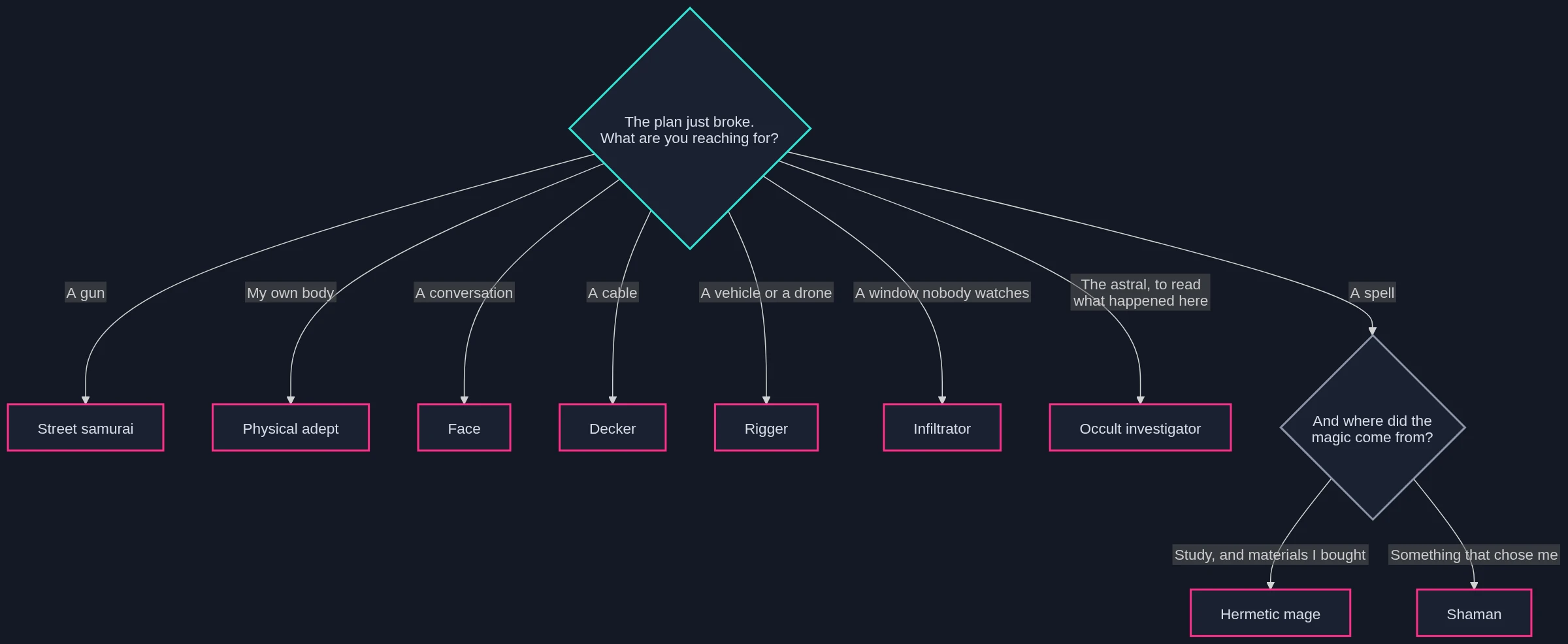
Start from what you want to be doing when the plan comes apart, because that's the part of a run that's actually play. Follow it down:
Claude#
Gemini#
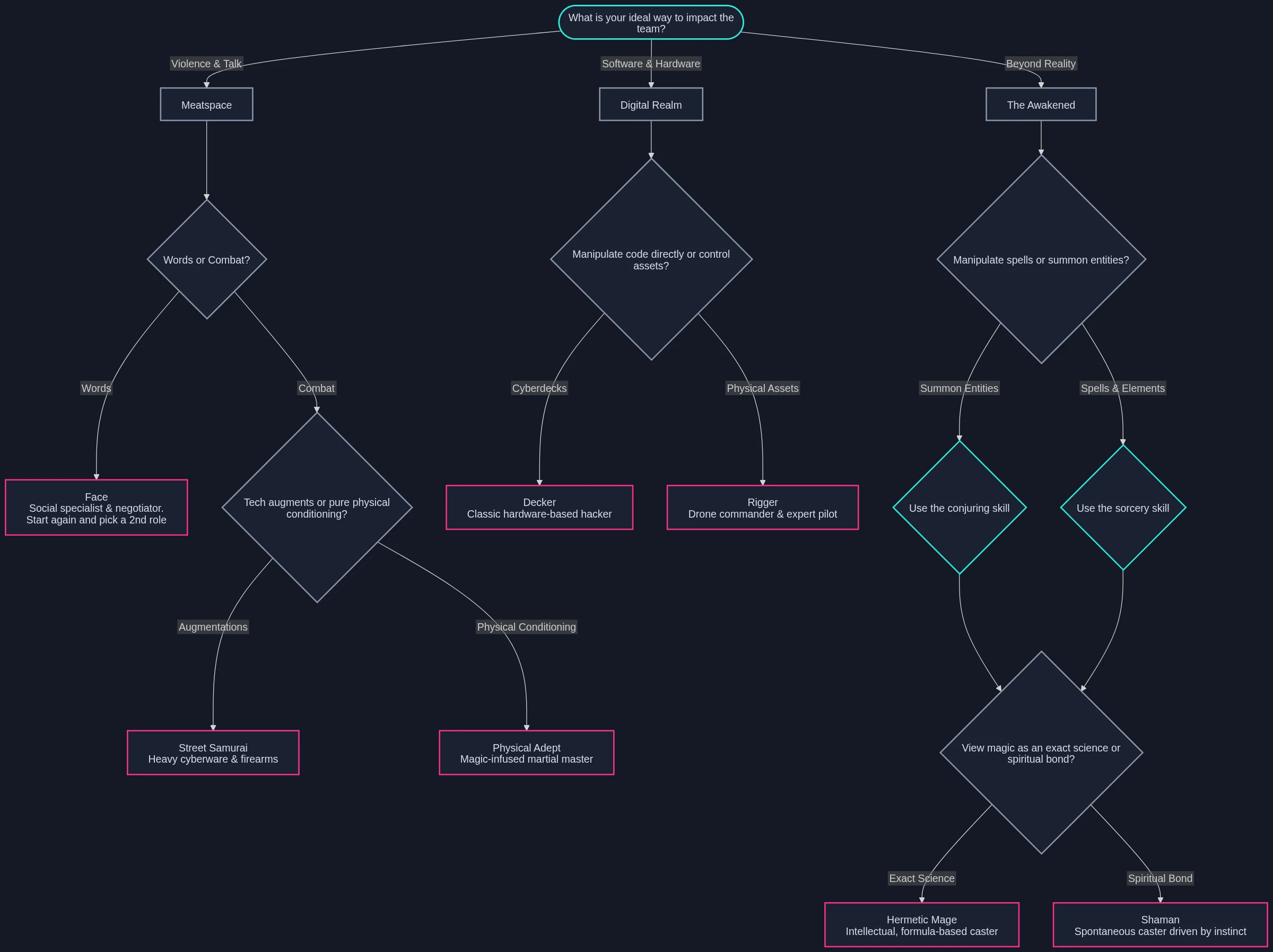
If two answers felt equally true, say both out loud at session zero. Overlap is usually good news: two people who can both drive, or both talk, means neither of you is the single point of failure, and the pregens in the book are nearly all two words (combat decker, face infiltrator, social adept face) because hybrids are the norm rather than the compromise. If the table would rather spread out, that's worth knowing early too, and it's a conversation rather than a race.
What our Los Angeles does to the choice#
Four things about this setting change what these roles are worth, and none of them are subtle:
- The Matrix is wired. No technomancers: they're twenty years out. No mesh, no drone swarm, no deck work from a coffee shop. Decking is a place you have to physically get to, which makes the decker's problem the infiltrator's problem, and makes the two of them natural partners.
- Nobody has a SIN. Every licensed thing (a clinic, a gun, a flight plan, a lease) is closed to you as a person and open to you as a fiction. That's the Face's whole territory, and it's why paper is a recurring prize on this wiki.
- Nobody is coming. No police contract, no reliable ambulance for people like you. A firefight has no cavalry on either side, which cuts both ways and is worth remembering before the first one.
- Your metatype has a date on it. Officially, elves and dwarves are the 2030 cohort, which makes the oldest of them thirty. Anyone plainly older than that was born inside one of the six places where mana surfaced first, because for the years before the reveal that was the only ground where it happened, and the 2019 to 2026 cohort has never accepted being called the second generation. So an elf is thirty or they're from Guatemala, Ireland, Cascadia, the eastern Congo, Tibet or central Australia, and either answer tells you something. See the timeline. Orks and trolls came out of 2039, which hit everywhere at once, so any age and any background works. Humans are most people. None of it is a bloodline and all of it is public knowledge.
What a crew needs covered#
Four jobs keep coming up: violence, the Matrix, magic, and talking. Before you feel obliged to plug a hole: this campaign does not need the Matrix or magic covered by a player. Both can be handled without one, so don't take a deck or a tradition out of duty. Take it because you want to play it.
What you give up isn't capability, it's presence: work that happens off-screen and gets reported back instead of being a scene you were in.