Oceanwide Plaza
Three unfinished towers downtown that nobody owns and everybody uses.
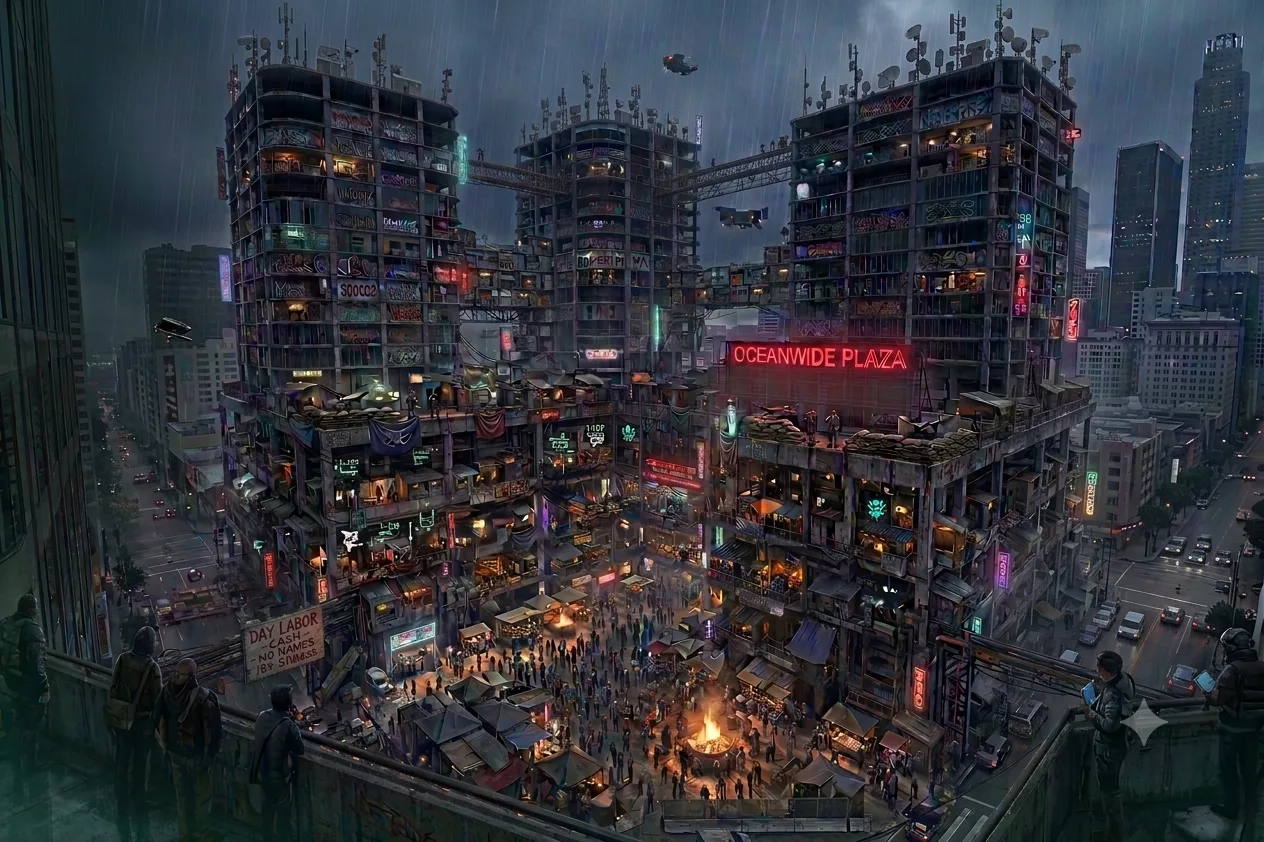
Three towers on four and a half acres in South Park, across from the arena. Construction stopped in 2019 when the developer ran out of money. Taggers covered twenty-seven floors of it in 2024, one enormous piece per floor stacked all the way up, and people parachuted off the roof for sport. Below the tenth floor those pieces went onto glass and are still sharp; above it they went onto bare concrete spandrels and have had thirty-six years of weather on them, so the high ones have gone soft and the one on thirty-four can no longer be read at all. The foreclosure auction failed, the bankruptcy went nowhere, and then the plague came and nobody ever came back.
The arena is four hundred feet away, same era, same legal fog (the ground held by an entity nobody can serve, the naming rights owned by a company that died in the Crash), and it has a box office, ushers and a sound roof. The only difference between the two buildings is that somebody incorporated to run one of them. This one has a water queue instead.
It was supposed to be finished for the Games. That was the whole pitch to the receivers: a hotel and two residential towers open in time for 2028, across the street from a venue, in a city about to be full of people with money. Two consortia looked at it and both walked, because the frame needed surveying before anybody could price the work and nobody wanted to pay for the survey.
The Games came and went four hundred feet from the site. Then the quake, then the plague years, then no more money for anything. 2028 was the last date on which finishing this building was ever a plan, and missing it is the reason several thousand people live here.
Thirty-three years later it is a concrete frame with no glass above the tenth floor, no lifts, no water riser above six, and several thousand people living in it: almost all of them below that sixth floor, because water is where people can live and everything above it is dry. Floors are known by the pieces painted on them. Water gets carried. Power is whatever somebody has run from where.
Downtown is full of empty buildings: a third of the old office core has been dark since before the plague, and a dozen towers have no owner anybody can name. Those buildings failed; this one was never finished. It has no certificate of occupancy because it never earned one, no lifts because none were ever installed, no fire system, no glass, and legally it isn't a completed structure at all. A dead tower has to be broken into; this one was never closed, so the population here is thousands rather than dozens, and it's the only one of them anybody has bothered to name.
The base is the strange part, twice over. The complex was designed to be wrapped in an enormous advertising screen, and that screen works: somebody pays the maintenance on it and it lights the intersection every night, on a building they have never claimed to own. And the podium it sits on, four stories of unfinished retail and parking around an open plaza, has become the largest night market downtown: stalls, tarps, cook fires, and a couple of thousand people moving through after dark. Catwalks and scaffold bridges span between the three towers where somebody welded them, so you can cross at height without going down.
The three towers are not the same tower, and knowing which one somebody means saves an hour. Construction stopped at three different stages, so one still has its structural core standing bare in primer up the outside, one got most of its glass and holds it below the tenth floor, and one was barely clad and is the one the taggers had the easiest time with. Original planking and rigging are still hanging off the ledges between floors on all three.
It is the only place in Los Angeles where you can eat well and buy anything without once being asked for a name.
The plaza#
The podium encloses it on four sides and the sky is a rectangle a long way overhead, so the market is outdoors and roofed at the same time. Stalls, tarps, cook fires, a couple of thousand people after dark, and the tap on six is the reason for the queue that runs across it all evening.
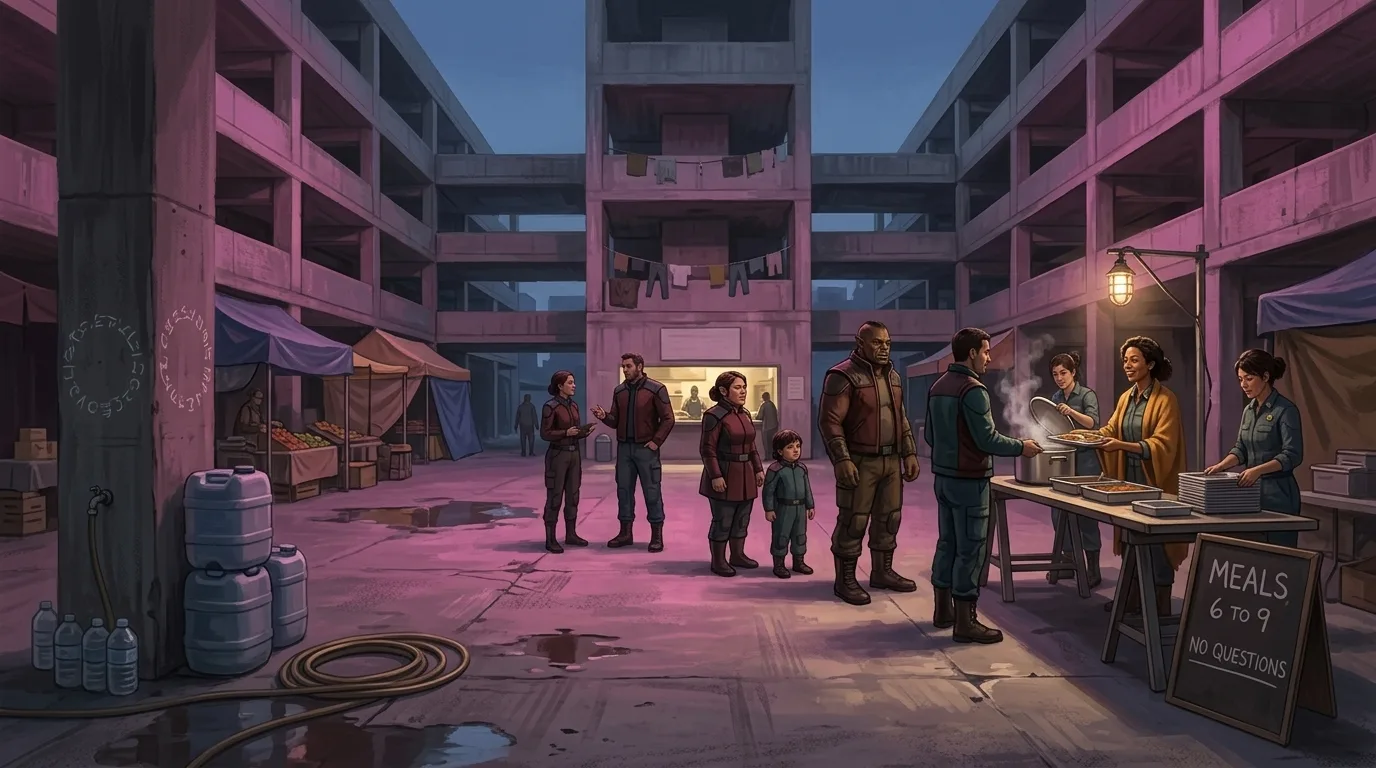
The Brotherhood cooks here, at the end of the water queue, so anybody heading for either stair passes it: trestles, a serving counter, a tray handed over with nothing asked for it, and the food is good.
The stairs#
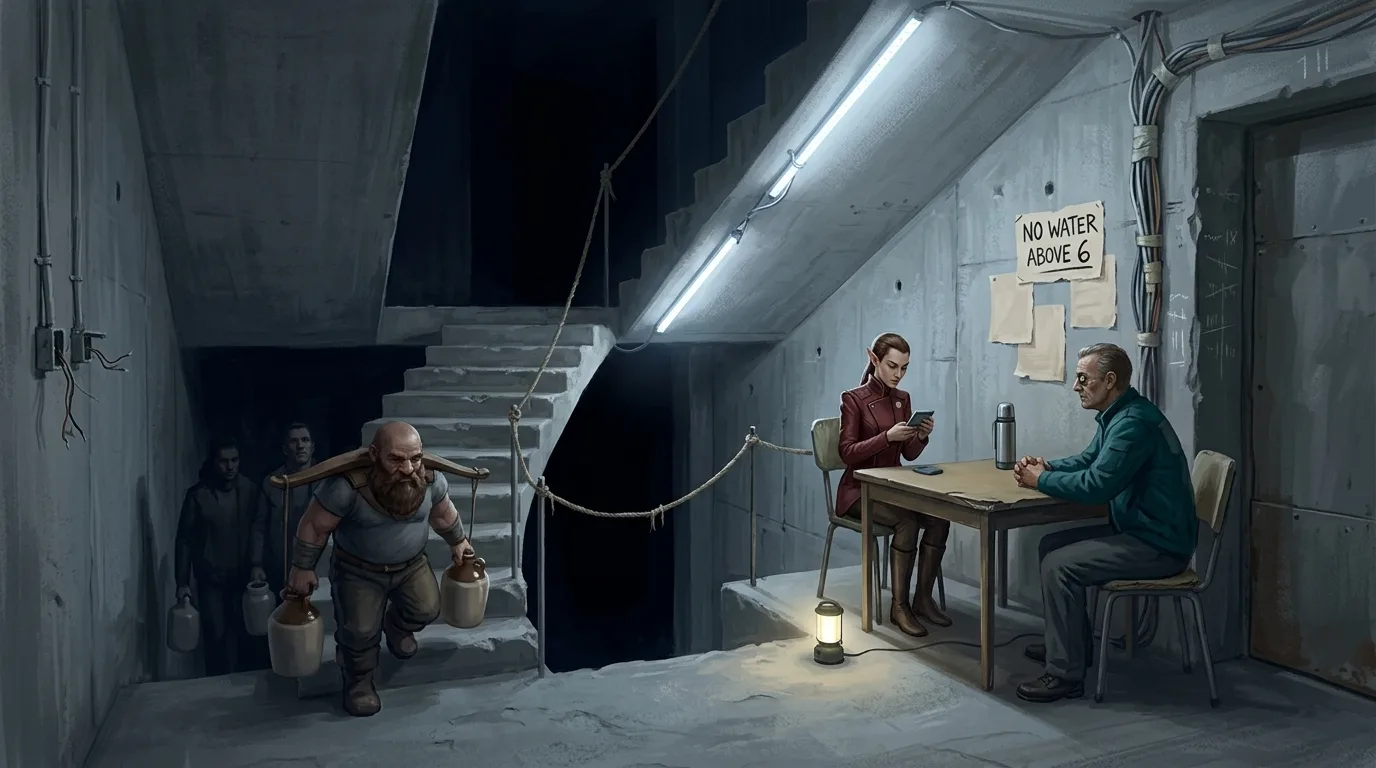
Both start off the plaza. Two stairwells go all the way up and neither one was finished. The treads are bare concrete with no nosings, rounded off at the edges by thirty years of traffic and wet most mornings off the condensation the building makes on its own. The inner handrails were never installed, so each stair has an open well down the middle of it for the full height of the tower, and everybody who uses them knows better than to stand under it.
North stair, in the hotel tower, is the public one. Wide, busy, and lit in patches: nothing here came with lighting, so residents have wired LED strips onto the landings they use off their own taps. The stair is bright where people live and black for long runs in between, and where the light stops is where people stopped. It carries the water, so it is slow, and it is the one you take when you don't mind being seen.
South stair is the quiet one, and what makes it quiet is a missing pour between nineteen and twenty where the formwork came off and the concrete never came. You cross on two scaffold planks and a rope somebody replaced last year. Nobody carries water over that, so above nineteen there is no traffic, no light and no reason for anybody to be on it. Everybody using the south stair above twenty is doing something, and they all know that about each other.
Water reaches the tap on six and no further, so everything above that arrives on somebody's back. A jug on thirty costs four times what it costs on three and the whole difference is somebody's legs. Carriers work the north stair all day with shoulder yokes and handcarts, and they are the only people in this building everybody is polite to.
Above about twenty, the parrots. You hear them ten floors down.
Thirty-four#
Thirty-four is the last full plate. The pours above it were never completed: from thirty-five up there are gaps where the formwork came off and nothing replaced it, so those are sections rather than floors and you can't walk a circuit on any of them. Thirty-four is the highest place in the building you can walk right around, and that is the physical fact underneath the word.
The word itself came off the wall. The 2024 pieces were writers' names, one to a floor, so most floors up here are still called by whoever painted them: you go up to Poetz, or to Badger, and the number never comes into it. Thirty-four is the exception, and the exception is why the number stuck. Its piece runs across two columns at the east end, it is old enough that nobody here remembers it being new, and the concrete took thirty-six years of weather off the open side until the letters stopped being letters. Nobody can read whose floor it was, so the floor went back to being a number, and the number is the one address the whole building agrees on. It has since left the building and now means any meet that costs you a climb.
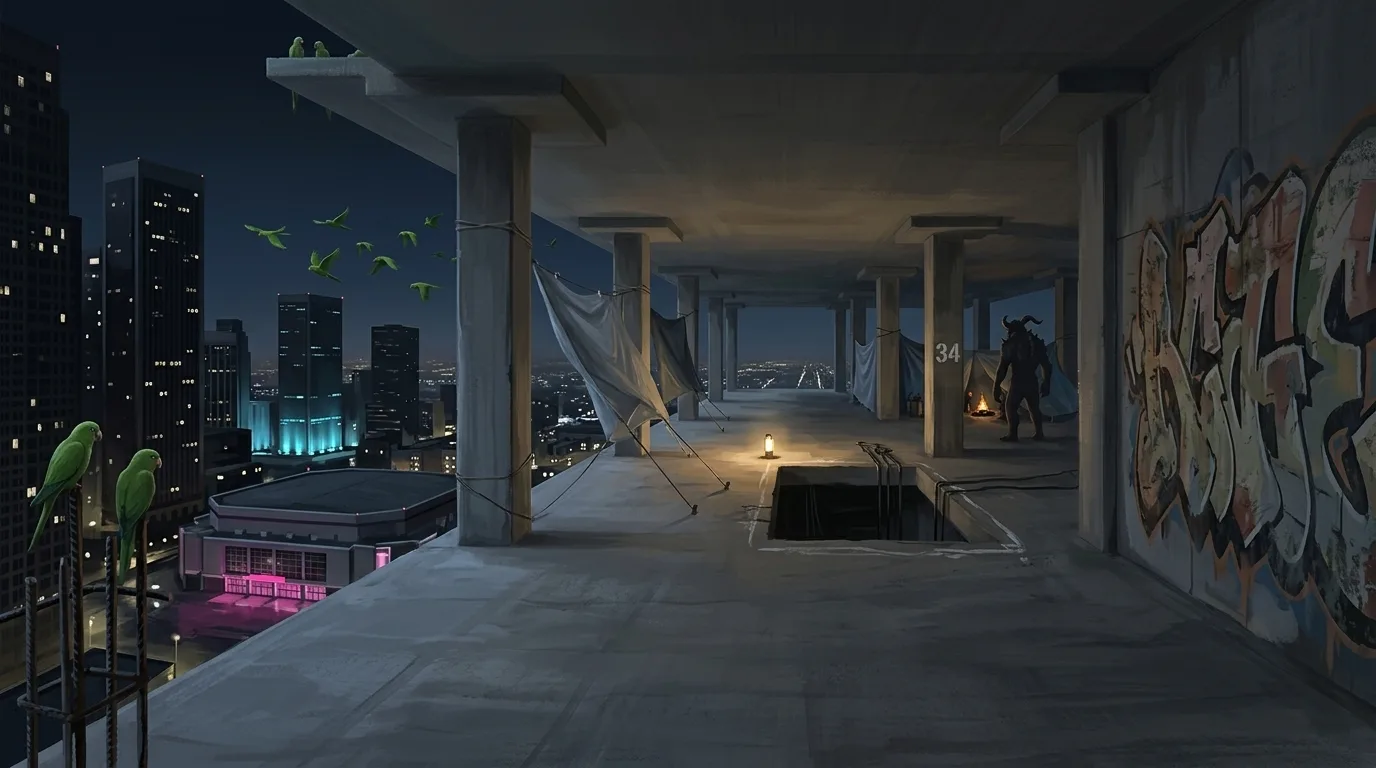
Standing on it: an open concrete plate, no glass, columns on a grid, tarps rigged between them where somebody wanted a wall, and the city lit underneath you on every side. The arena is four hundred feet away and a long way down. Bunker Hill is uphill and looking straight at you. The lift shaft is an open hole with dead cable still hanging in it, and a chalked ward around its mouth that somebody keeps remaking is the only thing on the floor anybody maintains.
Wind is the weather up here and it decides what kind of meet you get. On a still night two people can talk quietly at ten feet. On a bad one you can't hear somebody at arm's length, and neither can anybody aiming a dish at you off a taller roof.
The air on all four sides should be a public gallery, and the birds are the reason it is not. No walls means a small drone could hold station forty meters out and be a dot at night. It does not get to stay there. Several hundred parrots roost on these floors, and a red-crowned parrot has ninety years of practice at driving a hawk off its own roof: anything that hovers is treated as one and mobbed by more birds than it has rotors. There is no grace period. The roost goes at anything holding still over it the moment it stops, all at once, the way it goes at a hawk, and nothing about what happens next is quiet enough to keep flying afterwards.
Two things follow, and the second is the useful one. Low is still open: a drone kept below the roost line, in against the towers or parked on the arena's light, is a real threat and the floor has no answer to it. And the flock is nobody's asset, so it cannot be paid, spoofed, scheduled around or switched off; a rigger who wants this floor has to solve a wild animal rather than a countermeasure. Once in a while one of the birds is not only a bird, which is a different problem again for whoever is flying.
Listening is the other way around, and the reason is that there's no glass in this building above the tenth floor. A laser mic reads speech off a pane; concrete plate is far too heavy to move at the amplitude of a conversation, and a tarp is too loose and too busy in the wind to send a beam anything back, so that whole class of listening has nothing up here to work with.
What the crew knows#
- Nobody owns it, and that's the whole value. Ask three lawyers and you get three answers about who holds title. Nothing that happens here is anybody's jurisdiction, and meets happen here for that.
- The climb is the filter, and everybody who calls a meet here is using it as one. Anybody who arrives has decided to, arrives slow, and arrives heard. So a meet on 34 tells you something about who called it before they open their mouth.
- The stairs have one social rule and it is worth keeping. You don't look at a face you don't need. Half the people on the south stair above twenty are working for somebody who would rather not be placed in this building, and that includes, on a given night, the crew.
- Neutral by exhaustion. Too many factions live in the towers for any one of them to hold the building, so the convention holds: business gets done, nobody starts anything indoors.
- The upper floors are full of equipment that isn't residents': antennas, cameras, relays, all of it pointed at Bunker Hill and the interchange, all of it installed by people who came at night and left.
- Day work gets hired at the base, cash, no names, no record.
Getting in#
Walk in. There is no door.
The difficulty is vertical and social, and it is all in the stairwells above: which of the two you take, what you say on the landing on eleven, and how you come back down carrying something.