The Sprawl
Most of the city, and the definition is a negative: no council, no contract, nobody coming.
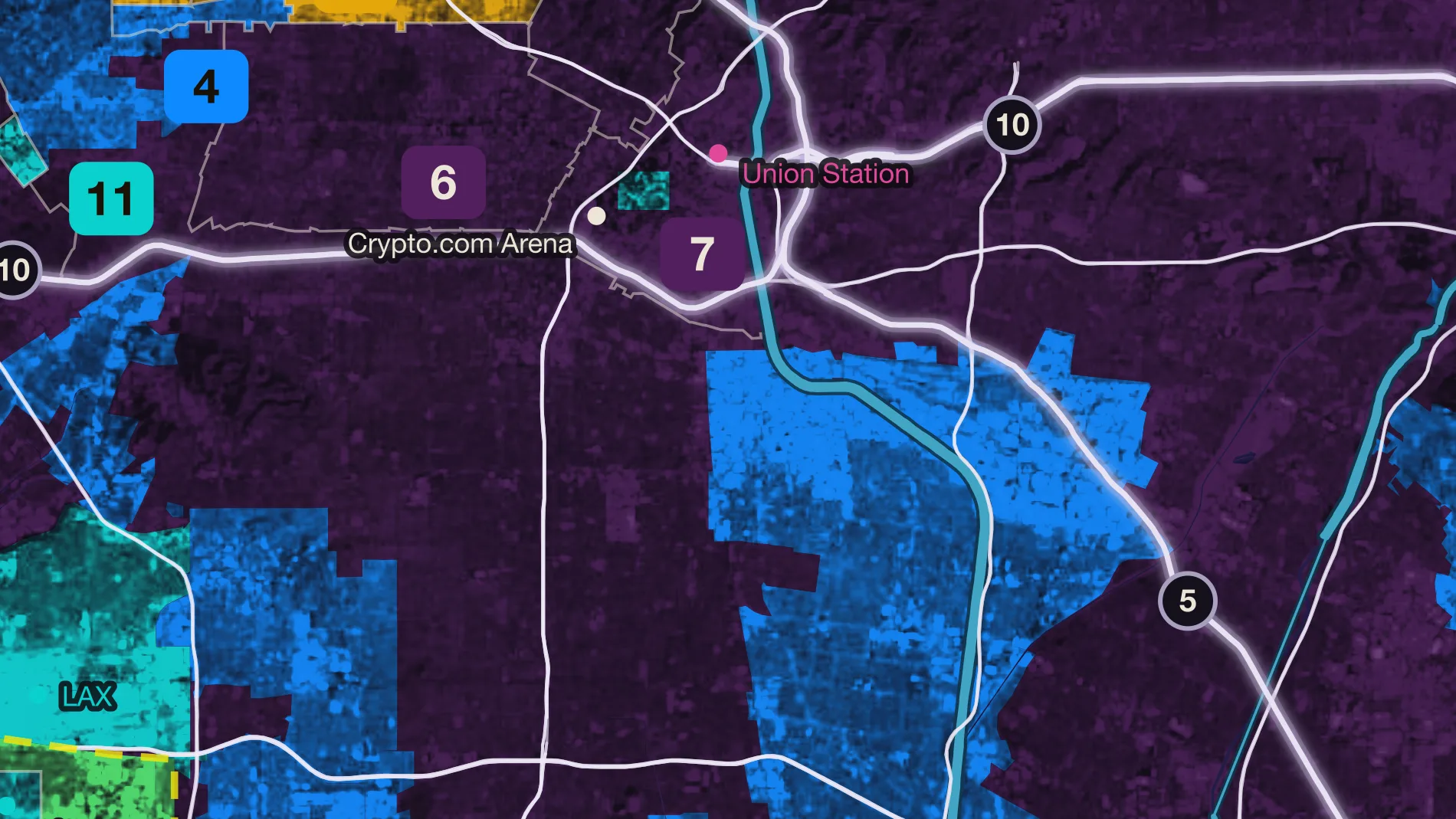
The sprawl is what is left when you subtract everybody who owns something. It is not a district and it has no edges you could walk to. It is the gray-violet on the map: about two thirds of the basin, from Pacoima down through the flats to the harbor, and the only thing every part of it has in common is what it lacks.
No functioning city government. Los Angeles stopped having one in 2057 and the sprawl is the ground that had nothing else underneath. Santa Monica had its Rent Control Board and an elections office that simply carried on; West Hollywood had a council it built in 1984 and never lost. Everywhere on this color had the city and only the city, so when that went there was no second layer to fall back on.
No security contract either, and that follows from the first. A patrol is a thing a government buys. No council, no budget, no contract, nobody to call and nobody who comes: Knight Errant runs Santa Monica because Santa Monica's board pays them and can fire them, and the sprawl is every block where that sentence has no subject. What replaces it is uneven and local, which is the whole texture of the campaign: parishes, families, a shop that watches its own street, somebody's cousin, and in a few places a gang doing the job badly and charging for it.
Poor is not the same as ruined, and this is where the distinction lives. Most of the sprawl works. The stacks are full, the buses run, the clinics are open, people go to jobs. What is missing is anyone with the authority to decide anything about it.
What the crew knows#
- Nobody is coming, and that cuts both ways. No response time to plan around, and no response time to hide behind. A job that goes loud here produces neighbors rather than sirens, which is slower, more local and much harder to leave behind.
- The lack is not uniform and the crew should learn the difference by block. Some streets have a parish or a family that answers for them and will want to know who you are. Others have nothing at all, which is quieter and worse.
- It is the default, so it is where the crew live. Anything that is not corporate, studio, cordoned, sealed, ash or one of the two districts with a council is this.
- Nothing here is on a map anybody keeps. No addresses get audited, no permits get pulled, and half the buildings have been subdivided twice since anyone last wrote them down.
Getting in#
There is no getting in, and the absence is the whole description: no gate, no badge reader, no line of questioning at the edge. The friction in the sprawl is social rather than procedural, and it starts once you are already standing on the street.