Union Station
The land border, and the reason the trains still run.
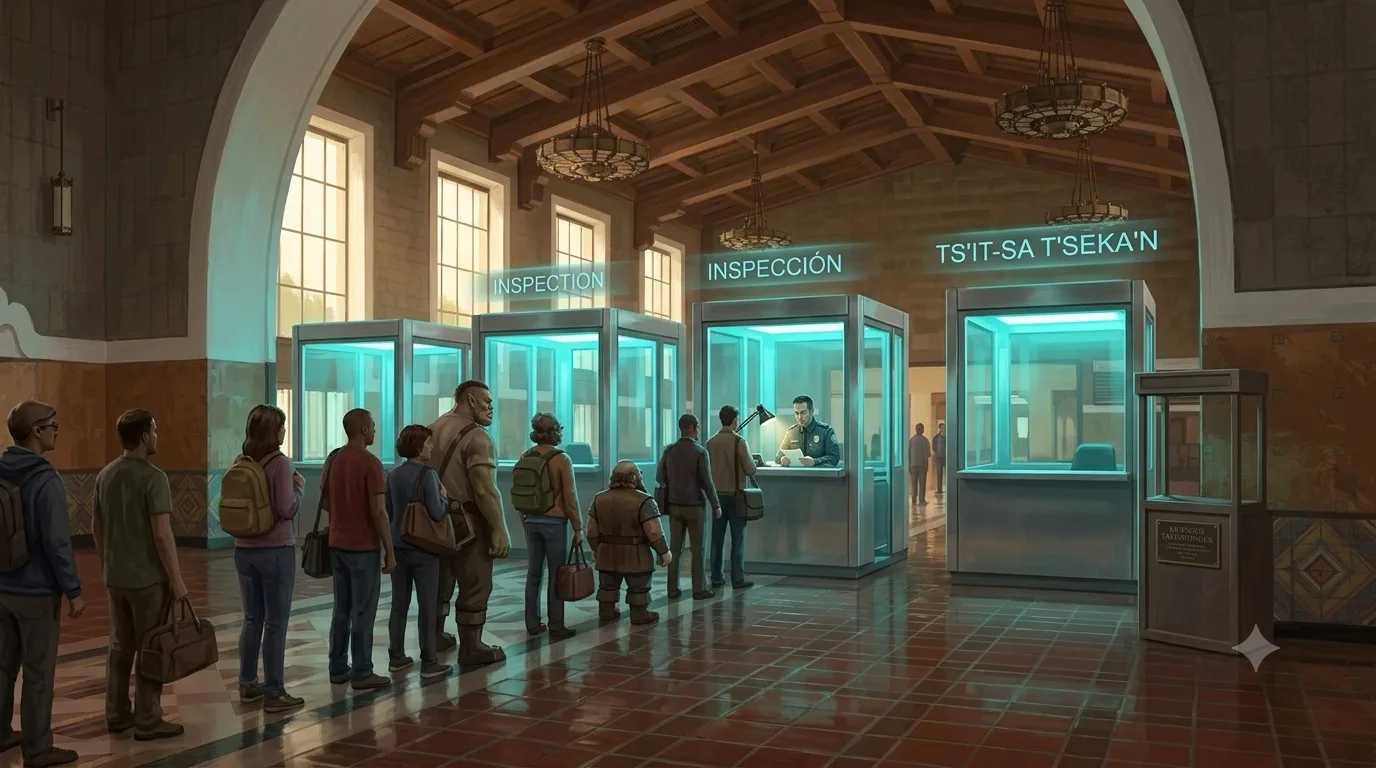
The 1939 building is intact (tiled floor, high beamed ceiling, the original chandeliers, the courtyards), because nobody could afford to replace it and nobody needed to. What changed is what it's for. Glass inspection booths are bolted into the middle of the concourse now, and everything leaving Los Angeles by land leaves through them, because the city is ringed by Pueblo and this is where Pueblo does its paperwork.
The trains do run, but only the ones somebody's balance sheet needs. There is no transit authority, because there's no government to house one. What exists instead is a service contract, the same shape as a policing contract, bought by the people who need the workforce moved.
The reason there is anything to run on is 2028. The rail network got its last real money in the run-up to the Games: extensions finished, stations rebuilt, signaling replaced, the Regional Connector and the airport line delivered inside a decade of work nobody has matched since. Every line still carrying traffic is one of those. The lines that weren't touched then have been out of service for twenty years and their right-of-way is somebody's storage now.
So the map hasn't grown since 2028, it has only shrunk, and every piece of it is thirty-two years past its last inspection program. Ask anybody who works a platform and they'll tell you which viaduct they walk instead of ride.
Three services, in order of who matters:
Freight is first and it never stops. The corridor from the harbor to the inland yards is the most valuable rail in North America, the port's Corporate Court guarantee effectively covers it, and freight sets the timetable that everything else fits around. It is also audited to the same standard as the docks, which makes it useless for anything the crew wants to move.
Labor shuttles are second, and they're reliable. The corps and the terminals need people brought from the stacks to Century City, the plants, the refinery belt and the port every morning and returned every night. Those lines run, cheaply and on time, because the alternative is a workforce that doesn't arrive. The trick worth knowing: a labor shuttle checks employment, not identity, which makes a borrowed badge worth more on these lines than a good fake SIN.
Leisure service is third, which is to say it doesn't exist. The lines that once took people to places for fun are dark, stripped, or handed over to freight. Anything serving a district that can't pay (the dried Valley, the far east, ash country) was closed a generation ago, and its tunnels and rights-of-way are part of the underground now.
Intercity is Pueblo's, and that's the border hall. They run what leaves, and the city rents what stays.
What the crew knows#
- Look employed and you can ride most of this city for nothing. The readers want a badge, not a SIN, and a badge is the easiest thing in Los Angeles to obtain.
- The concourse is public and the booths are not. You can stand in that building all day. Crossing the line in the middle of it needs a permit class, a manifest, and a countersignature.
- Sunday evening is the busiest hour in the city: day-trippers going home to Pueblo, four hundred deep, and the best cover in the city for moving in either direction.
- Freight is a trap. It goes where you want and it is manifested into the Court's own system, audited by eight corporations who are each watching the other seven.
- The timetable is public, it is set by freight, and it is the most reliable clock in Los Angeles.
- Weapons are a permit class here. Declared, or left somewhere else.
Getting in#
Walk in off Alameda. It's a railway station and it behaves like one: nobody stops you entering, the food is decent, and there are people asleep on the benches whom nobody moves along.
The border is the line across the middle. Everything hard about this building happens in twenty meters of it.