Homebrew
What we changed from published Shadowrun, and the six reasons we changed it.
This isn't canon Shadowrun. Everything below is design rather than plot, so none of it spoils anything.
Where the published version and this wiki disagree, this wiki is what happened here. Pages carry a bordered Canon reference line pointing at the published article or story, so you can read the other version whenever you want one; it is there for comparison, not as an authority.
Six reasons we changed things.
1. We're a Los Angeles table, and canon Los Angeles is thin. Seattle has thirty-five years of sourcebooks behind it. Districts with histories, a governor with a name, a police contract, bars, gangs, a border, an underworld whose factions hate each other for documented reasons. LA gets a handful of pages and a nickname.
So we wrote the rest. A page per district, an economy, and enough named ground that you can make a plan out of it.
2. Canon LA has nowhere to run. This is the real problem, and most of the other reasons follow from it. A shadow economy needs seams: borders to cross, jurisdictions that stop at a line, authorities that can't cooperate, ground where nobody's writ is clean. Canon calls LA a free city and then leaves it as scenery.
Ours has seams on purpose. Pueblo holds everything outside the city limits. The port answers to corporations instead of a country. The busiest airfield in the city runs on suspended paperwork nobody wants tested in court. There's no citywide police contract, only districts that hire their own, or don't.
3. Local landmarks are half the fun. A Seattle table gets a real kick out of a job in the Space Needle. We're sick of looking at the graffiti towers on Figueroa, and they're perfect for this.
So real places keep their real names and get a Sixth World job instead of being replaced by invented sprawl. Griffith is a mana observatory. Union Station is the border hall. Dodger Stadium is a market six days a week. The Bradbury is still the Bradbury.
4. Nothing before 2026 contradicts the world we actually live in. Published Shadowrun put its plague in 2010 and its Awakening in 2011. Both are behind us now, and neither happened. Its Crash is dated 2029, which is three years out and getting funnier.
So rather than ask you to hold an alternate history that already failed to come true, real history runs through 2026 and the divergence starts in 2027. Your character's grandparents lived in the world you live in. Everything strange happens after that, and it happens fast.
The clearest example is the disaster the whole campaign sits on top of. No reactor exploded offshore. San Onofre stopped generating power back in the twenty-tens and never stopped being a storage yard, so sixteen hundred tons of spent fuel are sitting in dry casks on an eroding bluff a hundred feet from the Pacific right now, today, because no repository was ever built to take them and nobody outlasted the argument about whose problem they were. We invented none of that. What we added was the bluff finishing the job, and the plume riding the same northward current that moves everything else on this shore. See Los Angeles.
5. Some of what read as progressive in 1989 doesn't now. Shadowrun was ahead of its time in places and it also picked up a lot of 1980s baggage. We've fixed what we caught and written down why.
Mexico keeps its own name, and the villain is a corporation. The Native nations are still a magical superpower, but we changed where the advantage comes from. It's institutional rather than inherited. Magic is learnable by anyone; they got there first, at scale, and then won the legal fight.
Poverty isn't a map of race here. The Tide followed the coastal current and the wave came off the shelf, and neither of them asked what a neighborhood earned: between them they took the harbor districts, the refinery belt and the beach towns, which is most of the range from the cheapest ground in the basin to the most expensive. Fire took the hills, and the hills are where the rest of the money lived, so some of the most expensive real estate in the history of the world has squatters in it now. See the beach cities, which are intact and empty with the furniture still in the houses, and Los Angeles for the fire country.
What came through is the flat inland city: Watts, Compton, Inglewood, Boyle Heights, East LA, Pacoima. It came through because the things that protect an expensive address are all bought and stop working the moment nobody is paying for them, while the things holding those neighborhoods together were people who were going to be there anyway. So the emptied places are the coast and the hills, the places still standing are the ones with institutions in them, and where this setting has villains they are corporations rather than communities.
6. We love our San Diego neighbors, but somebody's getting wrecked for plot purposes and it isn't going to be us. Every Shadowrun setting needs one place where the worst has already happened and nobody reliable has been back. Canon puts that in Chicago, which is two thousand miles from here.
Ours is San Diego, because you can drive to San Diego. Sealed since 2050, a hundred and twenty miles down the coast, close enough that people at this table have family in it. Canon had already put an Aztechnology garrison down there, so we shut the border and left it shut, and everything canon's ruined city was carrying moved onto that one city instead of being split between two. Chicago goes back to being a place this campaign doesn't visit.
The disaster that already reached us is smaller, and it's ours. The casks at San Onofre went in 2056 and a wave finished the beach strip two years later.
What hasn't changed: nearly everything. Chrome is ordinary and you can tell who bought which. You jack into the Matrix with a cable in your head. The corporations are sovereign and answer only to each other. Dragons are real and sit on boards. A man who won't give you his name buys you a drink in a loud bar and tells you most of the truth.
Where the name came from#
Two messages in the group chat:
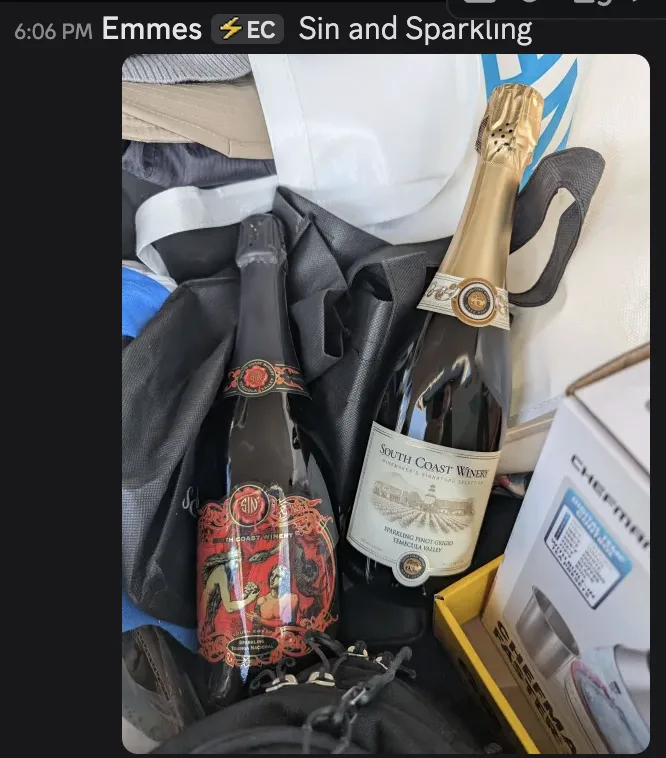
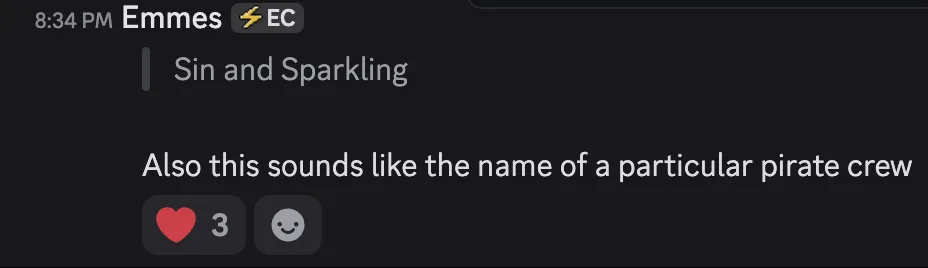
That's how the D&D group got its name. This campaign inverts it: SINless and sparkling.
Table agreements#
Moved to their own page: Table Agreements: the three rules we settled before play, plus how to read this wiki when it disagrees with a sourcebook.