San Onofre and the Seventeen Miles
The source, and seventeen miles of nothing after it. Two armed powers, and neither will enter.
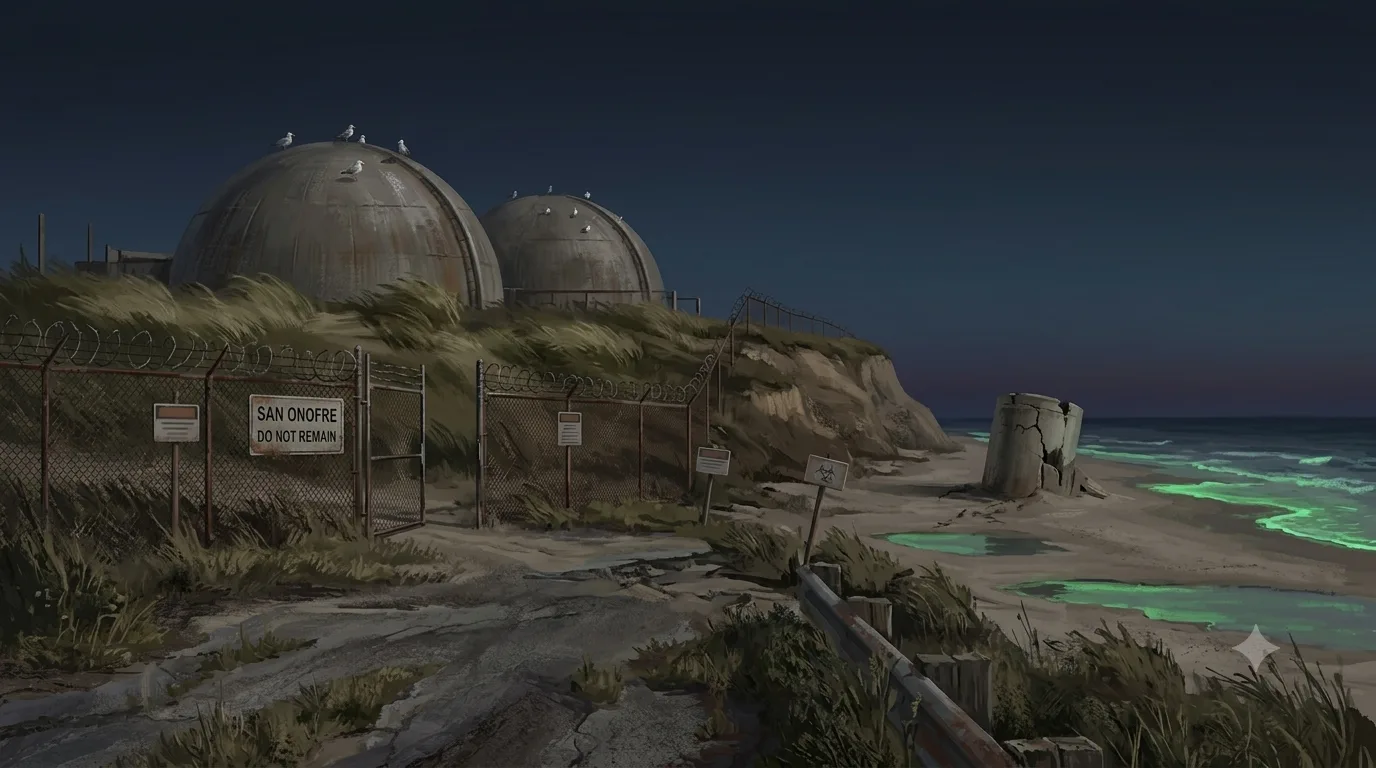
The cordon ends here, not because the wire stops but because the ground does: sixty-odd miles of poisoned coast to the north, and seventeen more miles of nothing to the south. Los Angeles calls this the source, and it's the one part of the whole hundred-mile cordon that needs no further explanation: this is where it started.
The twin containment domes at San Onofre stand on flat ground at the surf line behind a seawall, and beside them the cask storage monolith, cracked now, a hundred feet from water that still carries a faint Awakened green sheen thirty-odd years on. The casks failed in 2056. Nine days is how long the plume took to reach the harbor, which is nine days more warning than the million people it eventually put behind wire ever got.
South of the plant the coast simply stops being anybody's. Old Camp Pendleton, a hundred and twenty-five thousand acres the Marines never needed after they left, sits between Orange County and San Diego County: seventeen miles of scrub, one closed freeway, one closed rail line, and nothing else. Nobody built this border. Aztechnology inherited it.
Three bands, north to south:
- The buffer, Orange County's own coast down to Pendleton, patrolled under an Ares security contract paid for by the Corporate Court and the harbor interests south of Long Beach. Knight Errant is the uniform you see from Long Beach south.
- The gap itself, the old reservation: sensored, overflown, and not somewhere to be on foot. Ares watches the northern end. The middle belongs to neither side.
- The perimeter, Aztechnology's, facing north at the southern end: the only one of the three bands with an owner.
What the crew knows#
- The unattended casks at San Onofre are the only ground in Southern California two armed powers have agreed not to enter. Nobody has manned the storage yard since 2056, and neither Ares nor Aztechnology wants to be the one who has to explain why they were standing on it.
- A dosimeter does the pacing here, not a plan. Contamination is a condition of the place, not a resource to track: mask, don't linger, and the wind decides more than anybody's schedule does.
- The line is at Pendleton, the same line San Diego's page describes from the city side. From this side, what you meet first is the dead freeway, sealed with concrete where it enters the scrub, and the weekend drivers turn around there.
- Two ways through the gap exist on paper and both are shut: the I-5 corridor and the rail line. Overland, off both, is the only way anybody has actually crossed it.
Getting in#
San Onofre itself is a fence, a sign and the wind, most days: gates rusted open, nobody guarding sixteen hundred tons of the reason for all of this. Legitimate work still happens at the operating plant next door, which is the only way in that doesn't mean trespassing on a corpse.
The seventeen miles has exactly one honest route, and it is walking it. Overland, off the dead freeway and the dead rail line, sensored and overflown the whole way, and the slowest crossing on this coast by a wide margin. It is also the only crossing where paperwork helps rather than a badge: Pueblo holds the ground inland of the buffer, and standing with Pueblo gets a crew through that side of it even though nobody can clear Aztechnology's fence at the far end.