Santa Monica Pier
Half a mile of sealed deck over closed water, and not one foot of it is anybody's to zone.
On this page (8 sections)
A hundred and fifty years old, twice the length it was built at, and the tallest thing on this coastline below the bluff.
The pier is the reason there's anything to do in Santa Monica, and the reason is jurisdictional rather than scenic. The district's boards govern land: tenancies, rents, use, the things a city council does. The pier is a timber and concrete structure standing in water that a hazard cordon closed in 2056, which means it is not land, not inside the cordon's own remit, and not anybody's to zone. Nobody could give permission and nobody could refuse it, which in this city is the same as an invitation.
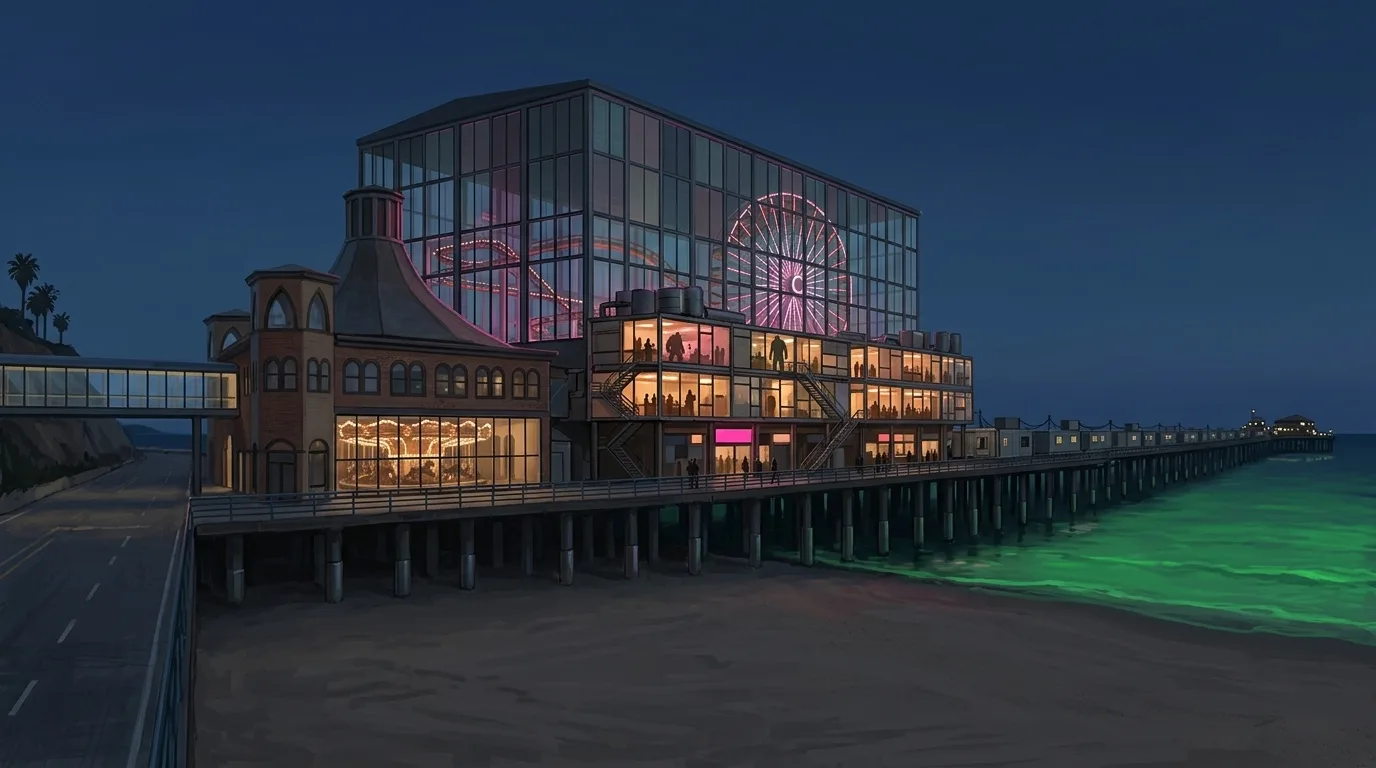
So it got built on, and then built out. The 1909 deck is still sixteen hundred feet, rebuilt so often that none of the original timber is left in it. Past that, the 2040s drove another sixteen hundred feet of light trestle out over closed water, and the tip now stands a little over half a mile from the bridge at Colorado. The inner half of that is behind glass. The outer half never was, and the rent out there is a third of the gallery's for exactly that reason.
What you are actually paying for#
The water is the point and you never touch it. What people buy is being above an ocean in a city where the ocean is fenced off: half a mile out, the Tide underneath you, six feet of glass in the way, and air you can breathe.
That last one is the expensive part. Standing over the Tide puts you in the worst air in the district. It comes off the surface, it's worse on a west wind, and being half a mile out means being in it rather than downwind of it. So everything here is sealed: fixed glazing, gasketed doors, filtration running on the tenants' own power, positive pressure so the leak goes outward. A wall of glass with the ocean six feet away and clean air on your side of it is available nowhere else on this coast, and people will pay a great deal for two hours of it.
"Tourist" means something different now, because nobody flies in: there is no commercial passenger aviation into this city. What the pier gets instead is three kinds of visitor. Angelenos, in numbers, who come to look at water they aren't allowed to touch, and because it's the ocean and it's theirs and this is the only way to have it. Corporate staff on rotation, posted here for eighteen months from somewhere else and shown the ocean on the company's money. And Pueblo day-trippers on weekend permits, who come for everything their Council won't license at any price and for a weekend that leaves no record against a shareholder's account. The licensed casinos are Pueblo's own and better, so nobody crosses the line for the tables. That last group spends the most and the whole structure is priced for them.
The sealing crept outward until there was none of it left. The Hippodrome went first, because it was already a building. The levels added from the 2040s were built sealed from the start. The old deck itself was last, glassed over end to end in the fifties, and nobody argued: by then it stood empty on any day the wind was wrong, which is most of them, and a ride nobody can run is worth less than a ride behind glass.
Nothing on the inner half is open to the air. A century of pictures says otherwise and every visitor arrives expecting a boardwalk. The rides are lit and turning six feet from a wall you cannot open.
The seal stops at sixteen hundred feet, and knowing where it stops is most of knowing how to move around out here. Everything on the old deck and everything stacked above it is one continuous pressurized envelope: the gallery, the upper rooms, and the glazed walkways between them. You can come off the tube and spend a day up there without putting a mask on. Past that mark the walkway is open trestle in open air, each container sealed on its own account, and the people who work out there carry a respirator the way anybody else carries keys.
The board at the Colorado end still posts the day's wind, the way other cities post a forecast. It tells you about the walk now rather than the destination, and the people it matters most to are the ones renting past the glass.
The gallery, on the old deck#
You come in at the Hippodrome, which was a building before anything else out here was: brick and stucco, arched windows, a broad conical roof with a cupola, gasketed decades ahead of the rest of the structure. The Looff carousel inside it still turns and a family from Pico is still riding it on a Sunday afternoon.
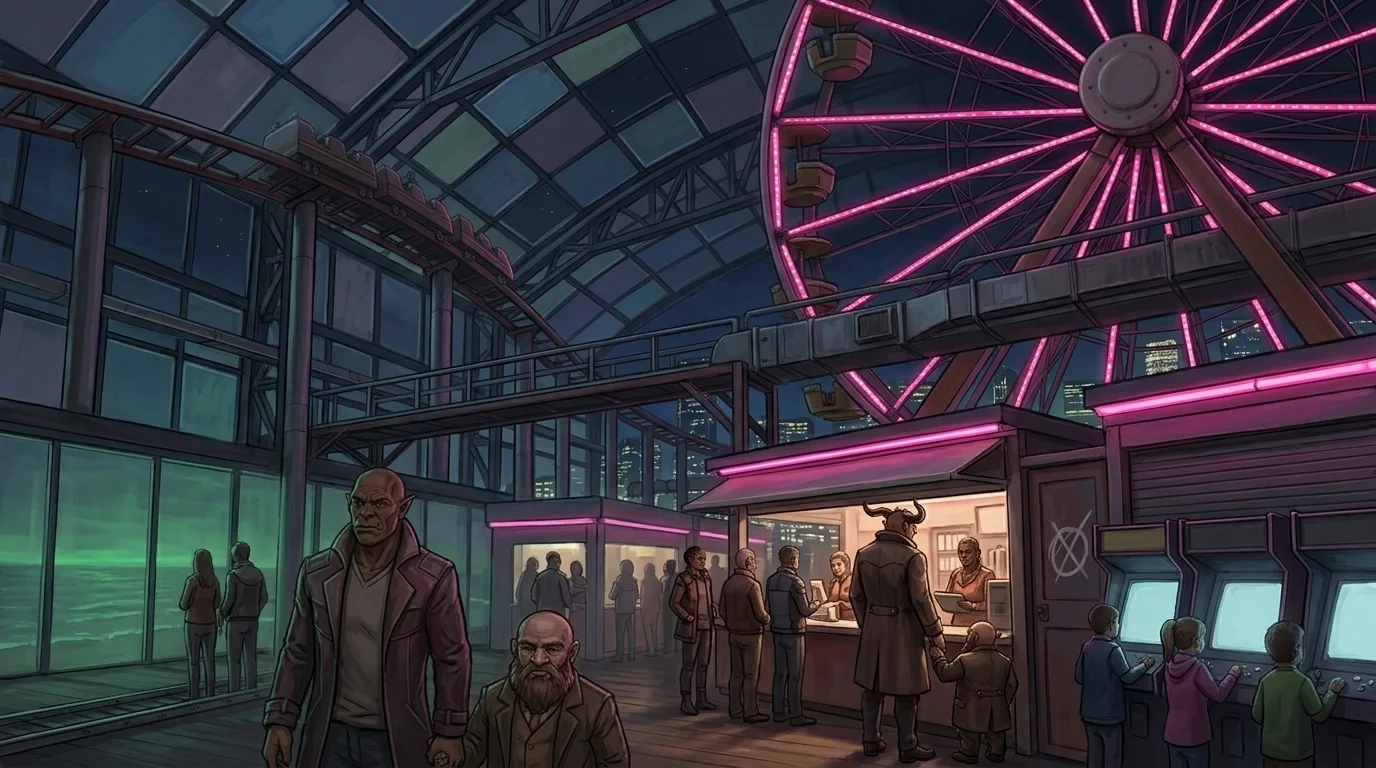
Past that is the gallery proper, one glazed hall built out over the old midway and following the shapes of what was already standing there: a hundred and forty feet at the crown of the wheel, nine stories of glass with a ferris wheel and a steel coaster running inside it. From the beach the whole thing reads as one long lit box with machinery moving in it. This is the level the boards have never contested.
What the gallery sells:
- The rides, all of them indoors. Pacific Park's wheel and its coaster, the small stuff around their feet, and the arcade at Playland running cabinets nobody has manufactured a part for in thirty years.
- Food down both sides, and Mariasol at sixteen hundred feet, the last table on the old deck.
- Untaxed liquor, tobacco and real coffee, sold openly at a counter with the prices on a lit board, because there is no authority here to be untaxed from.
- The aquarium, under the carousel, where it has been since long before the Tide. It is the only place on this coast where you can look at what the Tide did through glass, and it charges children nothing.
- Cheap storage. Two bays are fenced off as unsafe and rent as lockups anyway, at about a third of what a sound bay costs, to people who have read the fence and decided.
Upstairs, on the two added decks#
Two levels bolted on above the inner half from the 2040s onward, out of light steel, fixed glass and whatever else was to hand: sealed rooms, glazed walkways strung between them, and stairs mounted on the outside for anybody willing to be in the air for thirty seconds. The top walkway puts you sixty feet over the water with glass on both sides of you.
The walkways are the one thing up here nobody owns, so the plant that filters them runs off a levy the tenants argue about and underpay by habit. Corridor air is the worst air on the pier anybody breathes on purpose: hazy at the far end of a run, condensation standing on the glass, gray streaks down the wall under every intake. A respirator hangs on a hook beside each door to an outside stair, and going down one is the only time anybody up here puts one on.
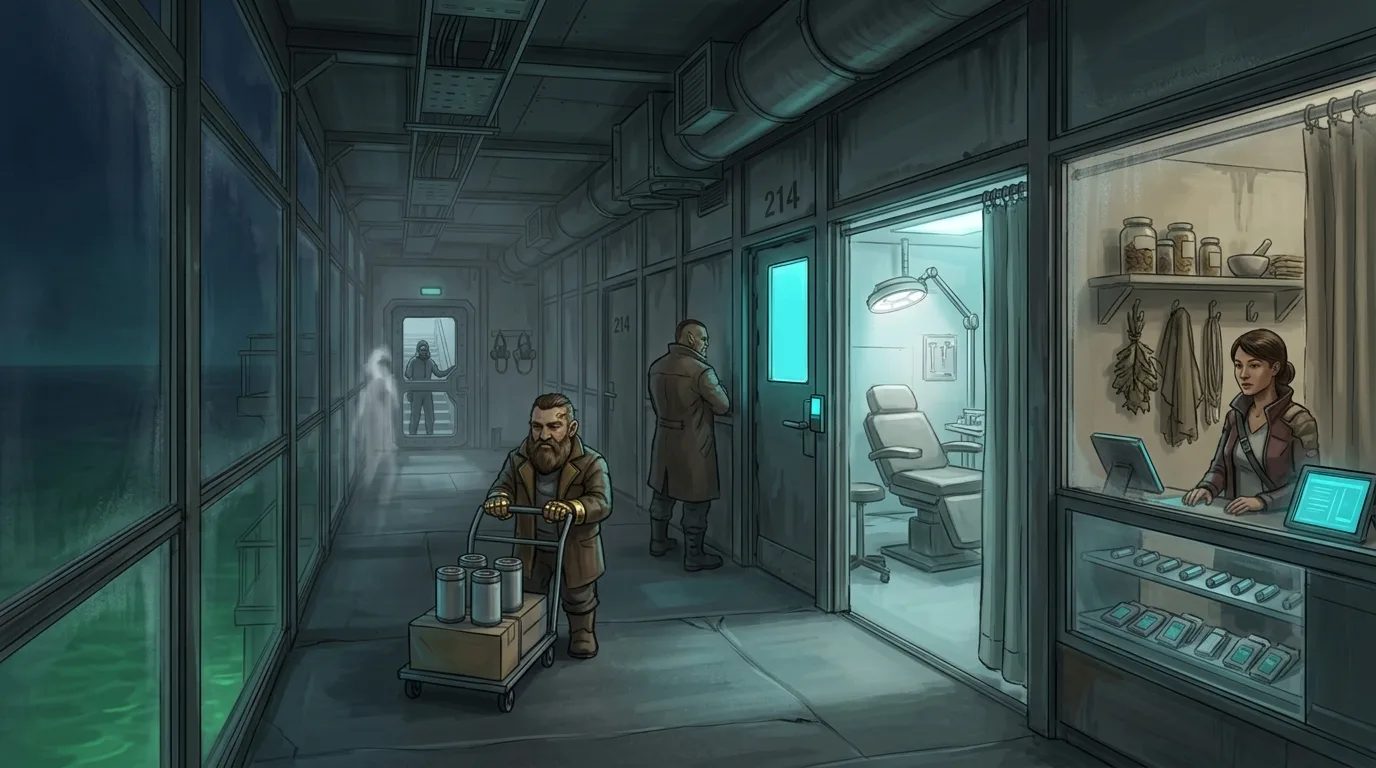
Nothing up here has a name on the door. Rooms carry numbers, hand-painted by whoever owned the room, in no sequence anybody has ever reconciled, and the number is what you get handed when somebody sends you: third level, 214, ask for the woman with the tablet. Walk up without one and you will be treated very politely and sold nothing.
This is where the trade is:
- Clinics. Ware fitted without a registration and, more profitably, ware taken out without one. Somebody from Fun City comes for the removal, because a serial number on a corporate medical record is a permanent fact and this isn't.
- Doctors who won't file. Gunshot wounds, terminations, anything a person needs treated without it becoming a document. See Esther Kwon for the good end of that trade; the pier is the other end.
- Paper. Fake SINs at the cheap end, and at the good end credentials issued by authorities that no longer exist and therefore can never be checked or revoked. The stock is usually sound and the name on it is invented, so it survives a gate guard and fails a list. Ask which one you're buying: the seller will tell you and won't volunteer it.
- Chips. Sim no ratings board would pass, because no ratings board exists. Personality overlays, unlabeled recordings, and the illegal end of BTL.
The containers, on the outer half#
Past sixteen hundred feet the deck changes under your feet. Nobody put another level out there, because the piles will not take one and everybody who has surveyed them says so, so nothing past that mark is more than one story tall. What went out instead is light: shipping containers craned on and bolted down, cabins framed in aluminum, gasketed at the seams, running off cable strung along the handrail with filtration boxes squatting on the roofs. Two rows and a walkway between them, a couple of hundred units, and the run goes on for another sixteen hundred feet.
Nobody ever glassed that walkway, so the outer half is the only part of the pier still outdoors. You put the mask on at the last door of the gallery and take it off inside whichever box you came for. Everybody out here owns a good respirator and most of them own a spare, and a tenant you pass on the walkway is a pair of eyes over a filter cartridge.
Every unit wears a porch, because a container with one door would flood itself every time somebody visited. They're bolted onto the door end out of sheet steel and salvaged panel: an outer door, three feet of nothing, an inner door, and the pressure blows outward when the outer one opens. Cycling through takes about twenty seconds and holds one person and a handcart, so nobody rushes a container out here and nobody leaves one quickly either. A porch coming apart at the seams belongs to somebody who doesn't get visitors.
An address out here is two numbers, the row and the box, stenciled on by whichever yard the container came out of and never repainted.
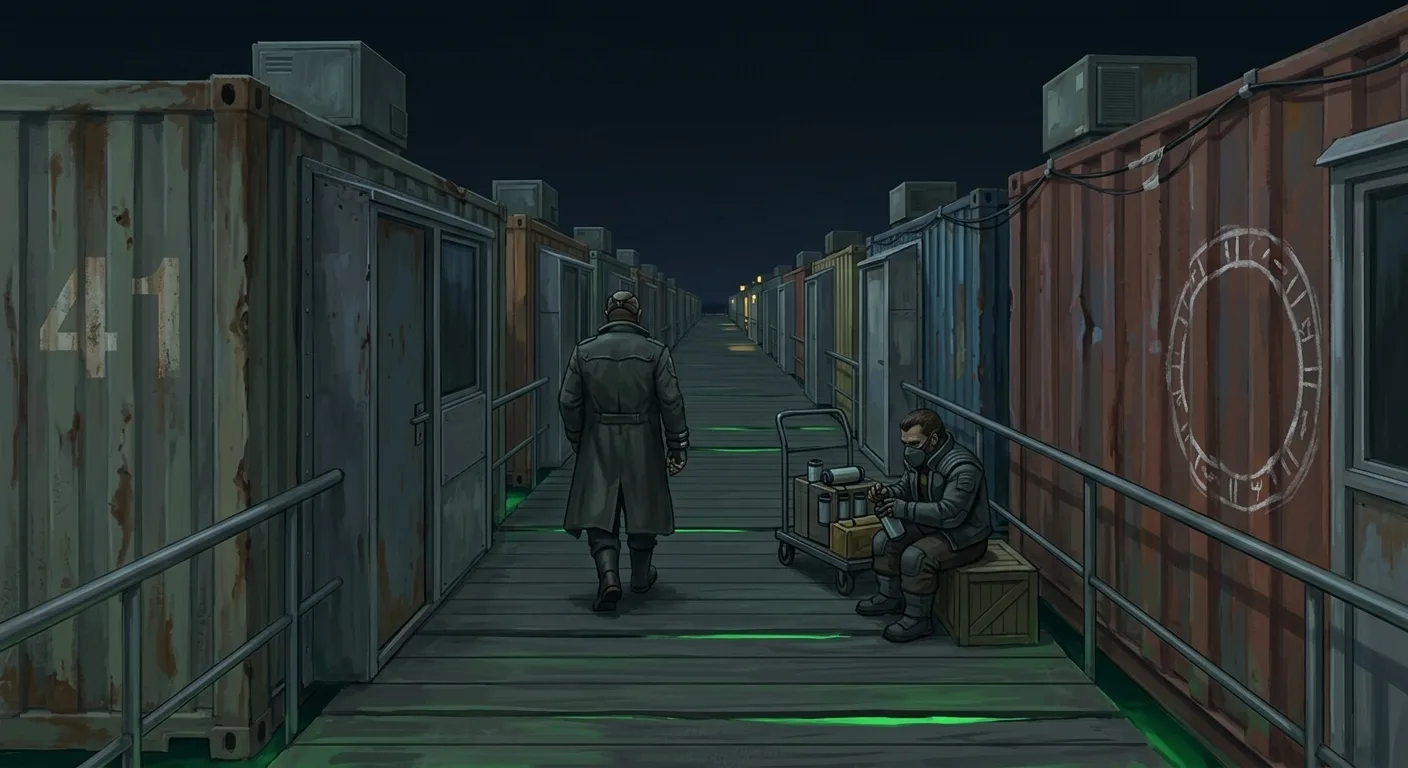
What the containers rent is a room with one door, at a third of the gallery's rent, and sixteen hundred feet of straight sightline down the walkway at anybody walking toward it.
- Fixers' offices, which is the reason the colony exists. Somebody who arranges rather than sells needs a place to be found by people who already have the number and by nobody else at all.
- Holding. A third party keeps the goods, or the money, or occasionally the person, until the other side performs. A plated container, no window, a padlock and somebody's word, and the word is the part you are paying for.
- Cold storage for things that spoil: paracritter material out of El Infierno, medical stock, anything that arrives in a jar.
- A room to be nobody in, sublet by the night with no name taken and none offered. Dearer than a room in a stack, because what you're renting out here is the filtration and not the floor.
- Row two, box 41 is a bar, with no sign and no name. It's the only room out here anybody walks into without business, because it's somewhere to get the mask off between the walkway and your own door.
One way in, no way off except the water, and every tenant out here knows exactly what is underneath them. People pay for the first two and live with the third.
Underneath#
The substructure is skirted and plated off, because what's down there is contaminated water and the piles standing in it. The one way to the sand is a gated stair about four hundred feet out, which is as far as the sand goes. Past that the deck stands in water.
A dozen people at a time work that sand, trading things that fit inside a coat. Salvage carried by hand out of the flats, jewelry and wine and medical stock and other people's documents. Paracritter parts and Tide-strange material out of El Infierno and the lower river, which is where the weird actually pays. Furniture goes out the long way, not through here.
What it is carrying#
It is holding about three times what it was built for, over water that eats steel. Piles get inspected by people the promoters and tenants pay privately, then patched, sleeved and re-sleeved. There are two closed sections on the old deck with fencing round them and a third that should have fencing round it. Only the inner half was ever properly rebuilt: the trade would carry four more levels and the piles will not, so the money stopped where the engineering did. What sits past that mark is occupied rather than built, containers and cabins that could in principle be craned off again, put there by people who did the arithmetic and took the rent anyway.
The rebuilt half pays to keep the whole structure open, so the trade upstairs and the trade on the sand both need the gallery to go on selling carousel rides to families from Pico. Every tenant out here can do that arithmetic too.
Nobody who works out there will discuss any of this with you, and everybody knows which bays to keep off.
What the crew knows#
- Up is private, down is watched. The upper decks are sealed rooms with gasketed doors and no authority entitled to open them. That is the actual value of the place, and it's why an unlicensed clinic is on the third level rather than on the sand.
- You need a number before you go. Nothing upstairs and nothing in the containers has a name on it, so an introduction here is a level and a room, or a row and a box.
- Filtration is the utility that matters, the way water is the utility in a stack. Every room has its own, they're maintained privately and badly, and a tenant whose plant fails is out of business the same afternoon. The man who sells the cartridges works a handcart on the second level, goes by Cartridge, and does better than most of his customers.
- Carry your own respirator and don't borrow one. You never need it on the inner half and you always need it past sixteen hundred feet, and everybody who works the containers can price a mask at ten feet. Arriving on that walkway in a cheap one says you don't come out here, which is the one thing nobody out there wants said about them.
- Holding a door open is a threat, and everybody understands it as one. Positive pressure only works while the room is shut. Nobody draws in a sealed room on a bad-wind day: they stand in the doorway, which is worse and takes longer. Out in the containers the same move gets made in somebody's porch, by a person wearing a mask, to a person who isn't.
- The wheel is private for talking and hopeless for hiding. A gondola holds nobody but the people you got in with, so nothing said in one is overheard, and the cycle hands the conversation a clock you didn't set. Everything else about it works against you: nine minutes in a lit glass case in clear view of the gallery floor, the mezzanine and every upper walkway, and you get off where you got on. Use it for a talk nobody knows is happening, and stay off it if somebody is already watching you, because there is no version of the ride you can leave early.
- The glass tints, and the tint is the record. Switchable glazing is older than the deck's own glass and every car has it, and the wheel runs clear, because the view is what the ticket buys and because an opaque gondola over the most-watched structure in the district is a conversation the operator would rather not have with the Rent Control Board. He'll darken a car for money. He also sees who got in together, remembers which car went dark, and draws a wage from a company with a phone. The privacy is for sale; the fact that you bought it isn't.
- The better use of the wheel is reconnaissance. It's the only thing on the pier that puts you above the upper decks, so one ride buys you the rooflines, who's standing on which walkway, and the whole container run out to the tip. It costs what a ride costs and nobody has ever found a bought ticket interesting.
- This is the most-watched structure in the district, because it's the way down to a cordoned beach. Patrol attention, resident cameras, and a district with a reason to keep an eye on it.
- Two bays on the old deck are fenced off and a third is worse than the fenced ones. Ask a vendor which and they'll tell you; ask a manager and they won't.
- No boats, however often people propose it. Bringing a hull in under this deck is the loudest thing you could do with a boat in Los Angeles. That trade happens twenty-eight miles south along empty cordoned coast, see the beach cities.
- No fights either: they need floor, seating and somewhere to hold money. The Coliseum does the cards, and it's a real business with books.
Getting in#
Almost nobody arrives on the deck any more, and on a bad-wind day nobody sane does. The way in is Santa Monica Place: the old mall at Broadway and Second, sealed and filtered in the 2040s the same way everything else here was, because a shopping center already had the plant for it. Park inside, and take the tube, a glazed and gasketed pedestrian passage that runs from the mall down Colorado, over the highway and out onto the pier's second level without ever putting you in the air.
It's four hundred yards of glass with the ocean on one side and the closed beach on the other, moving walkways that work about half the time, and vendors along it who pay rent to somebody. The tube is free; you pay to park. It is the pier's front door, its busiest retail, and its one genuine chokepoint: one way in, one way out, sealed at both ends, and both ends watched.
For everything else the pier is a vertical problem. The upper decks are reached by exterior stairs that tenants control, so each trip costs thirty seconds in the air. Nobody uses them casually and anybody who does is noticed, and the two useful ones appear on none of the pier's own maps, because they were added by whoever owned the room at the top. The gated stair down to the sand is the only way off the structure that isn't the tube or the bridge; used at night, it is the single most reliable way here to attract the patrol.
Walking on at the Colorado end is still possible and still public. It's also open-air the whole way, so on a good-wind day it's a pleasant approach and on a bad one it marks you as somebody who either doesn't know or can't afford the tube.